Lord Balarama
Strength, power, agriculture, patience, devotion, righteousness, protection
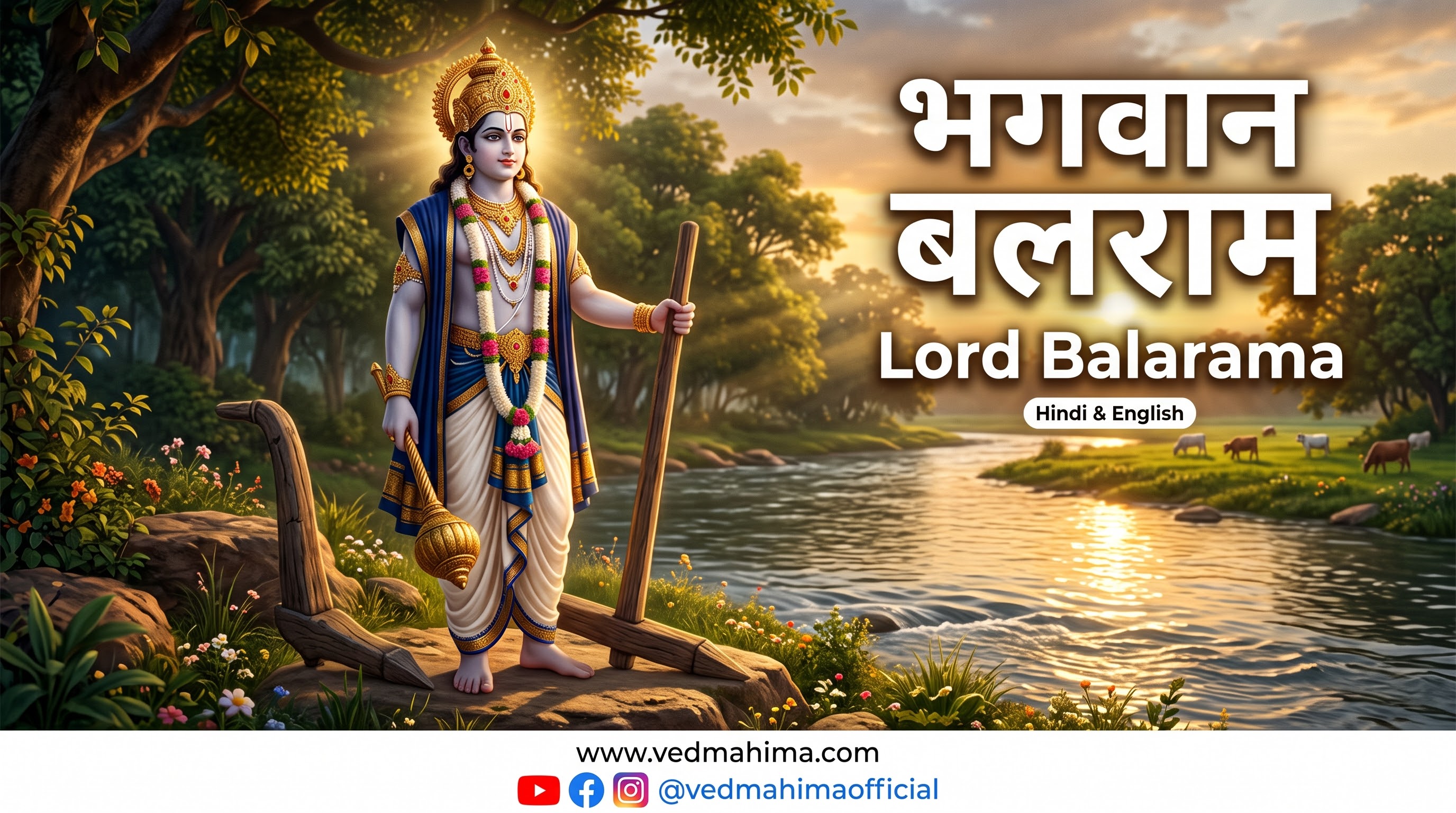
Lord Balarama is one of the most revered and worshipped deities in Sanatana Hindu tradition. He holds a special place as the deity of strength, power, agriculture, patience, and the protection of Dharma. He is the elder brother of Lord Shri Krishna. Among the 24 major incarnations of Lord Vishnu, he is considered the 19th incarnation as well as an inseparable form of the Lord Himself. He is recognized as the incarnation of the all-pervading Sheshanaga, who serves as the eternal bed and devotee of Lord Shri Hari Vishnu. While Shri Krishna symbolizes divine love and cosmic play (Lila), Balarama Ji embodies power, righteousness, and stability. In Sanatana tradition, he is devoutly addressed by several revered names such as "Baldau", "Balabhadra", "Halayudha", and "Sankarshana".
The form of Lord Balarama represents not only physical strength, but also righteousness, devotion, power, and the prosperity of agricultural culture. He is regarded as the guardian deity of agriculture and farming life, as his primary weapon is the "Hala" (plow). In Sanatana tradition, Lord Balarama is worshipped to attain strength, good health, protection of Dharma, and success in agriculture.
Prominent Names of Lord Balarama
- Haldhar / Halayudha: The one who wields a plow on his shoulder.
- Sankarshana: The one who was attracted (transferred) from Devaki's womb to Rohini's womb.
- Balabhadra: The extremely powerful and auspicious deity.
- Musali: The wielder of the Musala (a mace-like pestle weapon).
- Rohineya: The son of Mother Rohini.
- Ananta / Shesha: The incarnation of Sheshanaga, the serpent bed of Lord Vishnu.
- Revatiramana: The beloved husband of Goddess Revati.
Divine Story of Birth
A long time ago, a tyrannical king named Kamsa ruled the city of Mathura. The entire city lived in fear of his cruelty and arrogance. Kamsa had a sister named Devaki, who was married to the noble Yadava warrior Vasudeva Ji. After the wedding, as Kamsa was lovingly seeing off his sister, a divine voice echoed from the sky—“O Kamsa! The eighth child of the very sister you are sending off so lovingly will become the cause of your destruction.” Hearing this, Kansa's heart trembled with fear. His love instantly turned into cruelty, and he imprisoned both Devaki and Vasudeva.
Time passed. Whenever a child was born to Devaki, Kamsa mercilessly killed the newborn. The entire city of Mathura was in anguish witnessing this tyranny, but no one dared to oppose Kamsa. Hearing the prayers of the celestials, Lord Vishnu resolved to free the Earth from Kansa's atrocities. He orchestrated a divine play using His Yogamaya.
When the seventh child (an aspect of Sheshanaga Ji) arrived in Devaki's womb, Yogamaya transferred (attracted) the fetus from Devaki's womb to the womb of Mother Rohini, Vasudeva Ji's elder wife. At that time, Mother Rohini was living safely with Nanda Baba and Mother Yashoda in Gokul due to the fear of Kamsa.
As the time of birth approached, Mother Rohini was sent to a sacred forest named Vidruma Vana near Gokul. This was the place where Nand Baba's cows were sheltered, surrounded by greenery, peace, and divine purity. Near Vidruma Vana lay a village named Avairani, where enmity and malice did not exist. This location was considered the safest and most secluded from Kansa's tyranny.
As stated in sacred texts:
Shubhe Bhadrapade mase, hyagate punyayogatah.
Shashthyam tithau shuklapakshe madhyahne vrischika lagnake.
Rohinyam cha svayam jato adisheshah mahabalah.
According to the Garga Samhita and other holy scriptures, on this sacred land during the Bhadrapada month, on the sixth day (Shashthi Tithi) of the bright fortnight (Shukla Paksha) at noon under the Scorpio ascendant (Vrischika Lagna), Lord Balarama manifest Himself from Mother Rohini's womb. Upon His birth, joy spread throughout the forest, the celestials showered flowers, and sages offered their reverence. Because He was transferred (attracted) from Devaki's womb to Rohini's womb, He was named “Sankarshana”. As the son of Rohini, He was also called “Rohineya”.
Even today, on the Shashthi Tithi of Shukla Paksha in the month of Bhadrapada—known locally as Baladev Chhath—the birth festival of Lord Balarama is celebrated with immense devotion, faith, and grand festivities at the Shri Dauji Maharaj Temple in Baldeo town, where the ancient Vidruma Vana once stood. Devotees travel from far and wide to seek the blessings of Dauji Maharaj and bow to His holy birthplace.
Slaying of Dhenukasura (The Story of Talavana)
Near Vrindavan lay a vast palm forest called Talavana, where a fierce demon in the form of a donkey named Dhenukasura lived with his demon companions. He prevented everyone from eating the delicious palm fruits. One day, at the request of his cowherd friends and Shri Krishna, Lord Balarama entered Talavana and began shaking the trees to drop the ripe fruits. Enraged by this, Dhenukasura charged and kicked Lord Balarama in the chest with his hind legs. Smiling, Lord Balarama caught the demon by both hind legs, whirled him around in the air, and hurled him onto a massive palm tree, ending his life. Following this, He eliminated Dhenukasura's demon companions as well, making Talavana safe for all the cowherd boys.
Slaying of Pralambasura
Once in the Bhandiravana forest, Shri Krishna, Balarama, and the cowherd boys were playing a game called Harina Kreeda. The rule of the game was that the loser had to carry the winner on his back. A demon named Pralambasura joined the game disguised as a cowherd boy with the motive of kidnapping Lord Balarama. During the game, Pralambasura lost and had to carry Lord Balarama on his back. He rapidly ran away from Bhandiravana carrying Balarama Ji and revealed his huge demonic form. Realizing the situation, Lord Balarama struck Pralambasura's head with His thunderbolt-like fist so forcefully that the demon's skull cracked, and he collapsed to the ground, vomiting blood and dying instantly.
Diverting the Yamuna River (Yamuna Karshana)
Once, Lord Balarama was enjoying divine pastimes with the Gopis and cowherds in Brajmandal. In the joy of water sports and festivities, He requested the Yamuna River to flow closer to them for their enjoyment. However, Goddess Yamuna took His request lightly and ignored it. Enraged by this, Lord Balarama raised His plow, dug its tip into the riverbank, and declared, "If you do not come willingly, I will drag you with my plow and divide you into hundreds of streams across this region." Terrified, Goddess Yamuna trembled, appeared in her personified form, and begged for forgiveness. Lord Balarama forgave her, and from that day on, a branch of the Yamuna River began flowing towards that spot.
Slaying of the Demon Ape Dvivida
Dvivida was a powerful gorilla-like ape who was formerly a friend of Sugriva, but later fell into evil company with Bhaumasura (Narakasura) and became wicked. He destroyed the hermitages of sages, set cities on fire, and harassed people. One day, while Lord Balarama was enjoying the scenic surroundings on Mount Raivataka, Dvivida arrived and began creating chaos, throwing rocks and trees at Balarama Ji. Without using any weapons, Lord Balarama struck the fierce ape's chest with a single blow of His fist, breaking his ribs and ending his life.
Dragging Hastinapur with the Plow in the Kaurava Court
Samba, the son of Shri Krishna, married Lakshmanaa, the daughter of Duryodhana, in a Swayamvara, which angered the Kauravas into taking Samba captive. When this news reached Dwaraka, Lord Balarama went to Hastinapur as a peace envoy. He requested the Kauravas to release Samba respectfully. However, Duryodhana, Karna, and other Kauravas mocked Lord Balarama, stating that the Yadavas survived on the mercy of the Kauravas. Deeply angered by this insult, Lord Balarama raised His plow, drove it into the foundation of Hastinapur's fort, and began dragging the entire city into the Ganges River. Hastinapur began to shake violently. Terrified, Dronacharya, Bhishma, and Duryodhana begged Lord Balarama for forgiveness and respectfully bade farewell to Samba and Lakshmanaa.
Weapons and Their Names
Lord Balarama primarily wields two main divine weapons:
- Hala (Plow): Lord Balarama's primary weapon is named Saunanda. The plow symbolizes agriculture and productivity, demonstrating that power should be used for sustenance and creation rather than destruction.
- Musala (Mace/Pestle): His mace-like weapon is named Samvartaka. It symbolizes the complete destruction of evil and strict justice.
Family Background
- Parents: Vasudeva Ji (Father) and Mother Rohini (Mother). (The fetus was transferred from Devaki Ji).
- Wife: Goddess Revati (Daughter of King Kakudmi).
- Children: Lord Balarama and Goddess Revati had two sons—Ulmuka and Nishatha—and a daughter named Sulekha.
Famous Legend of Their Marriage:
Goddess Revati was the virtuous and beautiful daughter of King Kakudmi in Satya Yuga. Seeking a suitable groom for his daughter, King Kakudmi traveled to Brahmaloka to consult Lord Brahma. When they arrived, heavenly singers (Gandharvas) were performing. The king waited and listened to the music before asking Lord Brahma for suitable royal suitors on Earth. Lord Brahma smiled and said, "O King! During the brief time you listened to the music here, millions of years (four Yugas) have passed on Earth. Your kingdom, dynasty, and all those kings have vanished into time. Currently, Treta Yuga has ended, Dvapara Yuga is underway, and Lord Balarama, an aspect of Lord Vishnu, has incarnated. You should marry your daughter to Him." When the king returned to Earth, he noticed that human stature had shrunk significantly, whereas Revati possessed the tall stature of Satya Yuga. Lord Balarama gently pressed Goddess Revati's shoulders with the tip of His plow, adjusting her height to match the standards of Dvapara Yuga. Following this, the marriage of Lord Balarama and Goddess Revati was celebrated with great joy.
Auspicious Time for Worship
Early morning (at sunrise) or midday. Special worship is offered on the Shashthi Tithi of Shukla Paksha in the Bhadrapada month (Balarama Jayanti/Baladev Chhath).
Holy Ganges water, incense, lamp, fragrance, sacred rice (Akshata), white cloth, white flowers (lotus, water lily), Tulsi leaves, and symbols or images of the plow and mace.
Favorite Flowers and Offerings (Bhog)
- Favorite Flowers: White Lotus, Jasmine (Malati/Chameli), and White Oleander.
- Favorite Offerings: Butter with rock sugar (Makhan-Mishri), Kheer, milk-based sweets, Mahua offerings, and Panchamrita.
Worship Procedure:
- Take a bath in the morning and wear clean white clothes.
- Clean the altar and install the idol or picture of Lord Balarama along with Shri Krishna.
- Offer holy water from a copper vessel and bathe the deity with Panchamrita.
- Apply white sandalwood paste, sacred rice, and offer white flowers.
- Worship the symbols or images of the plow (Hala) and mace (Musala), as Lord Balarama is the deity of agriculture.
- Chant the mantra
Om Balabhadraya Namahwhile offering butter, Kheer, and fruits. - Perform the Aarti and seek forgiveness for any unintentional shortcomings.
Prominent Mantras
- Moola Mantra:
Om Balabhadraya Namah - Sankarshana Mantra:
Om Namah Bhagavate Vasudevaya Sankarshanaya Namah॥
Related Fasts, Festivals, and Tithis
- Balarama Janmotsav (Baladev Chhath): Celebrated on the Shashthi Tithi of Shukla Paksha in the month of Bhadrapada, locally known as Baladev Chhath or Devchhath. The birth anniversary of Lord Balarama is celebrated with great devotion on this day.
- Akshaya Tritiya: On Vaishakha Shukla Tritiya, farmers worship Lord Balarama and His plow before commencing the sowing season in the fields.
- Jagannath Rath Yatra: During the world-famous Jagannath Rath Yatra in Puri, Odisha, Lord Balarama's (Balabhadra's) chariot leads the procession, known as Taladhwaja.
Prominent Temples
Shri Dauji Maharaj Temple, Baldeo (Mathura, Uttar Pradesh): This is the most famous and ancient temple dedicated to Lord Balarama, located about 21 km from Mathura in a place called Baldeo. A majestic black stone deity of Lord Balarama with a seven-hooded Sheshanaga behind Him is enshrined here, alongside Goddess Revati. The Samkarshana Kunda (Kshirasagar) lies adjacent to the temple. The Baladev Chhath festival and the famous Huranga of Dauji are world-renowned, reflecting the cultural heritage of Braj.
Shri Jagannath Temple, Puri (Odisha): In the famous Jagannath Temple of Puri, Lord Balarama is enshrined on the Ratnavedi alongside His brother Shri Jagannath (Krishna) and sister Subhadra. The wooden deity of Lord Balarama here is white in color. During the annual Rath Yatra, His chariot Taladhwaja leads the grand procession.
Ananta Vasudeva Temple, Bhubaneswar (Odisha): This historical 13th-century temple in Bhubaneswar is unique as it houses complete carved stone deities of Balarama, Krishna, and Subhadra. Lord Balarama is depicted standing under the protective canopy of Sheshanaga.
Religious Materials Related to Lord Balarama
To seek the divine blessings of Lord Balarama, reciting the following prominent Stotras, Chalisa, and Mantras is considered immensely beneficial:
About Lord Balarama
❓ Frequently Asked Questions
Question: What does the name Sankarshana mean?
Answer: It refers to the miraculous transfer of Balarama's embryo from Devaki's womb to Mata Rohini's womb by Yogamaya, saving him from Kamsa.
Question: What weapons does Lord Balarama carry and what are their names?
Answer: His plow is named Saunanda, symbolizing agriculture and nourishment, and his mace is named Samvartaka, symbolizing the destruction of evil.
Question: Why did Balarama threaten to drag Hastinapur into the Ganges?
Answer: When the Kauravas imprisoned Samba for marrying Lakshmana, Duryodhana's daughter, an angered Balarama used his plow to pull the city toward the river until they apologized and released him.
Question: How did Lord Balarama marry Goddess Revati?
Answer: Since ages had passed on Earth during King Kakudmi's visit to Brahmaloka, Revati had grown too tall for humans of that era; Balarama adjusted her height with the tip of his plow before marrying her.
Question: What is Baladev Chhath?
Answer: According to the Garga Sanhita and other sacred texts, on the sixth day (Shashthi Tithi) of the bright fortnight (Shukla Paksha) in the month of Bhadrapada, at noon under the Scorpio ascendant (Vrischika Lagna), Lord Balarama manifested from the womb of Mother Rohini.
Question: What role did Balarama play in the Mahabharata war?
Answer: He remained neutral since both Bhima and Duryodhana were his disciples in mace warfare, choosing to go on pilgrimage rather than take sides.