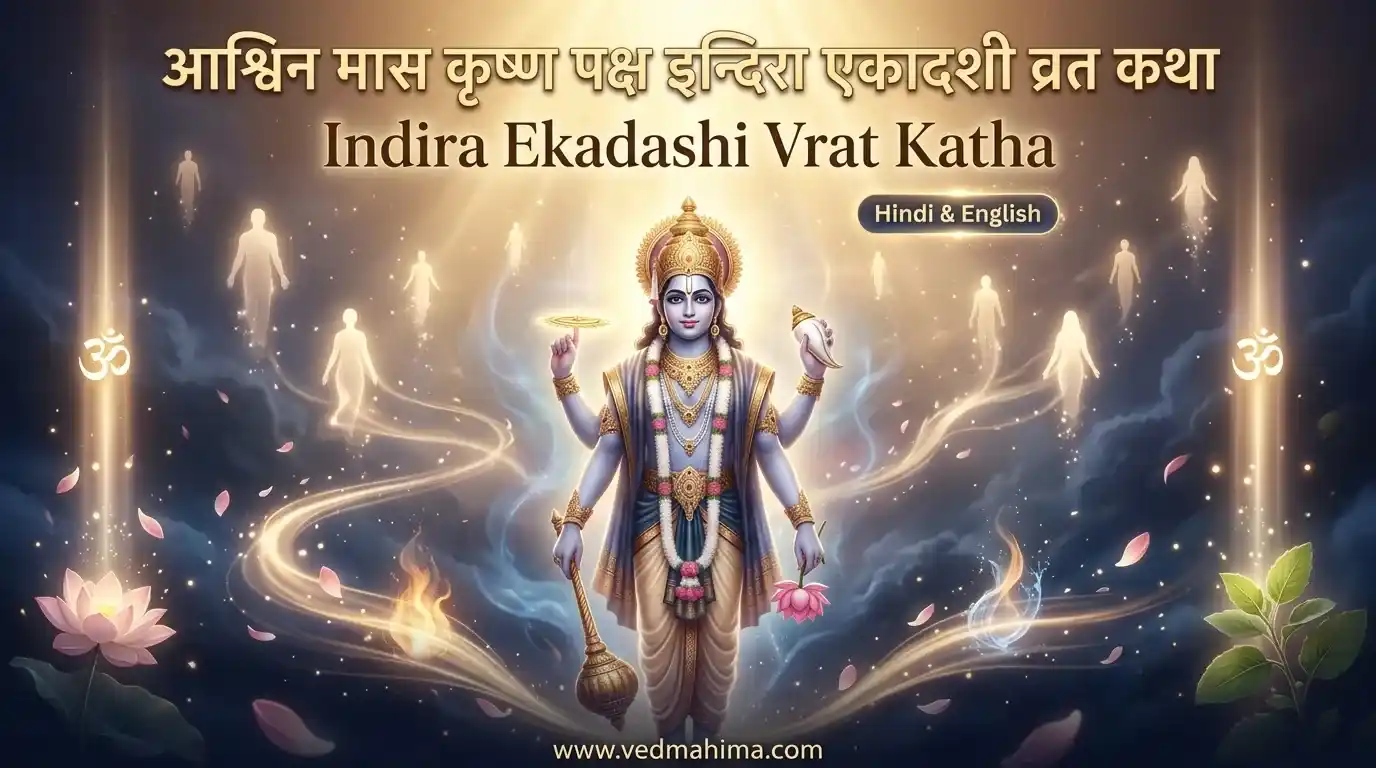
Ashvin Maas Krishna Paksha Indira Ekadashi Vrat Katha
Ancestor Satisfaction, Liberation, Sin Destruction, Devotion, Merit, Peace, Welfare
॥ Introduction ॥
Ashvin Krishna Ekadashi, profoundly celebrated across divine scriptures as Indira Ekadashi, holds an exceptionally unique and highly revered status in Sanatan Dharma. Falling during the holy dark fortnight of Ashvin month, this auspicious day is directly intertwined with the sacred period of Pitru Paksha. Observing this fast possesses the supreme cosmic power to destroy severe accumulated sins and grant immediate liberation or structural salvation (Sadgati) even to those ancestors or departed forefathers (Pitrus) who have fallen into lower, painful existences due to any structural flaws or broken vows during their earthly lifetime.
॥ Importance ॥
The spiritual excellence of Indira Ekadashi is incomparable. Lord Shri Krishna states that reading, hearing, or meditating upon the holy glory of this fast completely absolves a human being of all heavy karmic impurities. Unlike other fasts that primarily elevate the individual performer, the collective merit of Indira Ekadashi can be selflessly transferred to one's deceased father or ancestors. By dedicating the fruits of this fast to the ancestors, they are instantly released from the realms of Yamaraj and carried directly to Lord Vishnu's supreme abode, Vaikuntha Dham, on the celestial bird Garuda.
॥ Puranic Reference ॥
The holy narrative of this fast is rooted in an ancient celestial dialogue where Devarsi Narada, returning from the court of Yamaraj, visits the grand assembly of King Indrasena in Mahendrapuri or Mahishmatipuri. Later, during the Dwapar Yuga, Lord Shri Krishna dynamically narrated this profound historical event to King Yudhishthira to highlight how the meticulous performance of Ekadashi combined with Shaligram Shradh acts as an ultimate spiritual rescue for departed souls.
॥ Story ॥
King Yudhishthira asked—O Madhusudana! Please be merciful and tell me which Ekadashi occurs during the dark fortnight (Krishna Paksha) of the month of Ashvin?
Lord Shri Krishna replied—O King! In the dark fortnight of Ashvin, the Ekadashi named 'Indira' takes place. By the supreme influence of its fast, even the greatest of accumulated sins are completely destroyed. This Ekadashi bestows ultimate structural elevation (Sadgati) even to those ancestors who are trapped in lower, painful species or hellish dimensions.
O King! This is a history from ancient times. In the golden age of Satyayuga, there was a highly famous prince named Indrasena, who later became the King of the glorious city of Mahishmatipuri and ruled over his subjects with absolute righteousness. His spotless glory had spread in all directions. King Indrasena was deeply fixed in unalloyed devotion to Lord Vishnu and spent his precious time chanting the liberation-granting holy names of Govinda. He remained continuously absorbed in contemplating the ultimate spiritual truth through the method of self-realization.
One day, while the King was sitting comfortably in his royal assembly court, Devarsi Narada suddenly descended from the celestial sky and arrived there. Seeing him arrive, the King immediately stood up with folded hands, performed ritualistic worship with pure devotion, and offered him a highly respected seat. After this, the King spoke thus—'O best among sages! By your divine grace, everything is completely auspicious in my realm. Today, by your holy sight, all my sacrificial actions and internal rituals have become perfectly successful. O Devarsi! Please shower your mercy upon me by stating the specific cause of your arrival.'
Narada Muni spoke—O best among kings! Listen, my words will fill you with immense astonishment. Recently, I traveled from Brahmaloka to the realm of death (Yamaloka). There, I sat upon an excellent, highly respected seat, and Yamaraj worshipped me with deep devotion. At that time, in the grand assembly of Yamaraj, I caught sight of your deceased father. Due to the structural defect of a broken fast (Vrat-bhang) during his earthly lifetime, he had been brought there. O King! He has given a critical message for you, listen to it carefully. He said, 'O son! Please transfer the accumulated spiritual piety of the sacred 'Indira' Ekadashi fast to me, so that I may be delivered and sent directly to heaven.' I have come to you solely to deliver this message of his. O King! To grant the dynamic attainment of heaven to your father, you must execute the holy fast of Indira Ekadashi.
The King asked—O Bhagavan! Please instruct me on the exact method of the 'Indira' fast. In which fortnight, on which specific lunar day (Tithi), and through what systematic rules should it be executed?
Narada Muni replied—O Emperor! Listen, I shall detail to you the highly auspicious and systematic method of this fast. On the excellent tenth day (Dashami Tithi) of the dark fortnight of Ashvin month, one must wake up early and take a bath with a highly faithful and clean mind. Then, during the midday period (Madhyahnakala), take a second holy bath, and with a completely focused mind, eat food only once, and sleep on the bare earth during the night. When the night ends and a spotless dawn manifests on the holy day of Ekadashi, one must cleanse their mouth and brush their teeth; after this, with deep devotion, one must accept the strict vow of fasting while chanting the following sacred mantra:
Adya sthitva niraharah sarvabhog vivarjitah,
Shvo bhokshye Pundarikaksha sharanam me bhavachyut.
'O lotus-eyed Lord Narayana! Today, remaining completely detached from all material enjoyments, I shall stay entirely without food (fasting), and I shall break my fast only tomorrow on Dwadashi. O Achyuta (Infallible Lord)! Please grant me Your ultimate spiritual shelter.'
Having made this firm vow, during the midday period, for the ultimate satisfaction of one's ancestors, one must systematically perform a sacred Shradh ritual right in front of the sacred Shaligram Shila. One must satisfy the worthy Brahmins by giving standard charities (Dakshina) and feed them with pure Satvik food. The learned man must then take the food-offering or sacred Pinda meant for the ancestors, smell it with reverence, and feed it to a sacred cow. After this, perform the grand worship of Lord Hrishikesh using aromatic incense, sandalwood paste, and lamps, and spend the entire night performing vigilant spiritual awakening (Jagaran) near Him. Then, as the morning manifests on the next day of Dwadashi, perform the worship of Shri Hari once again with intense devotion. After that, feed the learned Brahmins, and finally, along with brothers, relatives, grandchildren, and sons, consume the food in absolute silence (Maun).
O King! If you execute the fast of 'Indira' without any laziness according to this precise method, your ancestors will instantly ascend to the eternal spiritual realm of Lord Vishnu, Vaikuntha Dham.
Lord Shri Krishna said—O King! Having spoken thus to King Indrasena, Devarsi Narada instantly vanished from sight. The King strictly implemented the supreme fast according to the exact method detailed by the sage, along with the queens of his inner palace, his sons, and all royal servants. O son of Kunti! The moment the fast was fully accomplished, a magnificent rain of celestial flowers poured down from the sky. Indrasena's father, being instantly liberated, mounted upon the divine bird Garuda and departed for the spiritual abode of Shri Vishnu. The royal seer Indrasena also enjoyed an absolute, thornless kingdom, and later, installing his worthy son upon the throne, ascended to the heavenly world. O King! In this manner, I have beautifully described the supreme glory of the 'Indira' fast before you. By reading and hearing this, a human being becomes entirely liberated from all sins.
॥ Moral of the Story ॥
- Spiritual merit is transferable through selfless intention; a son can systematically rescue his suffering ancestors from lower realms by dedicating his Ekadashi virtues.
- Strict adherence to spiritual vows is critical; the story warns that even a virtuous person can fall into Yamaloka due to the karmic defect of a broken fast (Vrat-bhang).
- True righteousness includes historical duty toward forefathers; King Indrasena immediately accepted a difficult fast to honor his father's celestial request.
- Worship performed before the Shaligram Shila combined with scriptural charity possesses the cosmic power to alter the post-death destiny of a soul.
॥ Vrat & Worship Method ॥
- On Ashvin Krishna Dashami, take a holy bath during midday, consume only a single Satvik meal, and maintain absolute celibacy by sleeping on the floor.
- On Ekadashi morning, wake up in Brahma Muhurta, cleanse yourself, and stand before the altar to take the strict fasting resolve using the Pundarikaksha mantra.
- During the midday period of Ekadashi, place a sacred Shaligram Shila on the altar and perform a meticulous Shradh ritual dedicated to the liberation of ancestors.
- Offer standard food grains, water, and Pinda to the forefathers, smell the remaining Pinda with deep reverence, and feed it directly to a sacred cow.
- Worship Lord Hrishikesh with deep love by offering Tulsi leaves, yellow flowers, seasonal fruits, incense, and ghee lamps.
- Spend the entire night of Ekadashi in complete spiritual vigil (Jagaran), singing Vishnu bhajans, reciting texts, and avoiding sleep.
- On Dwadashi morning, execute the morning rituals, perform a final worship of Lord Shri Hari, and feed learned Brahmins with absolute respect.
- Conclude the fast within the designated auspicious Parana time by consuming Satvik food in absolute silence along with family members.
॥ Rules for Ancestral Shradh & Cow Service ॥
- Shaligram Connection: The ancestral rituals on this specific day must strictly happen in front of the Shaligram Shila to multiply the liberation-granting energy.
- The Sacred Cow Ritual: Feeding the ancestral food-pinda to a cow after smelling it is a mandatory scriptural injunction that ensures the offering reaches the pitrus safely.
- The Vow of Silence (Maun Dan): Breaking the fast on Dwadashi day must be done in complete silence along with family members to lock the accumulated spiritual vibration.
॥ Parana (Breaking the Fast) Method ॥
- The fast of Indira Ekadashi must be systematically broken on Dwadashi Tithi, strictly after sunrise and after feeding the Brahmins.
- Ensure that the time of Hari Vasara has completely passed before initiating the fast-breaking ritual.
- The fast must be broken by taking holy water or a simple Satvik meal while maintaining deep internal silence.
॥ Benefits ॥
- Instantly delivers deceased parents or ancestors from the agonies of Yamaloka or hellish species, transferring them to Vaikuntha Dham.
- Completely dissolves the negative effects of Pitru Dosha from the devotee's horoscope and household, bringing structural peace.
- Eradicates the heaviest burdens of personal sins, bringing immense mental clarity, focus, and unwavering devotion to Lord Vishnu.
- Blesses the family lineage with continuous prosperity, unobstructed growth, and guarantees final salvation for the performer.
॥ Frequently Asked Questions (FAQ) ॥
What is the name of the Ekadashi that falls during Ashvin Krishna Paksha?
The Ekadashi that falls during the dark fortnight of the month of Ashvin is famously known as Indira Ekadashi.
How does Indira Ekadashi help our departed ancestors or Pitrus?
By keeping this fast and dedicating its spiritual merit, ancestors who are trapped in lower realms or suffering due to broken vows are instantly liberated and sent to Vaikuntha Dham.
Which king performed the Indira Ekadashi fast to save his father from Yamaloka?
King Indrasena of Mahishmatipuri performed this fast after receiving a celestial message from his father through Devarsi Narada.
What special ritual is performed on Indira Ekadashi before the Shaligram Shila?
During the midday period of Ekadashi, a dedicated Shradh ritual for the satisfaction of ancestors is performed directly in front of the Shaligram Shila.
⏰ Best Time
The absolute best and highly recommended time to read or listen to the Ashvin Indira Ekadashi Vrat Katha is during the midday Shradh rituals before the Shaligram Shila, or during the early morning hours of Ekadashi to structurally align the mind with the fasting rules.
🏷️ Tags
🔗 Related Pages
🔗 Related Trending Vrat-Utsav
About Ashvin Maas Krishna Paksha Indira Ekadashi Vrat Katha
Ashvin Indira Ekadashi Katha beautifully establishes the spiritual science of lineage redemption and the profound power of a son's devotion. Through the cosmic travel of Devarsi Narada and the flawless execution of King Indrasena, the scripture demonstrates that no soul is permanently trapped in lower realms if a living descendant executes the Shaligram Shila Shradh and selflessly surrenders their Ekadashi merits.