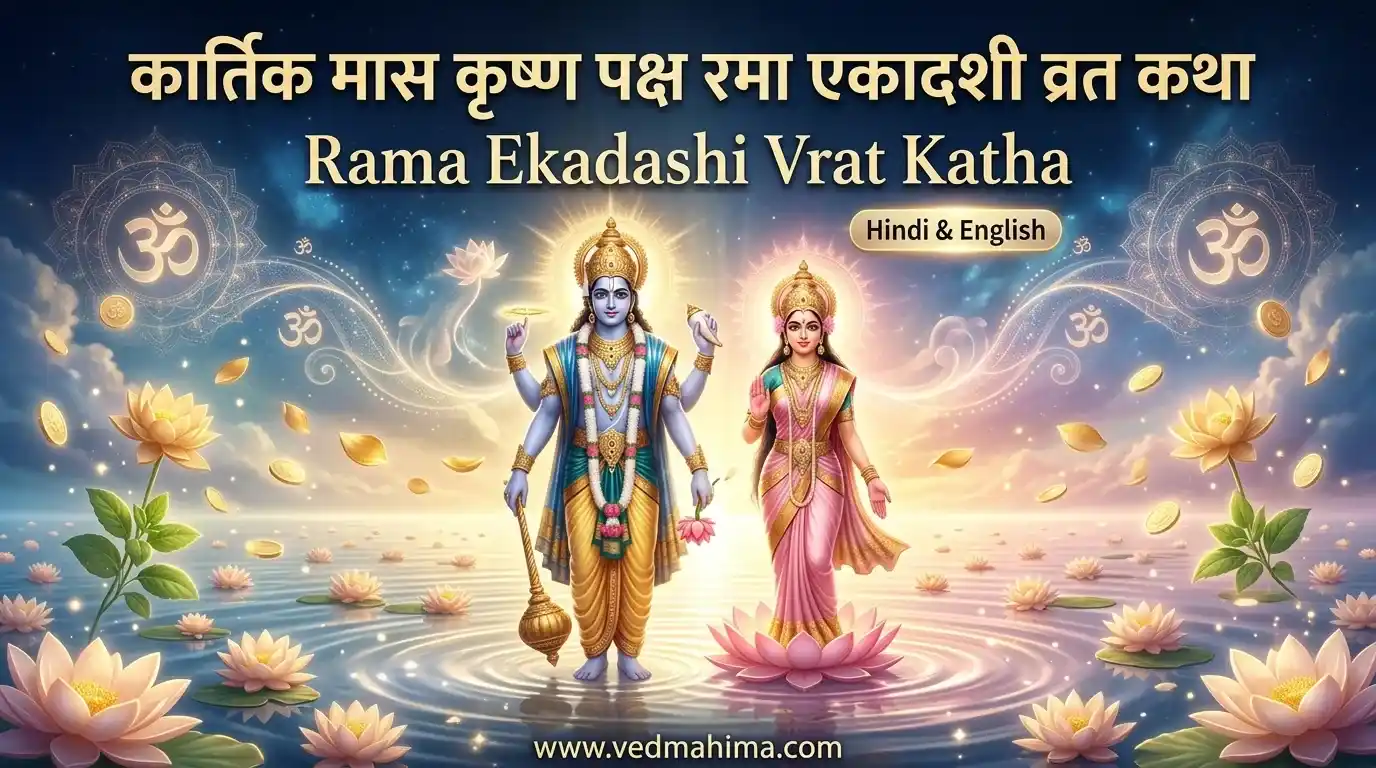
Kartik Maas Krishna Paksha Rama Ekadashi Vrat Katha
Lakshmi Grace, Prosperity, Vishnu Devotion, Liberation, Good Fortune, Wealth, Peace
॥ Introduction ॥
Kartik Krishna Ekadashi, celebrated across sacred texts as Rama Ekadashi, holds an exceptionally unique and highly powerful status in Sanatan Dharma. Falling during the highly auspicious month of Kartik, which is dearest to Lord Shri Hari Vishnu, this Ekadashi is named after 'Rama' (another name for Goddess Lakshmi). Observing this supreme fast acts as a profound spiritual cleanser, burning away heavy accumulated sins and granting absolute stability of wealth, heavenly comforts, and direct entrance into Vishnu Lok.
॥ Importance ॥
The spiritual excellence of Rama Ekadashi is incomparable. Lord Shri Krishna states that this fast is like a spiritual wish-fulfilling jewel (Chintamani) or the celestial cow (Kamadhenu) that fulfills every deep material and spiritual desire of a human being. The merit of this fast can completely transform an unstable, temporary heavenly reward into a permanent, eternal structural asset. Furthermore, Lord Krishna uses this specific text to destroy the illusion of discrimination between the Krishna Paksha (dark fortnight) and Shukla Paksha (bright fortnight) phases of Ekadashi.
॥ Puranic Reference ॥
The holy chronicle of this fast details an astonishing history from ancient times involving the righteous King Muchukunda, his exceptionally dedicated daughter Chandrabhaga, and her husband Shobhan (the son of King Chandrasena). Later, during the Dwapar Yuga, Lord Shri Krishna dynamically narrated this historical event to King Yudhishthira to reveal how a regular practice of Ekadashi from early childhood (eight years of age) accumulates an unshakeable storehouse of cosmic piety capable of stabilizing divine realms.
॥ Story ॥
King Yudhishthira asked—O Janardana! You hold absolute affection for me; therefore, please be merciful and tell me which name of Ekadashi occurs during the dark fortnight (Krishna Paksha) of the month of Kartik?
Lord Shri Krishna replied—O King! The highly auspicious and supreme savior Ekadashi that takes place in the dark fortnight of Kartik is famous across the worlds by the name of 'Rama'. Rama Ekadashi is exceptionally excellent and is the ultimate destroyer of massive accumulated sins.
In ancient times, there lived a highly famous king named Muchukunda, who was an unalloyed devotee of Lord Shri Vishnu and a royal seer of absolute truth. While ruling over a completely thornless and peaceful kingdom, a highly virtuous daughter was born to him, who became famous across the lands by the name of Chandrabhaga (being like the best among rivers). The King mathematically arranged her marriage with Shobhan, the prince and son of King Chandrasena.
Once upon a time, Shobhan arrived at the palace of his father-in-law (King Muchukunda). In that kingdom, the moment the tenth day (Dashami Tithi) arrived, a royal decree was loudly announced by beating drums throughout the entire city that no living being should consume food on the day of Ekadashi. Hearing this grand public announcement, Shobhan became deeply anxious and spoke to his beloved wife Chandrabhaga—'O beloved! Please instruct me on what I should execute at this critical moment.'
Chandrabhaga replied—O Lord! In my father's palace, no one is permitted to consume food on the holy day of Ekadashi. Not only humans, but even majestic elephants, horses, young calves, and all other domestic animals are completely barred from consuming grains, grass, or even a single drop of water. Therefore, O life-partner! If you consume food here today, it will lead to severe social criticism and structural dishonor. Please contemplate this in your mind and make your intellect completely firm.
Shobhan said—O beloved! What you say is absolutely true. I too shall observe the complete fast today. Whatever is the ultimate design of destiny (Daiva) will surely manifest.
Lord Shri Krishna continued—Having made this firm resolve, Shobhan accepted the strict discipline of the fast. However, due to intense physical hunger, severe pain began to manifest throughout his body, and he became deeply distressed. While he was trapped in the intense worry of hunger, the sun set and the night arrived. This holy night brought immense joy to the heart of the unalloyed Vaishnavas who were deeply dedicated to the worship and night vigil (Jagaran) of Lord Hari; however, the very same night proved to be exceptionally painful and fatal for Shobhan. Before the sun could rise the next morning, Shobhan perished due to extreme physical exhaustion.
King Muchukunda performed the grand cremation rituals for Shobhan using royal sacrificial woods. Chandrabhaga, executing all the post-death scriptural rituals for her deceased husband, continued to live in her father's house with a steady mind. O best among kings! Due to the ultimate hidden influence of observing that Rama Ekadashi fast, Shobhan instantly attained a highly magnificent, beautifully structured celestial city called Devapura, located on the highest peak of the sacred Mandarachala Mountain. There, Shobhan began to shine with immense glory, looking exactly like a second Kubera (the lord of wealth).
In the kingdom of King Muchukunda, there lived a highly learned Brahmin named Soma Sharma. Once, while traveling across various holy pilgrimage sites, he happened to ascend the sacred Mandarachala Mountain. There, he suddenly caught direct sight of Shobhan. Instantly recognizing the son-in-law of his king, the Brahmin approached him. Seeing the best among twice-borns (Soma Sharma) arrive, Shobhan immediately stood up from his golden throne and offered profound respects. He then step-by-step inquired about the well-being of his father-in-law King Muchukunda, his beloved wife Chandrabhaga, and the overall prosperity of the entire city.
Soma Sharma replied—O King! Everything is perfectly auspicious there. But what I am seeing here is an absolute, jaw-dropping wonder! No human being has ever seen or heard of such a highly beautiful and mystical celestial city anywhere. Please tell me the truth, how did you acquire this magnificent kingdom?
Shobhan spoke—O best among Brahmins! It is solely due to the performance of the Rama Ekadashi fast that falls in the dark fortnight of Kartik month that I acquired this grand city. But, O holy Brahmin! Because I executed this supreme fast without deep internal faith (Shraddhaveen), I firmly believe that this beautiful city is structurally unstable and will not last forever. Therefore, please return and narrate this entire historical sequence to Chandrabhaga, the beautiful daughter of Muchukunda.
Hearing these words of Shobhan, the Brahmin Soma Sharma immediately returned to Muchukundapura and detailed the entire incident directly before Chandrabhaga.
Soma Sharma said—O auspicious lady! I have directly seen your husband with my own eyes and have closely observed his unconquerable city, which is equal to the city of Indra. However, he defines it as unstable. Now, you must utilize your power to make it permanently stable.
Chandrabhaga spoke—O Sage among gods! A deep spiritual intense desire to see my husband has awakened within my heart. Please carry me to that place instantly. By dedicating the entire accumulated piety of my lifelong fasting rituals, I shall make that city structurally stable forever.
Lord Shri Krishna said—O King! Hearing these words of Chandrabhaga, Soma Sharma took her along and arrived at the sacred hermitage of Sage Vamadeva near the Mandarachala Mountain. There, by the cosmic power of the Rishi's mantras combined with the absolute residual influence of her lifelong Ekadashi service, Chandrabhaga's physical body instantly transformed into a divine, radiant form, and she attained an extraordinary spiritual speed. After this, she approached her husband.
At that moment, her eyes were blooming with immense joy. Seeing his beloved wife arrive, Shobhan was filled with ultimate ecstasy. He called her near and seated her on his left side upon the royal throne. Then, filled with intense happiness, Chandrabhaga spoke these highly pleasing words to her beloved husband—'O Lord! Listen to a highly beneficial fact. Ever since I was living in my father's palace and crossed the age of eight years, from that very day up until today, I have strictly and flawlessly observed every single Ekadashi fast. By the absolute influence of that accumulated spiritual piety (Punya), this celestial city will remain completely stable until the very end of the cosmic cycle (Kalpa), and it will remain filled with every imaginable form of material and spiritual wealth!'
O best among kings! In this manner, due to the ultimate power of the 'Rama' fast, Chandrabhaga, beautifully adorned with divine enjoyments, a celestial body, and magnificent ornaments, continues to enjoy blissful pastimes with her husband on the peaks of Mandarachala. O King! I have detailed before you the complete glory of Rama Ekadashi. It is like Chintamani and Kamadhenu. I have explained the sin-destroying glory of both fortnights of Ekadashi. Exactly like the bright fortnight Ekadashi, the dark fortnight Ekadashi is identical; there must be absolute zero discrimination made between them. Just as a cow may be white in color or black in color, both of them yield identical white, nourishing milk; similarly, the Ekadashis of both fortnights yield the exact same spiritual fruits. Any human being who reads or hears this holy glory becomes entirely liberated from all sins and establishes himself eternally in the supreme realm of Shri Vishnu.
॥ Moral of the Story ॥
- Early childhood alignment with righteousness creates an unshakeable foundation; Chandrabhaga's regular fasting since the age of eight created enough spiritual energy to stabilize an entire celestial kingdom.
- Faith (Shraddha) determines the durability of spiritual fruits; fasting under social pressure or without internal faith yields temporary rewards, whereas fasting with pure devotion makes the rewards eternal.
- A husband and wife are spiritual partners; the accumulated piety of a virtuous wife can rescue, elevate, and permanently stabilize the destiny of her husband.
- Absolute non-duality of the lunar phases; discriminating between Krishna and Shukla Paksha Ekadashis is an error, as proved by the classic cow milk analogy.
॥ Vrat & Worship Method ॥
- On Kartik Krishna Dashami, maintain clean conduct, consume only a single Satvik meal, and prepare the mind for complete fasting.
- On Ekadashi morning, wake up in Brahma Muhurta, perform complete bathing, and take a firm fasting resolve to please Goddess Rama and Lord Hari.
- Set up an altar, place an image of Lord Vishnu along with Goddess Lakshmi, and perform an elaborate worship using yellow flowers, incense, lamps, and fresh Tulsi leaves.
- Spend the day chanting the holy names of Vishnu and reading the sacred text of Rama Ekadashi with deep focus.
- Maintain a complete waterless fast or a simple fruit-based consumption (Phalahar), strictly avoiding all forms of grains, rice, and sea salt.
- Perform a dedicated night vigil (Jagaran) filled with devotional singing, avoiding sleep to maximize the absorption of Kartik month energies.
- On Dwadashi morning, perform a final prayer, offer standard charities to worthy Brahmins, and break the fast within the designated auspicious timing.
॥ The Analogy of the Black and White Cow ॥
- The Illusion: Many human beings fall into the sectarian or intellectual mistake of considering Shukla Paksha Ekadashi superior to Krishna Paksha Ekadashi.
- The Analogy: Lord Krishna completely shatters this bias by giving the beautiful example of cows. A cow may be completely white or completely black, but when milked, the milk of both cows is identically white, pure, and nutritious.
- The Verdict: Both the dark and bright fortnight Ekadashis yield the exact same ultimate liberation and must be kept with equal faith.
॥ Parana (Breaking the Fast) Method ॥
- The fast of Rama Ekadashi must be systematically broken on Dwadashi Tithi, strictly after sunrise and after respecting the local Brahmins with food or charity.
- Ensure the period of Hari Vasara has fully ended before initiating the fast-breaking meal.
- Break the fast by taking holy Tulsi water or a light Satvik preparation, keeping the mind anchored in Lord Vishnu.
॥ Benefits ॥
- Dissolves the heaviest accumulations of personal sins and financial obstacles from the devotee's life due to Kartik month blessings.
- Grants unshakeable stability of wealth, material resources, and domestic peace, mirroring the traits of Goddess Rama (Lakshmi).
- Elevates the destiny of one's family members, transforming temporary material luck into permanent spiritual assets.
- Guarantees final liberation from the physical cycle of birth and death, establishing the soul directly in Vishnu Lok.
॥ Frequently Asked Questions (FAQ) ॥
What is the name of the Ekadashi that falls during Kartik Krishna Paksha?
The Ekadashi that falls during the dark fortnight of the month of Kartik is famously known as Rama Ekadashi.
Why is this Ekadashi called Rama Ekadashi?
It is called Rama because it falls in the month of Kartik and is deeply associated with Goddess Rama (an epithet of Goddess Lakshmi), the eternal consort of Lord Vishnu.
Who was King Muchukunda's daughter, and at what age did she start fasting?
His daughter was Princess Chandrabhaga, and she started systematically keeping the Ekadashi fast since she was eight years old.
What happened to Shobhan after he kept the Rama Ekadashi fast without deep faith?
Shobhan passed away due to severe hunger during the night, but due to the merit of the fast, he acquired a magnificent but temporary celestial city on Mandarachala Mountain.
What example does Lord Krishna give to show that both Ekadashis are equal?
Lord Krishna gives the example of black and white cows, stating that regardless of their external skin color, their milk is identically white and nourishing; similarly, both Ekadashis yield the same fruit.
⏰ Best Time
The most recommended and spiritually charged time to read or listen to the Kartik Rama Ekadashi Vrat Katha is during the morning hours right after completing the combined Lakshmi-Narayana puja, or during the holy Kartik lamp offering (Deepadan) in the evening.
🏷️ Tags
🔗 Related Pages
🔗 Related Trending Vrat-Utsav
About Kartik Maas Krishna Paksha Rama Ekadashi Vrat Katha
Kartik Rama Ekadashi Katha masterfully reveals the cosmic science of spiritual dedication and the transformational power of pure marital vows. Through the profound example of Chandrabhaga's lifelong discipline and the unique cow-milk analogy given by Lord Shri Krishna, the scripture establishes that faith is the primary engine of spiritual durability, proving that even a compromised start can be turned into an eternal asset through pure, unalloyed devotion.