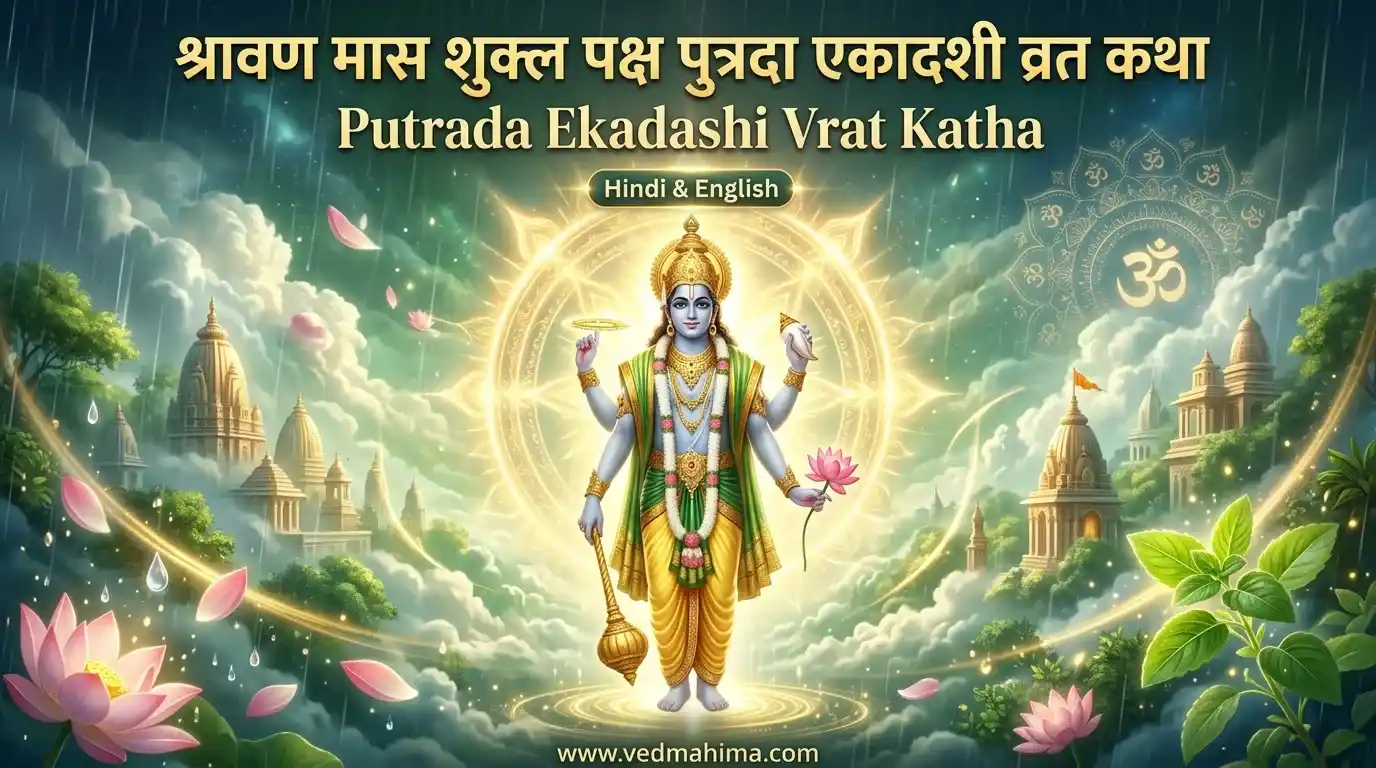
Shravan Maas Shukla Paksha Putrada Ekadashi Vrat Katha
Child Blessing, Son Gain, Devotion, Merit, Liberation, Prosperity, Blessings
॥ Introduction ॥
Shravan Shukla Ekadashi, widely celebrated as Putrada Ekadashi, holds an immensely divine and significant position in Sanatan Dharma. Falling during the highly auspicious bright fortnight of Shravan month, this sacred day is uniquely renowned for destroying past karmic blockages that obstruct the blessing of progeny. Observing this fast with ultimate devotion and gifting its accumulated merits can bless childless couples with a virtuous son, clean past sins, and ensure material and spiritual progress.
॥ Importance ॥
The supreme importance of Shravan Putrada Ekadashi is direct and unparalleled. Lord Shri Krishna states that hearing or reading the holy glory of this fast instantly liberates a human being from terrible sins, grants immense happiness in the current lifetime, and guarantees a heavenly state in the afterlife. It teaches the timeless law of Karma, proving that even a small unrighteous act done out of ignorance can obstruct personal happiness, which can only be rectified through the spiritual penance of Ekadashi.
॥ Puranic Reference ॥
The divine reference of this holy katha is rooted in the Dwapar Yuga, where Lord Shri Krishna beautifully narrates an ancient historical incident to King Yudhishthira. The narrative introduces Mahishmatipur's righteous King Mahijit, his concerned subjects, and the legendary long-lived seer, Maharshi Lomas—a sage whose single hair drops only after the passing of an entire cosmic cycle (Kalpa). This sacred account perfectly illustrates how collective prayers and Ekadashi virtues can transform a king's destiny.
॥ Story ॥
King Yudhishthira asked—O Madhusudana! Which Ekadashi occurs during the bright fortnight (Shukla Paksha) of the month of Shravan? Please be kind enough to describe it before me.
Lord Shri Krishna replied—O King! It is a matter of ancient times, during the beginning of the Dwapar Yuga. In the city of Mahishmatipur, a king named Mahijit ruled over his kingdom. However, he did not have any son, due to which his kingdom did not bring him any real happiness.
Seeing his advanced age, the King became heavily worried. He sat down among his subjects and spoke thus—'O citizens! No sin has been committed by me in this lifetime. I have never collected wealth in my treasury through unjust means. I have never taken the wealth belonging to Brahmins and deities. I have protected my subjects like my own children, ruled over the earth with absolute righteousness, and punished the wicked even if they were like my brothers or sons. I have always honored the disciplined and never considered anyone an object of hatred. Then, what is the reason that no son has been born in my house till date? Please ponder over this.'
Hearing these words of the King, the subjects along with the royal priests and Brahmins thought about his welfare and entered the dense forest. Wishing for the King's absolute good, they wandered around searching for ashrams inhabited by realized sages. Soon enough, they caught sight of the supreme munishrestha Lomas.
Lomasji is a true knower of religious principles, a distinguished scholar of all scriptures, immensely long-lived, and a great soul. His entire physical body is covered with hair. He is as radiant as Lord Brahma himself. Upon the completion of each Kalpa (a cosmic age), a single hair falls from his body; hence, his name became Lomas. That great sage knows the events of all three periods of time (past, present, and future). Seeing him, all the people were filled with immense joy.
Seeing them approach, Lomasji asked—'For what purpose have you all come here? State the reason for your arrival. Whatever beneficial task is there for you, I shall definitely execute it.'
The subjects replied—O Brahman! At this time, the king named Mahijit has no son. We are his subjects, whom he has protected like his own children. Seeing him childless, and being aggrieved by his grief, we have come here with a firm resolve to perform penance. O best among the twice-born! By the good fortune of the King, we have obtained your divine vision today. By the mere sight of great personalities, all tasks of humans get automatically accomplished. O Muni! Now instruct us on that specific remedy by which the King may obtain a son.'
Hearing their words, Maharshi Lomas went into deep meditation for two gharis (about 48 minutes). Thereafter, discovering the detailed account of the King's past life, he spoke—'O assembly of subjects! Listen attentively—King Mahijit in his previous birth was a wealth-less merchant (Vaishya) who used to exploit people. That merchant used to travel from village to village to conduct trade.
One day, on the Dashami Tithi of the bright fortnight of Jyeshtha month, when the midday sun was burning hot, he reached a water reservoir at the boundary of a village. Seeing the stepwell filled with water, the merchant thought of drinking water. Just then, a thirsty cow arrived there along with her young calf. Aggrieved by thirst and tormented by the blazing heat, she entered the stepwell and began drinking water. The merchant drove the drinking cow away and drank the water himself. Due to that specific sinful action, the King is childless in this lifetime. However, due to the merits of some birth, he has attained this thornless kingdom.'
The subjects pleaded—O Muni! It is heard in the Puranas that sin is destroyed through meritorious deeds performed as an atonement; therefore, please instruct us on a merit by which that sin can be completely eradicated.
Lomasji spoke—'O citizens! The Ekadashi that falls during the bright fortnight of Shravan month is famously renowned by the name of 'Putrada'. It bestows all mind-desired fruits. All of you must observe its sacred vow.'
Hearing this, the subjects bowed down to the sage, returned to the city, and systematically performed the rituals of Putrada Ekadashi fast. They also observed a night vigil (Jagaran) with pure procedures and affectionately transferred the clean merits of the fast to the King. Thereafter, the Queen conceived and, when the time of delivery arrived, gave birth to an exceedingly powerful son.
Lord Shri Krishna concludes—By hearing the glorious mahatmyam of this fast, a human being becomes entirely liberated from sins, experiences absolute happiness in this world, and obtains the highest heavenly destination in the next world.
॥ Moral of the Story ॥
- The cosmic law of Karma is unyielding; driving away a thirsty cow from a water source brought a curse of childlessness even to an otherwise righteous king.
- Collective spiritual efforts and transferring merits (Punya-daan) can rewrite the destiny of a loved one, just as the subjects saved their king.
- The sight and guidance of a true enlightened Master (like Maharshi Lomas) instantly resolves the most complex problems of human life.
- Ekadashi fast serves as a supreme cosmic atonement (Prayaschitta) that can completely burn away the deep-rooted negative karmas of past lives.
॥ Vrat & Worship Method ॥
- On Shravan Shukla Ekadashi, wake up in Brahma Muhurta, clean the house, and take a holy bath with pure intent.
- Take a solemn vow (Sankalpa) of fasting before the image of Lord Vishnu, praying specifically for the blessing of progeny or a virtuous son.
- Worship Lord Shri Hari Vishnu with absolute devotion, offering yellow flowers, incense, sandalwood, fruits, and fresh Tulsi leaves.
- Observe a strict fast throughout the day—either complete waterless (Nirjala) or fruit-based (Phalahar), strictly keeping away from grains and rice.
- Perform night vigil (Jagaran) collectively or individually, singing Vishnu bhajans and reciting sacred stotras until the next morning.
- On Dwadashi morning, complete your prayers, offer food and gifts to deserving Brahmins, and break the fast within the specified Parana time.
॥ Special Rules for Progeny Blessing ॥
- Putrada Ekadashi Specific Rule: Childless couples should ideally observe this fast together. If the subjects or family members observe it and dedicate the merits to the couple, it works with identical power.
- Fasting Code: Grains, wheat, rice, corn, lentils, garlic, and onions are totally prohibited. Pure milk, water, and fresh seasonal fruits are highly recommended.
- Righteous Conduct: Avoid harsh words, anger, and lying on this day. Dedicate maximum time to thinking about the well-being of all living beings, especially cows.
॥ Parana (Breaking the Fast) Method ॥
- The fast of Shravan Putrada Ekadashi must be formally broken on the next day, Dwadashi Tithi, after the local sunrise.
- It is mandatory to complete the Parana before the Dwadashi Tithi ends and outside the duration of Hari Vasara.
- Break the fast by taking the holy charanamrit of Lord Vishnu or consuming a simple Satvik meal prepared without grains if still under Chaturmas rules.
॥ Benefits ॥
- Removes cosmic blockages and blesses childless couples with a healthy, virtuous, and strong son (progeny).
- Completely eradicates the heavy past sins accumulated due to troubling animals or denying basic needs to living beings.
- Brings unparalleled joy, peace, and domestic stability to the family, turning a sorrowful household into a blissful one.
- Guarantees absolute happiness in the mortal world and a glorious, elevated path toward heaven (Swarga) after death.
॥ Frequently Asked Questions (FAQ) ॥
Why is this specific fast called Shravan Putrada Ekadashi?
It is named Putrada Ekadashi because the observing of this fast uniquely bestows the blessing of a son (Putra) and eradicates obstacles related to childbirth.
Which past sin caused King Mahijit to be childless?
In his past life as a merchant, he drove away a thirsty cow and her calf from a water stepwell on Jyeshtha Dashami. This unrighteous act caused his childlessness.
Who was Maharshi Lomas and what was his special feature?
Maharshi Lomas was a great long-lived seer who knew past, present, and future. His unique feature was that a single hair fell from his body only after the passing of an entire Kalpa (cosmic age).
Can family members fast and donate its merit to someone else?
Yes, as illustrated in the story, the subjects of Mahishmatipur kept the fast and successfully donated its spiritual merits to King Mahijit to bless him with a son.