Lord Ganesha
Birth story, divine names, sacred form, mantras, festivals and temples of Lord Ganesha
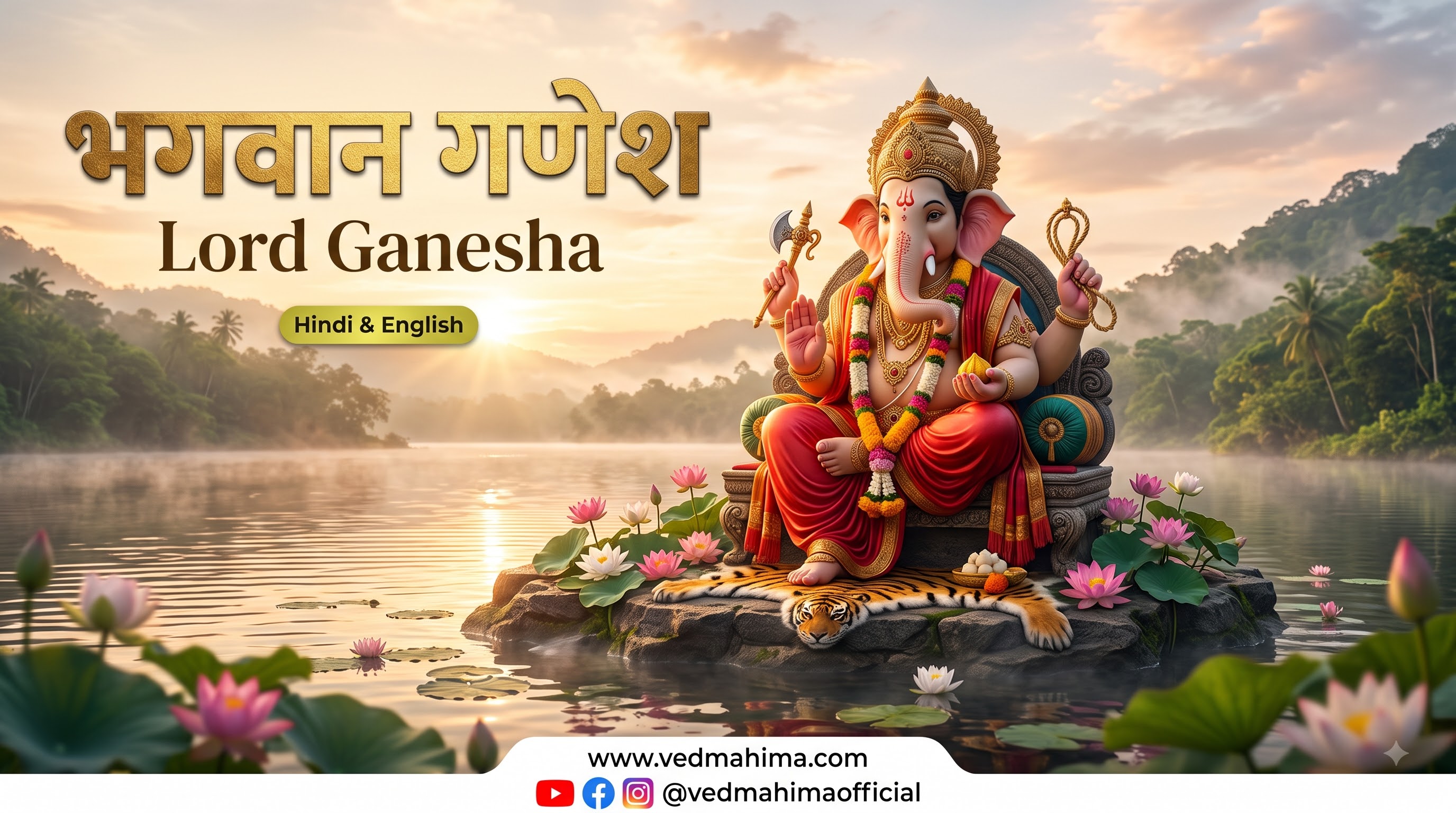
Lord Ganesha is one of the most worshipped and revered deities in the Sanatan Hindu tradition. Lord Ganesha holds a special place as the deity of wisdom, intellect, learning, knowledge, auspiciousness, prosperity, and auspicious. In Hinduism, there is a tradition of remembering and worshipping Lord Ganesha before beginning any auspicious activity, worship, religious ritual, yajna, sacrament, marriage, housewarming ceremony, or any new undertaking. For this reason, Lord Ganesha is known as the First Worshipped Deity and Vighnaharta, the remover of obstacles.
Lord Ganesha is also known by many names such as Ganapati, Gajanan, Ekadanta, Lambodara, Vinayaka, and Vighnaraja. Each of his names carries a special meaning related to his form, qualities, and religious significance. In the Sanatan tradition, Lord Ganesha is worshipped not only for removing obstacles but also for seeking good intellect, wisdom, knowledge, and auspicious intentions.
Major Names of Lord Ganesha
Lord Ganesha is known by many names in religious and devotional traditions. Some of the major names are:
- Ganesha
- Ganapati
- Vighnaharta
- Vinayaka
- Ekadanta
- Gajanan
- Lambodara
- Vakratunda
- Sumukha
- Heramba
Birth of Lord Ganesha
The story of Lord Ganesha's birth is one of the most famous stories in the Sanatan Hindu religious tradition. Lord Ganesha is known as the son of Lord Shiva and Goddess Parvati. Stories related to his birth and elephant-headed form are described in different ways in various Puranas and religious traditions. The story associated with the Shiva Purana is one of the most widely known traditions.
According to the Puranic story, once Goddess Parvati was going to take a bath. At that time, she created a child from the sacred paste applied to her body and infused life into him. Goddess Parvati accepted the child as her son and named him Ganesha. She then instructed Ganesha to guard the entrance while she was bathing and not allow anyone to enter without her permission.
Ganesha stood at the entrance and faithfully followed his mother's command. After some time, Lord Shiva arrived there. Lord Shiva wanted to enter and meet Goddess Parvati, but Ganesha stopped him. Ganesha did not recognize Lord Shiva and was simply following his mother's instructions. He told Lord Shiva that he could not allow him to enter without his mother's permission.
Lord Shiva tried to explain the situation to Ganesha, but Ganesha remained firm in obeying his mother's command. A conflict arose between them. Eventually, Lord Shiva, in anger, separated Ganesha's head from his body with his trident.
When Goddess Parvati learned about the incident, she became extremely sorrowful and angry. She demanded that Lord Shiva restore her son to life. According to the religious story, Goddess Parvati also stated that if her son was not brought back to life, she could take action that might affect the entire creation.
Considering the seriousness of the situation, Lord Shiva decided to find a way to revive Ganesha. He instructed his attendants to go toward the north and bring back the head of the first living being they encountered. The attendants found an elephant and brought its head back to Lord Shiva.
Lord Shiva placed the elephant's head on Ganesha's body and restored him to life. In this way, Ganesha appeared in his Gajanan form. Lord Shiva accepted him as his son, blessed him, and granted him a special place of honor.
Lord Shiva then granted Ganesha the boon that no auspicious activity or religious ritual would be considered complete without worshipping him at the beginning. Because of this religious tradition, Lord Ganesha is known as the First Worshipped Deity. He is also revered as Vighnaharta, the deity who removes obstacles and difficulties.
Why is Lord Ganesha Called Gajanan?
Lord Ganesha is called Gajanan because his face resembles that of an elephant. The word "Gaja" means elephant and "Anana" means face. Thus, Gajanan means the one with an elephant's face.
In Indian religious symbolism, Ganesha's elephant-like head is associated with wisdom, strength, patience, memory, and a broad perspective. This is why Lord Ganesha is also given special reverence as the deity of wisdom and intellect.
Religious Significance of Lord Ganesha
Lord Ganesha holds a highly important position in Hinduism. According to religious belief, Ganesha is the deity worshipped at the beginning of auspicious activities. The purpose of worshipping Lord Ganesha before any auspicious work is to begin the activity with an auspicious intention and to pray to God for its successful and obstacle-free completion.
Lord Ganesha is reverently worshipped as Vighnaharta, the remover of obstacles. Devotees pray to Lord Ganesha for wisdom, patience, and intellect to face difficulties in life. For this reason, the worship of Ganesha is especially popular among students, business people, artists, writers, and people working in various fields.
Form of Lord Ganesha
Lord Ganesha's form is highly distinctive and symbolic. His elephant-like head is considered a symbol of wisdom, strength, memory, and a broad vision in Indian religious tradition. His large ears inspire us to listen carefully and absorb useful knowledge. His small eyes are associated with concentration and subtle perception.
Ganesha's trunk is also considered an important part of his form. An elephant's trunk possesses both strength and the ability to perform delicate tasks. Therefore, Ganesha's trunk is symbolically associated with the ability to act with strength, flexibility, and wisdom according to different circumstances in life.
Ganesha's large belly, or Lambodara form, is associated with tolerance, balance, and the ability to accept different situations in life. His single tusk is also of special significance, and for this reason Lord Ganesha is called Ekadanta.
Lord Ganesha and His Mouse Vehicle
The mouse is traditionally regarded as the vehicle of Lord Ganesha. The presence of the mouse with Ganesha has great religious significance. Symbolically, the mouse is associated with the restless mind, desires, and worldly cravings. Lord Ganesha riding the mouse represents the idea that a person should control the restlessness of the mind and uncontrolled desires through wisdom and intellect.
Worship of Lord Ganesha
Lord Ganesha is worshipped through different methods in various regions and religious traditions. Generally, Ganesha worship includes meditation, invocation, sandalwood paste, Akshata, flowers, Durva grass, incense, lamps, and offerings. Durva grass and Modak are especially considered dear to Lord Ganesha.
During Ganesha worship, devotees chant various mantras of Lord Ganesha. One of the most famous mantras is:
Om Gam Ganapataye Namah.This mantra is widely chanted with devotion as part of the worship of Lord Ganesha. In addition, many devotees recite the Ganesha Atharvashirsha, Ganesha Chalisa, Sankatnashana Ganesha Stotra, and Lord Ganesha Aarti.
Ganesha and Kartikeya's Competition
A famous story describes a competition between Lord Ganesha and his brother Kartikeya to circumambulate the world. Kartikeya set out on his peacock to travel around the world, while Ganesha circumambulated his parents, Lord Shiva and Goddess Parvati. He explained that his parents were equal to the entire universe for him. Pleased with his wisdom and intellect, Ganesha was declared the winner.
Ganesha and the Writing of the Mahabharata
According to a famous traditional account of the Mahabharata, Maharishi Ved Vyasa decided to compose the Mahabharata and accepted Lord Ganesha as its scribe. Ganesha placed a condition that he would write continuously without stopping, and Maharishi Ved Vyasa would have to continuously recite the verses. According to the story, when Ganesha's writing instrument broke, he did not stop writing. Instead, he broke one of his tusks and used it as a writing instrument, continuing the composition of the Mahabharata. For this reason, Lord Ganesha is also known as Ekadanta. This episode is especially famous in Indian religious and literary traditions.
Ganesha and Parashurama
A famous Puranic story describes a conflict between Parashurama and Lord Ganesha. When Parashurama arrived at Mount Kailash, Ganesha stopped him according to the instructions of Goddess Parvati and Lord Shiva. A battle took place between them, and Parashurama's axe broke one of Ganesha's tusks. This story is also associated with Ganesha's Ekadanta form.
The Story of Ganesha and the Moon
According to a Puranic story, once Lord Ganesha was traveling somewhere. His vehicle was the mouse, and he was carrying Modaks with him. Modaks are traditionally considered very dear to Lord Ganesha. During the journey, for some reason, his mouse vehicle became unbalanced. As a result, Lord Ganesha fell down, and some of the Modaks he was carrying also fell onto the ground. Lord Ganesha picked up his Modaks and once again mounted the mouse before continuing his journey.
At that moment, the Moon in the sky saw Lord Ganesha. The Moon was proud of its beautiful and attractive appearance. Seeing Lord Ganesha fall while riding the mouse, the Moon made fun of his elephant-headed and large-bellied form. Lord Ganesha did not appreciate this behavior. Considering the Moon's pride inappropriate, he cursed the Moon.
Lord Ganesha said that the Moon, which was so proud of its beauty, would cause a person who looked upon it to face dishonor or false accusations. In religious tradition, this curse is associated with the belief concerning seeing the Moon on Ganesh Chaturthi. In particular, seeing the Moon on the fourth day of the bright fortnight of the month of Bhadrapada is associated with the possibility of false accusations or Mithya Kalank.
After hearing Lord Ganesha's curse, the Moon realized its mistake. It understood that making fun of someone's appearance and being arrogant about one's own beauty was not appropriate. The Moon apologized to Lord Ganesha and requested him to withdraw the curse. It humbly praised Lord Ganesha and expressed regret for its offense.
Seeing the Moon's humility and repentance, Lord Ganesha became pleased. Instead of completely removing the curse, he limited its effect. According to religious tradition, this is why special caution regarding seeing the Moon on Ganesh Chaturthi became part of the tradition. It is traditionally believed that seeing the Moon on this day may lead to false accusations or Mithya Kalank.
Major Festivals Associated with Lord Ganesha
Several festivals and fasts associated with the worship of Lord Ganesha hold special importance in the Sanatan Hindu tradition. Among them, Ganesh Chaturthi, Sankashti Chaturthi, Vinayak Chaturthi, and Angarki Chaturthi are particularly important. On these occasions, devotees worship Lord Ganesha according to traditional rituals and pray for happiness, prosperity, wisdom, intellect, and relief from obstacles in life.
- Ganesh Chaturthi: Ganesh Chaturthi is a major Hindu festival dedicated to Lord Ganesha. It is celebrated on the Chaturthi Tithi of the Shukla Paksha of the month of Bhadrapada. On this day, devotees install an idol of Lord Ganesha and perform worship, Aarti, and mantra chanting according to traditional rituals. Ganesh Chaturthi is celebrated with great enthusiasm and devotion in many parts of India, especially in Maharashtra. Devotees offer Modaks, Durva grass, and other sacred offerings to Ganesha. In many places, the Ganesh festival continues for several days, after which the idol is immersed in water.
- Sankashti Chaturthi: Sankashti Chaturthi is an important monthly fast dedicated to Lord Ganesha. It is observed on the Chaturthi Tithi of the Krishna Paksha every month. On this day, devotees observe a fast and worship Lord Ganesha while maintaining discipline and devotion throughout the day. According to tradition, the fast is concluded after seeing and worshipping the Moon. Sankashti Chaturthi is regarded as a special occasion to pray to Lord Ganesha for relief from difficulties and obstacles through his worship.
- Vinayak Chaturthi: The name Vinayak Chaturthi is used in various religious and regional traditions for the Chaturthi fast and worship dedicated to Lord Ganesha. In particular, there is a tradition of worshipping Lord Ganesha on the Chaturthi of the Shukla Paksha. Devotees worship Ganesha on this day and pray for wisdom, learning, happiness, prosperity, and success in their endeavors. In some regions, it is also known as Vinayak Chaturthi or Vinayak Chavath.
- Angarki Chaturthi: Angarki Chaturthi is considered a special form of Sankashti Chaturthi. When Sankashti Chaturthi falls on a Tuesday, it is known as Angarki Sankashti Chaturthi. Tuesday is associated with the planet Mars, and for this reason this Chaturthi is considered especially significant in religious tradition. Special worship, fasting, mantra chanting, and devotion to Lord Ganesha are performed on this day. Devotees pray to Lord Ganesha to remove obstacles, grant auspicious results, and maintain happiness and prosperity in life.
The central spirit of all these festivals and fasts is associated with devotion to Lord Ganesha and the seeking of faith, devotion, and good intellect. Devotees worship Ganesha, observe fasts, chant mantras, perform Aarti, and offer sacred food according to their traditions and capabilities.
Major Temples of Lord Ganesha
Numerous ancient and famous temples dedicated to Lord Ganesha are located in different parts of India. Various forms of Lord Ganesha are worshipped with devotion in these temples. Ganesha devotees visit these temples from different parts of the country for Darshan, worship, and prayer. Maharashtra has many important temples and pilgrimage traditions associated with the worship of Lord Ganesha, while several famous Ganesha temples are also located in South India. Some of the major temples include:
- Shri Siddhivinayak Temple, Mumbai: Located in the Prabhadevi area of Mumbai, Shri Siddhivinayak Temple is one of the famous temples dedicated to Lord Ganesha. Here, Lord Ganesha is worshipped in the Siddhivinayak form. The idol of Ganesha holds special religious significance, and a large number of devotees visit the temple throughout the year for Darshan and worship. Special devotion can be seen at the temple during Ganesh Chaturthi and other Ganesha festivals.
- Dagdusheth Halwai Ganpati Temple, Pune: Shreemant Dagdusheth Halwai Ganpati Temple in Pune is among the famous temples of Lord Ganesha. The temple is especially known for its grand decorations and religious celebrations during the Ganesh festival. Large numbers of devotees visit to have Darshan of the beautifully decorated idol of Lord Ganesha. The temple's Ganesha worship tradition is an important part of Pune's religious and cultural life.
- Ashtavinayak Temples of Maharashtra: The eight major temples of Lord Ganesha in Maharashtra are collectively known as the Ashtavinayak pilgrimage tradition. Each temple has a distinct form of Lord Ganesha and its own religious traditions. The Ashtavinayak pilgrimage is considered an important pilgrimage journey for Ganesha devotees. These temples are associated with different names and forms of Lord Ganesha.
- Ganpatipule Temple, Maharashtra: Located near the seashore in Ratnagiri district of Maharashtra, Ganpatipule Temple is one of the famous pilgrimage sites dedicated to Lord Ganesha. According to religious tradition, Lord Ganesha is worshipped here in a Swayambhu form. Another special feature of the temple is that the idol of Ganesha is worshipped in a distinctive natural form. Ganpatipule is also considered one of Maharashtra's important religious and tourist destinations.
- Kanipakam Vinayaka Temple, Andhra Pradesh: Located in Chittoor district of Andhra Pradesh, Kanipakam Vinayaka Temple is one of the famous temples dedicated to Lord Ganesha. Here, Lord Ganesha is worshipped as Shri Varasiddhi Vinayaka Swamy. The religious tradition associated with the temple gives special importance to the Swayambhu idol of Lord Ganesha. It is regarded as an important pilgrimage destination for Ganesha worship in South India.
Ashtavinayak
Ashtavinayak is the pilgrimage tradition of eight major and revered temples of Lord Ganesha located in Maharashtra. Ashta means eight, while Vinayaka is one of the prominent names of Lord Ganesha. Different forms of Lord Ganesha are worshipped in these eight temples, and each temple has its own religious story, tradition, and spiritual significance.
The Ashtavinayak pilgrimage holds special religious significance for devotees of Lord Ganesha. Traditionally, devotees visit all eight Ganesha temples. The eight major Ashtavinayak temples are located in different parts of Maharashtra, and visiting them is considered an important pilgrimage tradition associated with the worship of Lord Ganesha.
Eight Major Ashtavinayak Temples
- Mayureshwar (Morgaon): The Mayureshwar or Moreshwar Temple in Morgaon is a major temple in the Ashtavinayak pilgrimage tradition. Here, Lord Ganesha is worshipped in the Mayureshwar form. Morgaon is regarded as an important center of the Ashtavinayak pilgrimage tradition.
- Siddhivinayak, Siddhatek: The Siddhivinayak Temple at Siddhatek is dedicated to Lord Ganesha in the Siddhivinayak form. In religious tradition, this place is associated with the worship of Lord Ganesha and spiritual accomplishment.
- Ballaleshwar, Pali: Ballaleshwar Temple in Pali, Raigad district, is one of the famous Ashtavinayak temples dedicated to Lord Ganesha. Its name is associated with the famous religious story of the devotee Ballal.
- Varadvinayak, Mahad: Varadvinayak Temple in Mahad is dedicated to Lord Ganesha in the Varadvinayak form. Varada is understood to mean the one who grants blessings or boons. Devotees pray here to Lord Ganesha for blessings and fulfillment of their wishes.
- Chintamani, Theur: Chintamani Temple in Theur is dedicated to Lord Ganesha in the Chintamani form. In religious tradition, this form of Lord Ganesha is associated with removing worries and providing mental peace.
- Girijatmaj, Lenyadri: The Girijatmaj Temple, located in the hills of Lenyadri, is one of the important Ashtavinayak temples. The name Girijatmaj is associated with Girija, another name of Goddess Parvati, and means her son. The temple is also known for its distinctive location in a natural hill region.
- Vighneshwar, Ozar: Vighneshwar Temple in Ozar is dedicated to Lord Ganesha in the Vighneshwar form. The name Vighneshwar represents the form of Lord Ganesha associated with the removal of obstacles and difficulties.
- Mahaganapati, Ranjangaon: Mahaganapati Temple in Ranjangaon is one of the eight major Ashtavinayak temples. Here, Lord Ganesha is worshipped in the Mahaganapati form. The temple is regarded as an important religious pilgrimage site for Ganesha devotees.
Each Ashtavinayak temple has its own religious significance, form, and local history. The pilgrimage tradition of these temples reflects the worship of Lord Ganesha in different forms and the rich religious culture of Maharashtra. For Ganesha devotees, the Ashtavinayak pilgrimage is considered an important opportunity for devotion, worship, and pilgrimage Darshan.
Religious Content Related to Lord Ganesha
- Ganesha Mantra
- Ganesha Aarti
- Ganesha Chalisa
- Ganesha Stotra
- Ganesha Katha
- Ganesha Temple
- Gakaradi Shri Ganapati Sahasranamavali
- Gakaradi Shri Ganapati Sahasranama Stotram
About Lord Ganesha
❓ Frequently Asked Questions
Question: Why is Lord Ganesha called Vighnaharta?
Answer: Lord Shiva granted Ganesha the boon that no auspicious activity would be considered complete without worshipping him first, which is why he is revered as Vighnaharta, the remover of obstacles.
Question: Why does Lord Ganesha have only one tusk (Ekadanta)?
Answer: One tradition says he broke his own tusk to use as a pen while writing the Mahabharata for Maharishi Ved Vyasa; another says it broke during a battle with Parashurama at Mount Kailash.
Question: Why do people avoid looking at the Moon on Ganesh Chaturthi?
Answer: According to the Chandra-darshan legend, the Moon mocked Ganesha's form after he fell from his mouse, and Ganesha cursed that anyone who saw the Moon that day would face false accusations.
Question: What is Ashtavinayak?
Answer: Ashtavinayak is a pilgrimage of eight major Ganesha temples in Maharashtra, including Mayureshwar, Siddhivinayak and Ballaleshwar, each with its own form and story.
Question: What is Lord Ganesha's main mantra?
Answer: "Om Gam Ganapataye Namah" is the most widely chanted mantra dedicated to Lord Ganesha.
Question: Which festivals are dedicated to Lord Ganesha?
Answer: Ganesh Chaturthi, Sankashti Chaturthi, Vinayak Chaturthi and Angarki Chaturthi are the major occasions for his worship.