Shri Dauji Maharaj Temple Baldeo
Shri Dauji Maharaj Temple Darshan Guide
🙏 Devotional
🔥 Powerful
📿 Daily Prayer
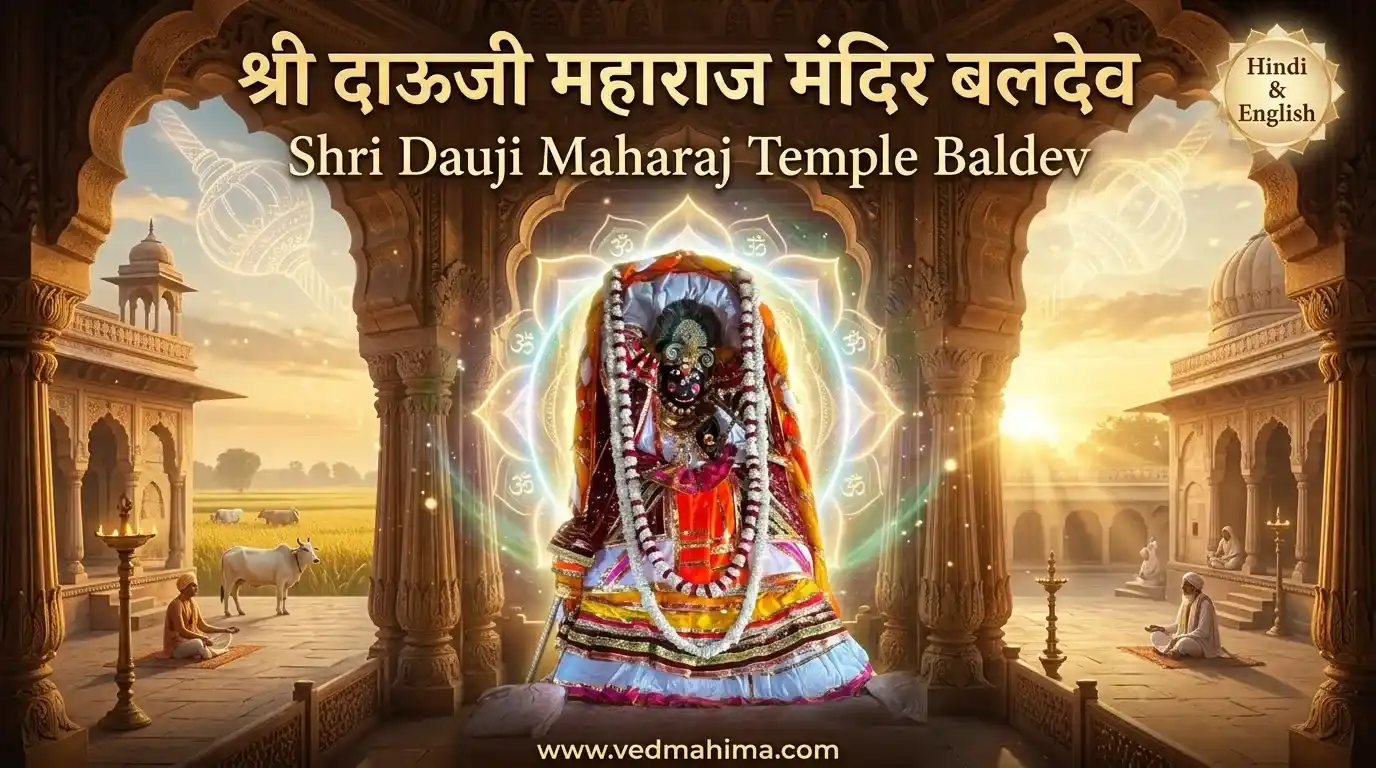
॥ Overview and Divine Glory of the Temple ॥
Located in the historic region of the sacred Braj Bhoomi in Mathura district of Uttar Pradesh, Shri Dauji Maharaj Temple is an important center of ancient Vaishnava devotion, Braj culture, and popular faith. Baldev is traditionally associated with the ancient Vidrum Van. It is situated approximately 20 kilometers from Mathura on the Mathura-Etah road.Lord Balarama Ji, the elder brother of Lord Shri Krishna, is the presiding deity of this sacred dham and is lovingly worshipped as Dauji Maharaj. Lord Balarama Ji is revered as the incarnation of Sheshnag. Bhadrapada Shukla Shashthi, known as Baldev Chhath, is celebrated with great devotion as the appearance festival of Lord Balarama Ji. In Braj culture, the affectionate term "Dau" is traditionally used for an elder brother, and therefore Lord Balarama Ji is lovingly known as Dauji Maharaj.
According to the religious traditions of Brajmandal, Dauji Maharaj is worshipped not only as the principal deity but also with great reverence as the King, Lord, and protector of Braj. At Baldev Dham, Lord Dauji Maharaj is seated on a royal throne in a majestic form, and the temple''s worship traditions reflect the grandeur of a royal court.
Inside the sanctum sanctorum, the magnificent dark-stone idol of Lord Baldev Ji is enshrined together with His divine consort, Mata Revati Ji. Lord Balarama Ji is especially associated with His divine weapons, the plough (Hala) and mace (Musala), which are regarded as symbols of His strength, agricultural tradition, and protection of Dharma.
॥ Religious and Historical Introduction to Baldev City ॥
Baldev is situated on the eastern edge of Brajmandal in Mathura district. Gokul and Mahavan, which are referred to as Brihadvan in the Puranic tradition, are also important religious places in this region. According to religious tradition, the Baldev region is associated with Vidrum Van.The tradition of worship and service at Shri Dauji Maharaj Temple is associated with the descendants of Brahmarshi Saubhari Ji. The temple''s hereditary sevayat Brahmins are Angirasa Gotriya traditionally regarded as descendants of Goswami Shri Kalyan Devacharya Ji. The sevayats are locally addressed as Panda Ji.
॥ Grandeur of Shri Dauji Maharaj Temple ॥
Shri Dauji Maharaj Temple is a magnificent temple complex surrounded by strong fortified walls, giving it the appearance of a fort. A circumambulation path and market areas are situated around the temple.The principal entrances of the temple include Singhpaur, Janani Deodhi, Gaushala Gate, and Badwale Gate. The large water reservoir situated behind the temple is known as Balabhadra Kund and is also referred to as Ksheer Sagar in religious tradition.
॥ Major Spiritual and Historical Aspects ॥
* Ancient Divine Deities: The idols of Shri Dauji Maharaj and Mata Revati Ji installed in the temple are regarded as extremely ancient according to religious tradition. According to belief, King Vajranabha, a descendant of Lord Shri Krishna, installed the divine idols of the Lord at several important sacred places in Braj. According to local religious tradition, the present idols are regarded as part of this ancient tradition of worship.* Tradition of Protecting the Deities from Foreign Invasions: According to local belief, during medieval invasions, the divine idols were buried beneath an ancient banyan tree near the temple area in order to protect them. A popular local tradition also narrates that while the idols remained underground, a cow would come there every day and offer its milk at the sacred spot.
* Divine Command to Goswami Shri Kalyan Devacharya Ji: According to religious tradition, Goswami Shri Kalyan Devacharya Ji Maharaj had a divine vision of Lord Dauji Maharaj in a dream and received a divine indication regarding the buried idols. Thereafter, according to the Lord''s command, the tradition of the reappearance of the divine idols is associated with him.
* Tradition of Temple Service and Worship: Following the reappearance of the idols, the tradition of their worship and service remained associated with the descendants of Goswami Kalyan Devacharya Ji. Even today, the descendants of Goswami Shri Kalyan Devacharya Ji are the principal hereditary sevayats responsible for the worship and religious traditions of Shri Dauji Maharaj Temple. The responsibility for the temple''s service arrangements, traditions, and religious duties remains in the hands of this lineage, and generation after generation, this lineage has continued to carry forward the ancient tradition of temple service.
॥ Divine Appearance and Adornment of Shri Baldev-Rewati Ji ॥
The idol of Lord Baldev Ji is dark in complexion and attracts devotees with its magnificent form, graceful posture, and divine radiance. It is traditionally believed that regardless of the direction or angle from which devotees have darshan of the divine form, they experience the feeling that the Lord''s gaze is directly upon them.Behind Lord Baldev Ji stands Sheshnag with seven hoods. The posture of the Lord is extremely graceful and captivating. His right hand is raised in the Varada Mudra, while a cup is beautifully held in His left hand.
Near the feet of the divine idol are the idols of His companions Subal, Tosh, and Shridama. Lord Baldev Ji is adorned with ornaments such as Kadula on His arms, earrings in His ears, and a Vaijayanti Mala around His neck, while a traditional dhoti adorns His waist.
A finely carved crown adorns the Lord''s head. On various occasions, the Lord is adorned with a Kirita, Pag, Bank-Chandrika, Mukut, Jama, Choli, Patuka, Phenta, and Lakuta. The daily adornment includes numerous ornaments such as Kantha, Baghnakha, Kathula, Haar, Muktamala, Kardhani, Kadula, and Sirpech.
On special festivals and occasions, the Lord receives special adornment and is served with saffron, camphor, perfume, sandalwood, and other sacred fragrances.
The plough and mace are the distinctive symbols of Lord Baldev Ji. On the occasion of Dussehra, these divine weapons are specially offered and adorned as part of the service.
Mata Revati Ji is enshrined beside the Lord. Her divine form is beautifully adorned with a crown, tilak, and various auspicious ornaments.
॥ The Divine Cycle of Royal Bhog, Daily Service, and Aarti ॥
The daily service, darshan, bhog, and aarti at Baldev Temple are conducted according to traditional Braj and Vaishnava worship practices:* Morning Mangala and Bal Bhog: After the morning Mangala Darshan, various services of the Lord are performed. Following Padya, Arghya, Achamana, Marjana-Snana, and clothing services, Bal Bhog is offered. Makhan and Mishri are especially offered as part of this bhog. Devotional hymns are also sung during this service.
* Shringar Aarti and Rajbhog: Shringar Aarti is performed after Bal Bhog. Rajbhog is offered in the afternoon. This bhog includes puri, vegetables, kheer, basondi, raita, Mohanbhog, halwa, and the famous laddus of Braj.
* Special Importance of Kheer: According to religious tradition, on Margashirsha Purnima, after the appearance of the Lord, kheer, meaning milk-based sacred offering or ksheer, was offered as the first bhog. Therefore, kheer holds a special place in the temple''s bhog tradition.
* Utthapan and Vijaya Bhog: After the Lord''s afternoon rest, darshan resumes. During Utthapan Bhog, Vijaya, traditionally referring to bhang, is also offered as bhog. According to local tradition, devotees lovingly say while offering bhang—"Dau Dayal Braj ke Raja, Bhang Peeve To Yahan Pe Aaja."
* Evening Aarti and Samaj Singing: In the evening, traditional devotional singing and Samaj are conducted at the temple. The evening aarti is performed accompanied by traditional musical instruments.
* Night Shayan Bhog: Before the Lord retires for the night, He is given a special night adornment. After Achamana and other services, puri, vegetables, and sweetened milk are offered as bhog. Following the singing of Shayan and Vinay devotional verses, the temple doors are closed.
॥ Vaishnava Service Tradition and the Osra System of the Goswamis ॥
The worship practices of Dauji Temple reflect the influence of various Vaishnava traditions. According to the time and occasion, devotional songs describing the glories and divine pastimes of the Lord are sung in different traditional ragas and melodies.The temple''s service and worship traditions reflect influences associated with the Vallabha Sampradaya, Pushtimarg, Ramanuja, Radhavallabha, Radharaman, and Nimbarka traditions.
At Dauji Temple, the service responsibilities of Goswami families and hereditary sevayats are traditionally carried out according to the designated Osra system. On the day assigned to a particular Goswami family, that family traditionally makes special arrangements for Rajbhog, Prasad, and other services and may invite relatives, close associates, and distinguished guests.
॥ Temple Architecture and Historical Heritage ॥
Shri Dauji Maharaj Temple is distinguished by its massive fortified walls, high gateways, and fort-like architecture. The architecture of the temple complex reflects the influence of Braj and Rajasthani architectural traditions along with elements associated with different historical periods.The Naqqarkhana of the temple complex is also an important part of its historical identity. Local historical accounts mention traditions of royal patronage and the construction of the Naqqarkhana during the Mughal period.
Various historical and religious traditions are associated with the establishment of early places of worship following the appearance of the divine idols, followed by the construction of the temple and subsequent re-establishment of the worship traditions.
॥ Tradition of Shri Dauji Temple During the Mughal Period ॥
Local historical accounts relating to the Mughal period mention Shri Dauji Maharaj Temple and its associated religious arrangements. According to a famous local legend, during the reign of Aurangzeb, an army allegedly sent with the intention of destroying the temple encountered a huge swarm of bees and wasps on its way to Baldev.According to local tradition, following this incident, the attempt to damage the temple was abandoned and royal protection was subsequently granted to the temple. The traditions associated with royal orders concerning village revenue grants and the Naqqarkhana are also connected with this account.
Later historical accounts mention that during the period of Shah Alam and the Sindhia dynasty, arrangements relating to the temple''s jagir, Bhog-Rag, and maintenance continued.
॥ The Temple During the British Period ॥
During the British period, Shri Dauji Maharaj Temple continued to remain an important center of religious and social life. Local historical accounts mention traditions in which temple sevayats and members of the regional society provided assistance and shelter to people associated with the freedom movement.Local history also contains accounts of actions taken by the British administration concerning certain jagirs and arrangements associated with the temple, as well as the monitoring of the temple.
Because of the religious services, Sadavart, and food arrangements conducted at the temple, the temple continued to serve as an important center for pilgrims and the local community.
॥ Balabhadra Kund – Ksheer Sagar ॥
In Baldev, apart from Shri Dauji Maharaj Temple, Balabhadra Kund is another important religious site. The Kund is approximately 80 yards long and 80 yards wide and is surrounded by paved ghats.Devotees traditionally take a bath or perform Achamana here before proceeding for darshan of Shri Dauji Maharaj.
Balabhadra Kund is an important part of the religious identity of Baldev Dham and holds special significance in local traditions associated with the worship of Lord Balarama Ji.
॥ The Famous Dauji Maharaj Huranga ॥
The Holi celebrations of Braj are famous for their unique traditions, and the Dauji Huranga of Baldev holds a special place among the major Holi celebrations of Braj.In Braj, the festival of Holi begins from Basant Panchami. At Dauji Temple too, the tradition of offering Gulal and singing traditional Holi devotional songs begins from this period.
The famous Dauji Huranga is celebrated on Chaitra Krishna Dwitiya. Traditional Holi is played within the temple premises with colored water, colors prepared from Tesu flowers, Abir, and Gulal. Amid the sounds of Dhaps, Jhanjh, Manjira, and Mridang, Huriyare and Huriyarin participate in this traditional celebration.
Dauji Huranga is a major attraction for devotees and visitors because of its distinctive Braj traditions, folk songs, colorful celebrations, and collective festive spirit.
॥ Major Festivals and Celebrations ॥
* Baldev Chhath – Balarama Janmotsav: The appearance festival of Lord Balarama Ji is celebrated on Bhadrapada Shukla Shashthi. Special worship, adornment, bhog, and a fair are organized on this occasion.* Dauji Huranga: The famous Huranga celebrated on Chaitra Krishna Dwitiya is one of the most distinctive festive traditions of Baldev.
* Sharad Purnima: Sharad Purnima holds special religious significance at Shri Dauji Maharaj Temple.
* Margashirsha Purnima: This date is considered particularly significant because of its association with religious traditions concerning the appearance of Lord Dauji Maharaj.
* Basant Panchami: This is an important date associated with the beginning of the Holi celebrations at the temple.
* Shri Krishna Janmashtami: Like other major temples of Braj Bhoomi, Janmashtami is also celebrated with devotion in Baldev.
* Diwali and Other Vaishnava Festivals: Throughout the year, special bathing, adornment, bhog, and aarti are performed on various religious occasions.
॥ Main Prasad of Shri Dauji Maharaj ॥
Makhan and Mishri are regarded as the principal prasad of Shri Dauji Maharaj Temple. Makhan-Mishri holds special religious and cultural significance in the Krishna-Balarama tradition of Braj.Kheer also holds a special place in the temple''s bhog tradition. Various types of bhog are offered to the Lord during different festivals and special occasions.
॥ Darshan Timings ॥
The darshan timings at the temple may change according to the season, festivals, and special religious events. Traditional accounts mention different arrangements for morning, afternoon, and evening darshan during summer and winter.During major festivals, fairs, and celebrations such as Huranga, darshan timings and temple arrangements may differ from those on regular days.
Devotees are advised to verify the latest darshan timings and details of special events with the local temple authorities before planning their visit.
॥ Cultural Features of Baldev ॥
Baldev is important not only from a religious perspective but is also known for its distinctive Braj culture, folk art, and traditional festivals.The local Sanjhi art, traditional Akharas, folk celebrations, pottery, and social traditions of Braj form an important part of the cultural identity of the town.
The temple bells, Naqqarkhana, religious events, and festivals have long influenced the social and religious life of the town.
॥ Prominent Personalities Who Visited for Darshan ॥
Local historical accounts mention the visit of several prominent personalities to Baldev and their darshan of Shri Dauji Maharaj. These include Mahamana Madan Mohan Malaviya, Pandit Motilal Nehru, Pandit Jawaharlal Nehru, Mohandas Karamchand Gandhi, Kasturba Gandhi, Dr. Rajendra Prasad, Dr. Sarvepalli Radhakrishnan, Sardar Vallabhbhai Patel, Morarji Desai, Pandit Deendayal Upadhyaya, and Bharatendu Babu Harishchandra, among others.॥ How to Reach Shri Dauji Dham ॥
Shri Dauji Dham is located on the Mathura-Etah road and can be easily reached from Mathura by road:* By Road: Baldev Dham is situated on the Mathura-Etah road. It can be reached by road from Delhi, Noida, Agra, and nearby cities. Travelers arriving via the Yamuna Expressway can exit at the appropriate interchange and continue by road to Baldev. Buses, autos, taxis, and other local transportation options are available from Mathura to Baldev.
* By Rail: The nearest major railway station is Mathura Junction (MTJ). Mathura Junction is well connected by rail with many major cities across India. From the railway station, devotees can take a taxi, auto, or other local transportation to reach Baldev.
* By Air: The major nearby airports include Agra Airport (approximately 31 km), Noida International Airport, Jewar (approximately 87 km), and Indira Gandhi International Airport, New Delhi (approximately 147 km). Devotees arriving by air can continue their journey by road from these airports to Shri Dauji Maharaj Temple, Baldev Dham.
🙏 ॥ Thus completed ॥ 🙏
The Hindi text has been compiled based on original and authentic sources. If there is any difference,
error, or inconsistency between the Hindi and English versions, the Hindi text shall be considered the
authoritative version. If there are any errors or copyright-related concerns regarding this content,
please contact us.
📜 प्रामाणिक स्रोत:
📖 सार्वजनिक रूप से उपलब्ध स्रोत
📖 आधिकारिक मंदिर रिकॉर्ड
📖 सरकारी पोर्टल
📖 सत्यापित ऑनलाइन संदर्भ
About Shri Dauji Maharaj Temple Baldeo
The history of the Shri Dauji Maharaj Temple is an extraordinary saga of divine incarnation, preservation, and revelation. Originally known as Vidrum Van, this sacred site is the literal birthplace of Lord Balarama, who was born to Mata Rohini as the elder brother of Lord Krishna. The colossal monolithic deities were first installed 5,000 years ago by Krishna's great-grandson, King Vajranabha. To protect them from the 11th-century invasions of Mahmud Ghaznavi, they were safely buried beneath a Banyan tree, where a cow daily offered her milk over the hidden Lord. In 1582 AD (Samvat 1638), the great saint Goswami Kalyan Devacharya Ji excavated the deities following a divine dream. A temple was initially constructed by Goswami Gokulnath Ji in 1583 AD, and the present grand fortress-style temple was later erected in 1633 AD (Samvat 1689) by the pious merchant of Delhi, Seth Shyam Das. It also houses a historical Royal Nakkarkhana built during Aurangzeb's reign in 1672 AD, symbolizing its deep integration with medieval Indian history.