Pausha Maas Krishna Paksha Saphala Ekadashi Vrat Katha
Success, destruction of sins, devotion, virtue, liberation, peace, welfare
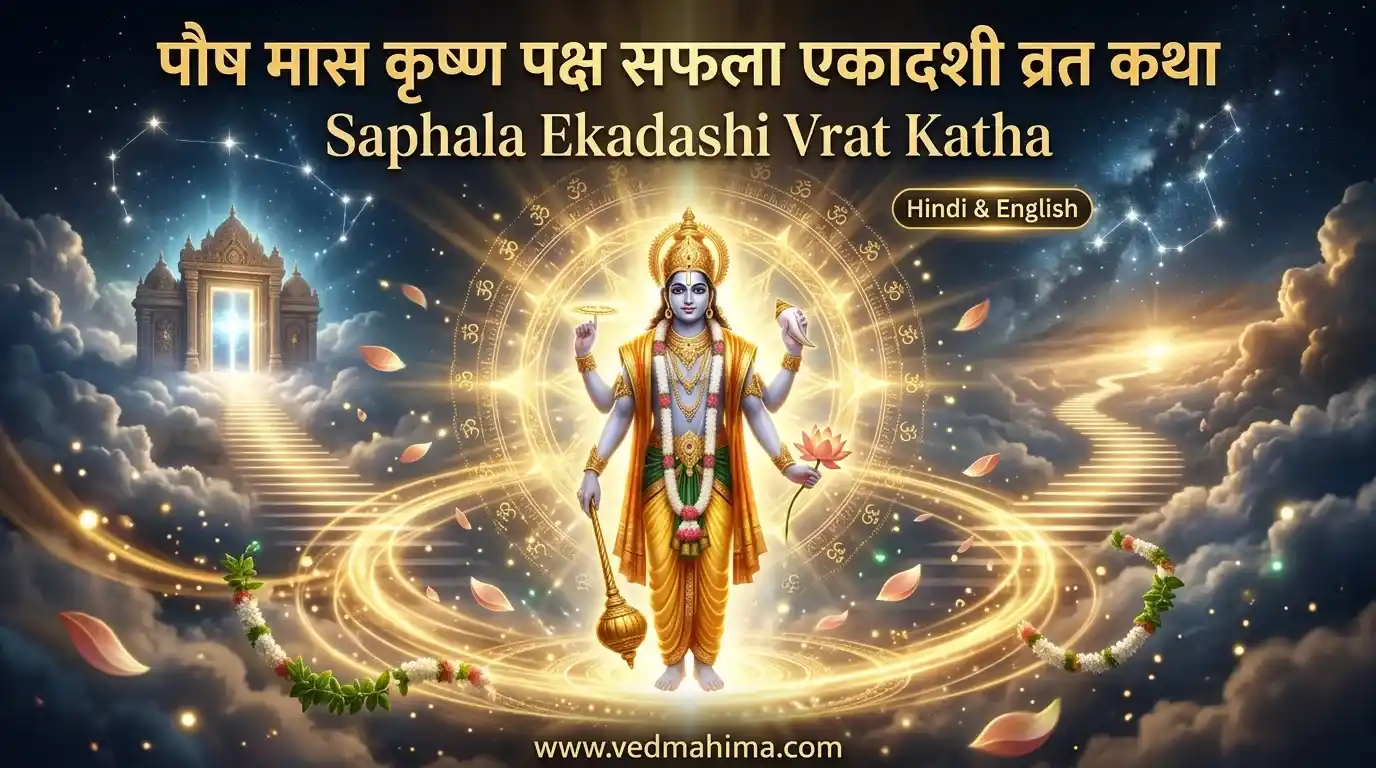
॥ Introduction ॥
The Ekadashi that occurs during the dark fortnight (Krishna Paksha) of the Hindu calendar month of Pausha is universally celebrated as Saphala Ekadashi. True to its divine name 'Saphala' (meaning successful), this sacred day possesses the absolute cosmic potential to make every righteous effort, spiritual practice, and worldly endeavor of a human being completely successful. Dedicated entirely to Lord Narayana, this fast acts as a ultimate divine catalyst for transforming adversity into prosperity and liberating trapped souls from the deepest oceans of negative karma.
॥ Importance ॥
The spiritual excellence of Saphala Ekadashi is highly magnified in the scriptures. Lord Shri Krishna proclaims that He is not as highly satisfied by grand Vedic sacrifices accompanied by massive monetary donations (Dakshina) as He is by the systematic performance of the Ekadashi fast. Just as Sheshnag is supreme among serpents, Garuda among birds, Shri Vishnu among deities, and Brahmins among humans, similarly, Saphala Ekadashi stands supreme among all vows (Vrats). Observing a night vigil on this day bestows structural spiritual merits that cannot be achieved even by thousands of years of severe physical penance.
॥ Puranic Reference ॥
The sacred narrative of this fast is rooted in an ancient dialogue between King Yudhishthira and Lord Shri Krishna during the Dwapar Yuga. King Yudhishthira, with deep humility, requested the Lord to describe the structural methodology and presiding deity of the dark fortnight of Pausha month. Lord Shri Krishna dynamically revealed the historical transformation of Prince Lumbhaka, the outcast son of King Mahishmat of Champavati, to prove how an accidental yet sincere performance of Saphala Ekadashi can override a lifetime of terrible sins and restore lost royalty and consciousness.
॥ Story ॥
King Yudhishthira asked—O Lord! What is the name of the Ekadashi that falls during the dark fortnight (Krishna Paksha) of the month of Pausha? What is its precise method, and which specific deity is worshipped on this holy day? Please reveal this to me.
Lord Shri Krishna replied—O King! Listen carefully, I am going to detail this to you. I am not as highly pleased by grand sacrifices with heavy donations as I am by the absolute execution of the Ekadashi vow. Therefore, a person must put forth every single effort to fast on Ekadashi. The Ekadashi of Pausha Krishna Paksha is known as 'Saphala'. On this day, according to the prescribed rules, a devotee must systematically worship Lord Narayana. Since Ekadashi is the ultimate bestower of welfare, it must absolutely be observed.
Just as Sheshnag is supreme among serpents, Garuda among birds, Shri Vishnu among deities, and Brahmins among humans, similarly, the lunar date of Ekadashi is supreme among all structural vows. O King! On Saphala Ekadashi, one should worship Shri Hari by offering seasonal fruits while chanting His divine Name-Mantras. The Lord of all Lords, Shri Hari, must specifically be worshipped using coconuts, betel nuts, big lemons, pomegranates, beautiful amlas (gooseberries), cloves, plums, and especially fresh mango fruits. Similarly, the devotee must offer pure incense and lamps. There is an exceptionally strict rule for deep-dan (donation of lamps) on Saphala Ekadashi. One must maintain a night vigil (Jagaran) in the holy association of Vaishnavas. The unyielding spiritual merit obtained by a person who performs this night vigil cannot be obtained even by executing intense penance for thousands of years.
O best among kings! Now listen to the highly auspicious and historical story of Saphala Ekadashi. There was a universally famous and prosperous city named Champavati, which was once the majestic capital of the righteous King Mahishmat. The royal king had five sons. Among them, the eldest son, named Lumbhaka, was continuously engaged in terrible sinful activities. He was heavily addicted to prostitutes and constantly indulged in illicit activities. He squandered his father's massive wealth solely on evil deeds. He was an absolute evildoer, a malicious critic of learned Brahmins, and continuously insulted Vaishnavas and the structural cosmic deities.
Seeing his son completely consumed by such demonic behavior, King Mahishmat officially named him 'Lumbhaka' (the destroyer). Subsequently, the King and his other brothers unitedly banished him from the kingdom. Banishment forced Lumbhaka into the deep, dark, and dense forest. Living there, the sinful prince began ruthlessly robbing the wealth of the innocent citizens of his father's kingdom. One night, when he entered the city to execute a theft, the royal night-watchmen caught him red-handed. However, when he revealed his identity as the son of King Mahishmat, the guards out of respect for the King released him. He returned to the forest and began surviving by consuming raw meat and wild fruits. The resting place of this wicked soul was beneath an ancient, massive Peepal tree (sacred fig), which was widely revered as a great sylvan deity in that forest.
After many years of suffering, by the sudden awakening of some highly hidden, accumulated meritorious deeds of his past lifetimes (Punya), he accidentally executed the fast of Ekadashi. On the Dashami (tenth day) of Pausha Krishna Paksha, the sinful Lumbhaka could only consume a few fruits, and due to a lack of proper winter clothing, he suffered intensely from the biting cold throughout the night. He could neither sleep nor find a moment of physical rest. He became completely rigid, appearing almost lifeless. Even after sunrise, the sinner did not regain physical consciousness. On the sacred day of Saphala Ekadashi, Lumbhaka lay completely unconscious. It was only during the midday period that he slowly regained consciousness. Looking around aimlessly, he limped on unstable feet deeper into the forest, severely weakened and tormented by intense hunger.
O King! Lumbhaka gathered some wild fruits and returned to his resting place under the Peepal tree just as the sun set. Placed in total helplessness, he offered all those fruits at the root of the sacred tree and prayed—'May the Lord of Goddess Lakshmi, Lord Vishnu, be satisfied with these fruits.' Saying this, he stayed awake throughout the entire night without a wink of sleep. In this manner, he unknowingly yet completely executed the strict fast and night vigil of Saphala Ekadashi. Suddenly, a celestial voice echoed from the sky—'O Prince! By the supreme grace of Saphala Ekadashi, you shall regain your lost kingdom and be blessed with a noble son.'
Accepting the blessing with deep gratitude, his body was immediately transformed into a divine, radiant form. From that very moment, his intellect became perfectly fixed on the continuous devotion of Lord Vishnu. Adorned with magnificent divine ornaments, he returned to his kingdom, faced no obstacles, and successfully ruled over the empire for fifteen glorious years. By the absolute grace of Lord Shri Krishna, a highly intelligent and beautiful son named Manojna was born to him. When the son reached maturity, Lumbhaka renounced all material attachments, officially handed over the kingdom to his son, and departed permanently to the divine abode of Lord Shri Krishna, where a soul never encounters grief again. O King! Anyone who executes this supreme fast of Saphala Ekadashi enjoys all material pleasures in this world and attains ultimate liberation (Moksha) after death. Blessed are those human beings who remain dedicated to Saphala Ekadashi; their birth is truly successful. Reading, hearing, or living according to its glory grants a human being the immediate spiritual fruit equivalent to performing the grand Rajasuya Sacrifice!
॥ Moral of the Story ॥
- Divine grace can redeem even the most fallen souls; Prince Lumbhaka was an outcast sinner, yet the unyielding power of Ekadashi completely purified his consciousness and destiny.
- Unintentional devotion still yields massive divine fruits; even though Lumbhaka fasted out of absolute helplessness and misery, Lord Narayana accepted his accidental surrender and granted him an empire.
- Nature and holy elements assist in redemption; the ancient Peepal tree, considered a living deity, became the sacred altar where his accidental offering was transformed into a divine ritual.
- Detachment is the ultimate goal of a successful life; after receiving material wealth and a son, Lumbhaka followed the righteous path of his ancestors, renounced his kingdom, and merged into the eternal service of Krishna.
॥ Vrat & Worship Method ॥
- On Pausha Krishna Dashami, consume only a single Satvik meal, avoid any form of sinful thoughts, and prepare your body for the sacred fast.
- On Ekadashi morning, wake up early, perform your morning ablutions, and take a firm vow (Sankalpa) to observe the Saphala Ekadashi fast to please Lord Narayana.
- Cleanse your altar and place a beautiful idol or picture of Lord Vishnu. Perform Shodashopachara worship using sandalwood paste, flowers, and incense.
- Specially offer fruits like fresh coconuts, betel nuts, pomegranates, amla, cloves, and mangoes, as these are highly dear to the Lord on this specific Tithi.
- Light a beautiful ghee lamp and ensure deep-dan (donation of lamps) is performed extensively in the temple or under a Peepal tree.
- Spend the entire night in the dynamic association of devotees, chanting the Vishnu Sahasranama, singing bhajans, and completely avoiding sleep.
- On Dwadashi morning, perform sunrise prayers, offer food and charities (Dakshina) to worthy Brahmins, and break the fast within the designated Parana period.
॥ Special Rules for Saphala Ekadashi ॥
- Fruit Offering Importance: Offering a variety of specified seasonal fruits to Lord Vishnu on this day is mandatory to unlock the full success-granting vibrations of the fast.
- Peepal Tree Worship: Since the historical redemption took place under a Peepal tree, lighting a lamp and offering water to a Peepal tree on this day removes deep financial obstacles.
- Avoiding Criticism: Maintain complete silence or speak only sweet, truthful words. Avoid criticizing others, as textually highlighted by Lumbhaka's past sinful habits.
॥ Parana (Breaking the Fast) Method ॥
- The fast must be broken on Dwadashi Tithi strictly after sunrise and after the completion of the Hari Vasara period.
- Do not consume heavy or Tamasik food during Parana; conclude the fast with Tulsi water, fruits, or simple Satvik food.
॥ Benefits ॥
- Grants absolute success (Saphala) in all stuck works, businesses, and structural worldly planning.
- Destroys the heaviest accumulated sins of a lifetime and guides the devotee from a state of ignorance to supreme cosmic consciousness.
- Bestows material wealth, family happiness, structural protection, and ensures a majestic place in the divine realm of Lord Vishnu after death.
- Grants the spiritual merit equivalent to performing the grand Vedic Rajasuya Sacrifice.
॥ Frequently Asked Questions (FAQ) ॥
What is the name of the Ekadashi that falls during Pausha Krishna Paksha?
The Ekadashi that falls during the dark fortnight of the month of Pausha is known as Saphala Ekadashi.
Which specific fruits are recommended for worship on Saphala Ekadashi?
Coconuts, betel nuts, pomegranates, amla, cloves, and fresh mangoes are highly recommended for worshipping Lord Hari on this day.
Who was the prince that got redeemed by this fast?
Prince Lumbhaka, the wild and exiled son of King Mahishmat of Champavati, was completely redeemed by this fast.
What grand Vedic merit is obtained by reading or hearing this Saphala Ekadashi Katha?
Reading or hearing this sacred katha grants the immediate spiritual fruit equivalent to performing the grand Rajasuya Sacrifice.
⏰ Best Time
The absolute best time to read or listen to the Saphala Ekadashi Vrat Katha is during the early morning after the Sankalpa ritual, or during the evening twilight period while performing the special Deepdan (lamp lighting) ceremony before Lord Narayana.
🏷️ Tags
🔗 Related Pages
🔗 Related Trending Vrat-Utsav
About Pausha Maas Krishna Paksha Saphala Ekadashi Vrat Katha
Saphala Ekadashi Katha beautifully demonstrates the absolute compassionate nature of Lord Narayana, showing that divine grace does not evaluate a devotee's past but welcomes sincere alignment in the present. Through the mystical redemption of Prince Lumbhaka, the text structurally establishes that true faith combined with scriptural alignment under holy elements like the Peepal tree can reverse the darkest karmic downfalls and convert absolute failures into divine success.