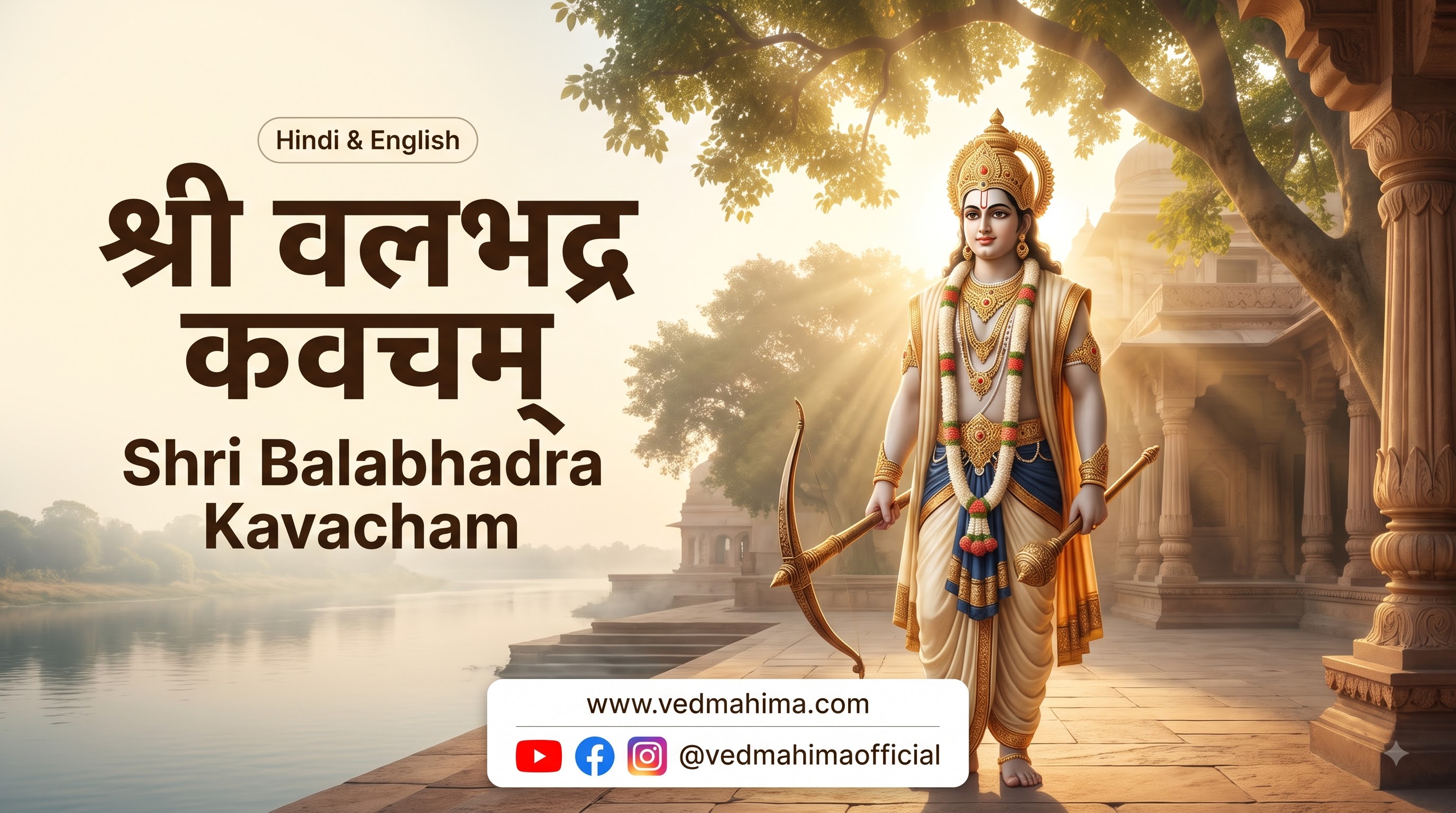
Shri Balabhadra Kavacham
Balabhadra Kavacham from Garga Samhita, protection in all directions, Balarama Janmotsav and Baldev Chhath paath vidhi, fearlessness and strength
Gopeebhyah Kavacham Dattam,
Gargaachaaryena Dheemataa.
Sarvarakshaakaram Divyam,
Dehi Mahyam Mahaamune ॥ 1 ॥
Meaning: Duryodhana said: O Great Sage! Please bestow upon me that divine, all-protecting armor (Kavacha) which was given to the Gopis by the wise Sage Gargacharya. ॥ 1 ॥
॥ Praagvipaaka Uvaacha ॥
Snaatvaa Jale Kshaumadharah Kushaasanah,
Pavitrapaanih Krita Mantra Maarjanah.
Smritvaaya Natvaa Balamachyutaagrajam-
Sadhaarayed Dharmasamaahito Bhaveat ॥ 2 ॥
Meaning: Sage Pragvipaka said: One should bathe in water, wear silk garments, hold Kusha grass in hand, perform ritual purification with mantras, remember and bow to Lord Balarama (elder brother of Achyuta), and wear this Kavacha with a focused and righteous mind. ॥ 2 ॥
Goloka Dhaamaadhipatih Pareshvarah,
Pareshu Maam Paatu Pavitra Keertanah.
Bhoomandalam Sarshapavat Pralasyate-
Panmoordhni Maam Paatu Sa Bhoomandale ॥ 3 ॥
Meaning: May the Lord of Goloka, the Supreme Ishvara whose glory is sacred, protect me from enemies. May He, upon whose head the entire earth rests like a mustard seed, protect me on this earth. ॥ 3 ॥
Senaasu Maam Rakshasu Sheerapaanih,
Yuddhe Sadaa Rakshatu Maam Halee Cha.
Durgeshu Chaavyaanmushalee Sadaamaa-
Vaneshu Sankarshana Aadidevah ॥ 4 ॥
Meaning: May Sheerapani protect me in armies, may Hali protect me always in battle, may Mushali wearing a garland protect me in difficult forts, and may the primal deity Sankarshana protect me in forests. ॥ 4 ॥
Kalindajaa Vegaharo Jaleshu,
Neelaambaro Rakshatu Maam Sadaamee.
Vaayau Cha Raamovatu Rave Valashcha,
Mahaarnave'nantavapuh Sadaa Maam ॥ 5 ॥
Meaning: May the subduer of Yamuna protect me in water, may Neelambara protect me in fire, may Balarama protect me in air, may Baladeva protect me in the sky, and may Anantavapu protect me in the vast ocean. ॥ 5 ॥
Shree Vaasudevo Vatu Parvateshu,
Sahasra Sheershaa Cha Mahaavipaade.
Romeshu Maam Rakshatu Rauhineyah,
Maam Kaamapaalo Vatu Vaa Viyatsu ॥ 6 ॥
Meaning: May Vaasudeva protect me in mountains, Sahasrasheersha in great calamities, Rauhineya in the pores of my skin, and Kamapala in times of adversity. ॥ 6 ॥
Kaamaatsadaa Rakshatu Dhenukaarih,
Krodhaatsadaa Maam Dvividhaprahaaree.
Lobhaatsadaa Rakshatu Velvalaarih,
Mohaatsadaa Maam Kila Maagadhaarih ॥ 7 ॥
Meaning: May Dhenukaari protect me from lust, the slayer of Dwividha protect me from anger, Velvalaari protect me from greed, and Maagadhaari protect me from delusion. ॥ 7 ॥
Praatah Sadaa Rakshatu Vrishnidhuryah,
Praahne Sadaa Maam Mathuraapurendrah.
Madhye Dine Gopasakhah Prayaatu,
Svaraat Paraahne Vatu Maam Sadaiva ॥ 8 ॥
Meaning: May Vrishnidhurya protect me in the morning, Mathurapurendra in the forenoon, Gopasakha at noon, and Swarat in the afternoon. ॥ 8 ॥
Saayam Phaneendro'vatu Maam Sadaiva,
Paraatparo Rakshatu Maam Pradoshage.
Poorne Nisheethe Cha Durantaveeryah,
Pratyoosha Eesho Vatu Maam Sadaiva ॥ 9 ॥
Meaning: May Phaneendra protect me in the evening, Paraatpara during Pradosha time, Durantaveerya at midnight, and Eesha at dawn. ॥ 9 ॥
Vidikshu Maam Rakshatu Revaateepatih,
Dikshu Pralambaariradho Yadoottamah.
Oordhvam Sadaa Maam Balabhadra Aaraat,
Tathaa Samantaad Baladeva Eva Hi ॥ 10 ॥
Meaning: May Revatipati protect me in intermediate directions, Pralambaari in primary directions, Yaduttama from below, Balabhadra from above, and Baladeva from all surrounding directions near and far. ॥ 10 ॥
Antah Sadaavyaat Purushottamo Vahih,
Naagendra Leelo Vatu Maam Mahaabalah.
Sadaantaraatmaanamato Harih Swayam-
Prayaatu Poornah Parameshvaro Mahaan ॥ 11 ॥
Meaning: May Purushottama protect me within, the mighty Lord of Naagendra-leela protect me without, and may Hari Himself, the complete and supreme Great Lord, protect my inner soul. ॥ 11 ॥
Devaasuraanaam Bhayanaashanam Cha,
Hutaashayam Paapachayendhanaanaam.
Vinaashanam Vighnagharasya Viddhi,
Siddhaasanam Varmavalam Valasya ॥ 12 ॥
Meaning: Know this armor of Lord Balarama to be a bestower of divine power and complete mastery. It destroys the fears of gods and demons, burns away mountains of sins like fire burns wood, and annihilates all obstacles and troubles. ॥ 12 ॥
॥ Iti Shree Gargaachaarya Samhitaayaam Shree Balabhadra Khande Praagvipaaka Duryodhana Samvaade Stotra Kavacha Varma Varnanam Naama Ekaadasho Dhyaayah ॥
About Shri Balabhadra Kavacham
Who is Balabhadra? Balarama is the elder brother of Krishna, the son of Rohini and Vasudeva, and in the Bhagavata tradition an avatar of Sheshnag, the serpent on whom Vishnu rests. He is called Sankarshana because the seventh child of Devaki was drawn across into Rohini''s womb to save him from Kamsa. He is Haladhara (carrier of the plough), Mushali (carrier of the pestle or club), Rauhineya (son of Rohini), Revatipati (husband of Revati), Baladeva and Balabhadra. Many of these names appear in the verses, so reading the Kavacham is also a way of remembering his life. His birth is celebrated as Baldeo Chhath on Bhadrapada Shukla Shashthi.
Verse 1: the request. Duryodhana says: O great sage, please give me that divine armour that gives protection from everything, which the wise Gargacharya gave to the Gopis. The Gopis of Braj were ordinary people who lived near danger, and the armour was given for their safety. The verse sets the purpose of the hymn: protection, and not power over others.
Verse 2: the method. Sage Pragvipaka says: bathe in water, wear silk or clean clothes, sit on kusha with kusha grass in hand, purify yourself with mantras, remember and bow to Balarama, the elder brother of Achyuta (Krishna), and then take up the Kavacham with a calm and righteous mind. This verse tells us that the hymn is read with cleanliness, focus and respect.
Verse 3: protection from enemies and on the earth. The Lord of Goloka, the Supreme Ishvara of sacred glory, is asked to protect against enemies. The second half says that he on whose head the whole earth seems like a mustard seed should protect on this earth. This refers to Sheshnag, who is said to bear the earth on his hoods, and shows the scale of the protector that the devotee is calling on.
Verse 4: armies, battle, forts and forests. Sheerapani (the one with a plough in his hand) protects in armies. Hali (the plough-bearer) protects in battle. Mushali, wearing a garland of forest flowers, protects in difficult forts, and Sankarshana, the primal deity, protects in forests. Each name is a weapon or a form of his, and each is matched to the kind of danger it suits.
Verse 5: water, fire, air, sky and ocean. The one who held back the force of the Yamuna (Kalindi) is asked to protect in water. This recalls the story in which Balarama, while enjoying the water play at Vrindavan, called the river to come to him and drew its course with his plough when she did not obey, until she bowed and came. Neelambara (the one in a blue garment) protects in fire, Rama (Balarama) in air, Baladeva in the sky and Anantavapu, whose form is endless, in the great ocean.
Verse 6: mountains, calamity, the body. Vasudeva protects in mountains, Sahasrasheersha (the thousand-headed) in great calamity, Rauhineya in every pore of the skin and Kamapala (the protector of wishes) in adversity. The mention of the pores shows that the prayer covers the whole body, down to its smallest part.
Verse 7: protection from the inner enemies. This is the most meaningful verse. It asks protection from lust (kama) through Dhenukari, the enemy of Dhenuka, from anger (krodha) through the slayer of Dwivida, from greed (lobha) through Velvalari, the enemy of Valvala, and from delusion (moha) through Magadhari. Each name recalls a story of Balarama:
(a) Dhenuka was a demon in the form of a donkey who guarded the Talavana palm grove near Vrindavan, and the cowherd boys could not eat its fruit for fear of him. Balarama seized him by the hind legs, whirled him and threw him at a palm tree, and the grove became safe.
(b) Dwivida was a mighty ape, a friend of the demon Narakasura, who troubled people and once insulted Balarama while he was enjoying himself on Mount Raivataka. Balarama killed him with his plough and club.
(c) Valvala was a demon who disturbed the sacrifices of sages, and Balarama killed him, as told in the Bhagavata Purana.
(d) Magadhari means the enemy of Magadha, which recalls the long fight against Jarasandha, the king of Magadha, who attacked Mathura many times.
The verse teaches that the greatest enemies of a person are within: desire, anger, greed and delusion.
Verse 8: protection through the day. Vrishnidhurya (the foremost of the Vrishnis) protects in the morning, the Lord of Mathura in the forenoon, Gopasakha (friend of the cowherds) at noon and Swarat (self-ruling) in the afternoon.
Verse 9: evening and night. Phanindra (lord of serpents) protects in the evening, Paratpara (beyond the beyond) at pradosh, Durantaveerya (of endless valour) at midnight and Eesha at dawn. Together with verse 8, the whole day and night is covered, which is why many people read it before sleep or before going out.
Verse 10: all directions. Revatipati protects in the corners, Pralambari (the enemy of Pralamb) in the main directions, Yaduttama from below, Balabhadra from above and Baladeva from all around, near and far. Pralamb was the demon who came as a cowherd boy and tried to carry Balarama away on his back, but was killed by him.
Verse 11: inside and out. Purushottama protects within, the mighty Lord of playful serpent-like grace (Nagendra-leela) protects outside, and Hari himself, the complete and supreme great Lord, protects the inner soul. The verse closes the circle: protection from outside dangers, from inner enemies and for the soul.
Verse 12: the fruit (phalashruti). The last verse says: know this armour of Balarama to be the destroyer of the fear of gods and demons, a fire to burn the fuel of heaped-up sins, the remover of all obstacles and a giver of siddhi. This is stated as a matter of faith and devotion. The text ends with the colophon: "Iti Shri Gargacharya Samhitayam Shri Balabhadra Khande Pragvipaka Duryodhana Samvade Stotra Kavacha Varma Varnanam Nama Ekadasho Adhyayah."
The wider message. The Kavacham moves outward and inward: places and elements (3 to 6), the inner enemies (7), time (8 and 9), direction (10) and the inner soul (11). Its central idea is that real protection is not only against outside danger but also against desire, anger, greed and delusion, and that the Lord is to be remembered at every moment. The benefits mentioned, such as courage, calm and freedom from fear, are matters of faith. A prayer is best taken alongside care and common sense, and for health, money or legal problems please also take proper professional advice.
How to read it. Read it slowly and with the meaning, in the morning after a bath, before a journey or a big task, and on Baldeo Chhath. Read other hymns to Balarama too: the Balabhadra Stotram, Baladevashtakam, Balarama Chalisa and Balabhadra Sahasranama. See also the Dauji Maharaj Temple, Baldeo.
❓ Frequently Asked Questions
Question: What is the Balabhadra Kavacham?
Answer: It is a protective hymn (kavacha, "armour") from the Garga Samhita, in the Balabhadra Khanda, where Sage Pragvipaka tells Duryodhana of the armour Gargacharya gave to the Gopis. It asks Lord Balarama to protect the devotee in every place, time and direction (see Balarama Ji).
Question: How should one prepare before reciting it?
Answer: The second verse says to bathe, wear silk or clean clothes, hold kusha grass, purify with mantras, remember and bow to Balarama, and wear the kavacha with a calm mind.
Question: Which names of Balarama appear in the verses?
Answer: It names Sheerapani, Hali, Mushali, Sankarshana, Neelambar, Rauhineya, Revatipati, Pralambari, Balabhadra and Baladeva, and calls him Lord of Goloka. See the Balabhadra Sahasranama for more of his names.
Question: Which inner enemies does the Kavacham mention?
Answer: Verse 7 asks protection from lust (kama) through Dhenukari, anger (krodha) through the slayer of Dwivida, greed (lobha) through Velvalari and delusion (moha) through Magadhari. These recall Balarama's deeds (see the Balarama Chalisa).
Question: How does it divide the day for protection?
Answer: Verses 8 and 9 ask protection in the morning, forenoon, noon, afternoon, evening, pradosh, midnight and dawn, and verse 10 in all directions, above and below.
Question: When should the Kavacham be recited?
Answer: Daily in the morning after a bath, before travel or an important task, and on Balarama Janmotsav (Baldev Chhath), Bhadrapada Shukla Shashthi. It is a prayer for courage and calm, to be taken alongside care and common sense.