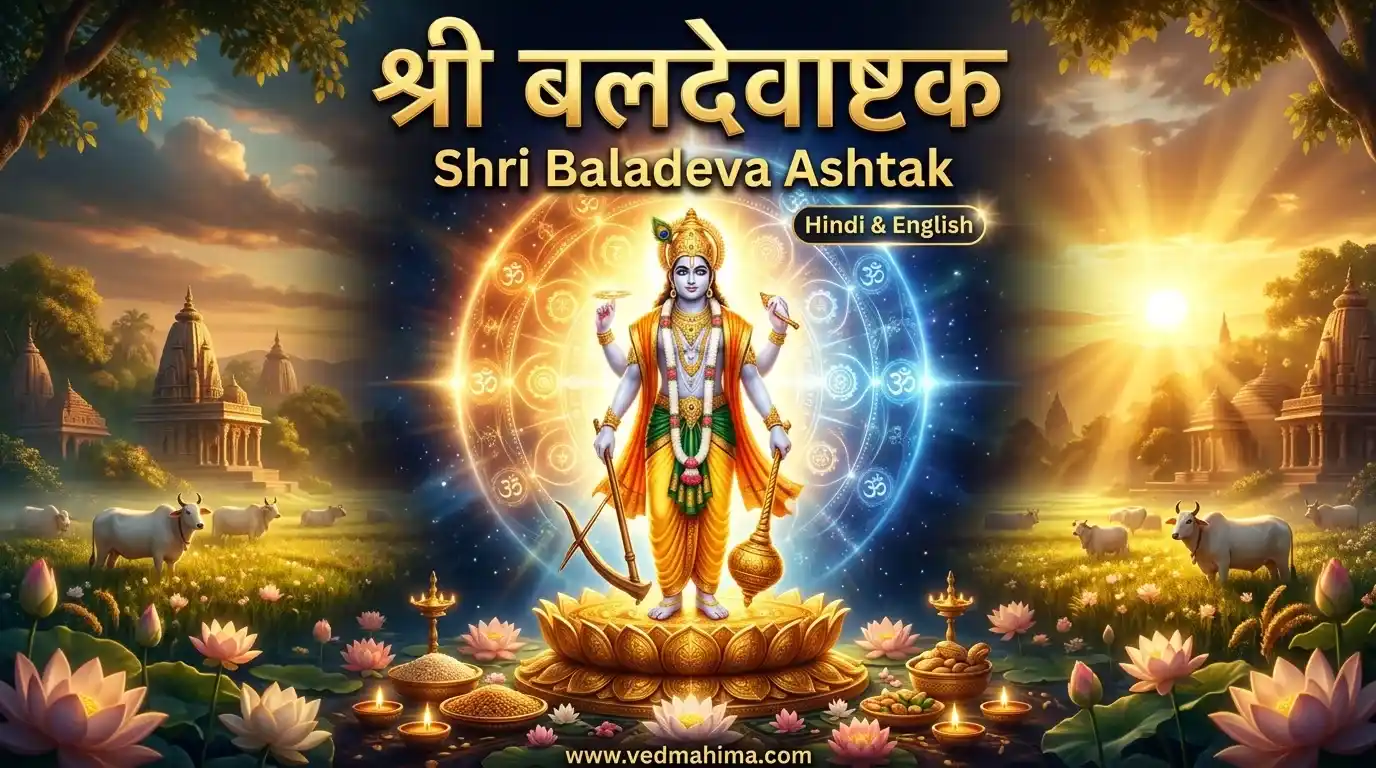
Shri Baladeva Ashtakam
Dhenuka and Pralamb vadh, Mushtik-Chanur wrestlers, "Kaun bakhaan sakai jag mein" refrain, boat in midstream prayer
Kaamp uthi dukh mein vasudha,
jab paap ka bhaar badhyo ati bhaaro.
Bhaar apaar utaaran ko,
sahasaanan ne nar ko tan dhaaro.
Rohini au Vasudev ke putra,
kiyo tum Gokul gaam sukhaaro.
Kaun bakhaan sakai jag mein,
Baldev vichitra charitra tihaaro॥1॥
Nand Yashomati ko sukhde,
Brajwasin ke ur prem prachaaro.
Raas rachaay kiyo parihaas,
sada nij bhaktan ko pan paaro.
Baal sakhaan mein khel rachaay ke,
Dhenuka maari dhara par daaro.
Kaun bakhaan sakai jag mein,
Baldev vichitra charitra tihaaro॥2॥
Maran hetu Pralamb tumhen,
nij roop banaay ke gwaal ko nyaari.
Baal sakhaan ke saath mein bhed chhupaay ke,
khelan khel sidhaaro.
Peeth chadhaay ke bhaago tumhen,
nij bojh ke bhaar se daabike maaro.
Kaun bakhaan sakai jag mein,
Baldev vichitra charitra tihaaro॥3॥
Mushtik mall bulaay ke,
Kans ne aapas mein mil mantr vichaaro.
Baandh langot akhaade mein aay,
firay langot javai kilkaaro.
Jaay akhaade mein kood pade tum,
Mushtik Chanur maari sanhaaro.
Kaun bakhaan sakai jag mein,
Baldev vichitra charitra tihaaro॥4॥
Maari anekan dushton ke dal,
bhutal bhaar apaar utaaro.
Dai sukh gau-dwij-devon ko,
muni-santan ke sab sankat taaro.
Phoolan ki varsha varasaay,
kiyo sab devan ne tero jaykaaro.
Kaun bakhaan sakai jag mein,
Baldev vichitra charitra tihaaro॥5॥
Ter suni na aver kari,
nij bhaktan ko sab kaaraj saaro.
Paap pahaad ko chhaar karo,
bhay bhoori haro bhav paar utaaro.
Kor kripa ki nihaarat hi,
vinasaavat kasht kathor karaaro.
Kaun bakhaan sakai jag mein,
Baldev vichitra charitra tihaaro॥6॥
Gyaan prakash karo ur maahi,
vinaash karo chit ko andhiyaaro.
Moh haro mad krodh haro,
aru kaam ko lobh ko naam pajaaro.
Naath anathan ke tum ho,
dhari haath kripa ko anaath sudhaaro.
Kaun bakhaan sakai jag mein,
Baldev vichitra charitra tihaaro॥7॥
Daas kare ardaas prabhu,
majhdhaar mein aay phasyau apu dhaaro.
Doobat aaj jahaaj mero,
naahi deekh parai dukh maahi kinaaro.
Haath tere patwaar dai,
ab naath tuhi ik khevanvaaro.
Kaun bakhaan sakai jag mein,
Baldev vichitra charitra tihaaro॥8॥
About Shri Baladeva Ashtakam
Who is Baladeva? A short background. In the Bhagavata tradition, when the earth was crushed by the weight of proud kings and demons, Bhumi Devi went to the gods and prayed for relief. Vishnu said he would descend with Sheshnag as his companion. Kamsa of Mathura had imprisoned his sister Devaki and her husband Vasudeva and killed their children. The seventh child, Sankarshana, was transferred in Devaki''s womb to the womb of Rohini, Vasudeva''s other wife, who was staying safely at Gokul. For this reason he is called Sankarshana, "the one who was drawn across," and is known as Rohini''s son. He grew up in Gokul and Vrindavan beside Krishna, in the company of Nanda, Yashoda and the cowherds of Braj. His birth is celebrated as Baldeo Chhath on Bhadrapada Shukla Shashthi (see the Balarama Ji page).
Verse 1: the earth in distress. The first verse says that the earth shook in sorrow when the weight of sin grew very heavy, and that to lift this immense burden the thousand-hooded one, Sheshnag, took a human body. He was Rohini''s and Vasudeva''s son, and he brought joy to Gokul. The verse ends by asking: who in the world can describe Baldev''s wonderful ways? The point of the verse is that his arrival was not for his own pleasure but to lighten the earth, which is why the hymn begins by honouring his purpose.
Verse 2: love for Braj and the story of Dhenuka. The second verse says he brought joy to Nanda and Yashoda, spread love in the hearts of the Brajwasis, joked and made merry in the Raas, and always kept the vow made to his devotees. Playing among the cowherd boys, he killed Dhenuka and threw him to the ground. In the Bhagavata story, the boys longed for the sweet fruit of the Talavana palm grove, but it was guarded by Dhenuka, a demon in the form of a donkey, with his herd. Balarama seized Dhenuka by the hind legs, whirled him and flung him against a palm tree, and threw his companions aside too. The grove became safe for people and cows. This verse shows his strength used for the protection of the simple people of Braj.
Verse 3: Pralamb, the demon in disguise. The third verse tells of Pralamb, who came in the form of a cowherd boy to kill him, hiding his true nature among the playmates. In the game "Haribhadra," in which the losers carried the winners on their backs, Pralamb lost to Balarama and had to carry him. Instead of stopping at the agreed place, he ran on, trying to take him away, and his body grew huge. Balarama became heavy with his own weight and struck the demon''s head with his fist, and Pralamb fell dead. The verse says that he crushed the demon with the weight of his own load. The lesson is that treachery wears the mask of friendship but cannot hide from the one who sees clearly.
Verse 4: the wrestling arena of Kamsa. The fourth verse takes us to Mathura. Kamsa called his wrestlers, Mushtik and Chanur, and plotted with them to kill Krishna and Balarama in a wrestling match. The brothers entered the arena, tied their loincloths and shouted a battle cry. The verse says Balarama leapt in and destroyed both Mushtik and Chanur. Please note that many traditions, including the Bhagavata, say Krishna defeated Chanur and Balarama defeated Mushtik, and the verse praises their joint victory in poetic shorthand. After this Krishna ended Kamsa''s rule. This is the high point of the hymn: strength used to end injustice and free a kingdom from fear.
Verse 5: the burden lifted. The fifth verse says that he destroyed the armies of many wicked ones and lifted the huge burden from the earth, gave happiness to cows, Brahmins and gods and removed the troubles of sages and saints. The gods rained flowers and hailed him. It repeats the purpose of verse 1, and shows that every act of his strength was directed at protecting the weak.
Verse 6: a prayer for help without delay. From here the hymn turns from praise to prayer. The sixth verse says: you heard the call without delay and fulfilled your devotees'' every task, so burn the mountain of sin to ash, remove my many fears and take me across the world. One loving glance from you ends cruel suffering. The devotee does not ask for riches. He asks for freedom from fear and from the weight of his own wrongs.
Verse 7: light of knowledge. The seventh verse asks for the light of knowledge in the heart and for the darkness of the mind to be destroyed. It prays: remove delusion, pride and anger, and burn up lust and greed. You are the Lord of the helpless, so put your hand of grace on this helpless one and mend him. This verse is the heart of the hymn''s inner meaning: the greatest enemies are within, and strength is useful only when delusion and pride are removed.
Verse 8: the boat in midstream. The last verse is the cry of a servant: I am stuck in the middle of the river, my boat is sinking, I cannot see the shore anywhere in my troubles. I have given the oar into your hands, and now, Lord, you alone are the boatman. This is the most personal verse. It shows surrender: doing one''s part, and then handing over the helm.
The wider message. The hymn moves in three steps: his purpose (verse 1), his deeds that protect (verses 2 to 5), and the devotee''s prayer (verses 6 to 8). It shows that real strength is gentle and protective, in line with Balarama''s image as the ploughman and the friend of farmers and cows. The text asks for courage, freedom from anger, greed and delusion, and the grace to cross difficulties. These are matters of faith and a devotional focus, not guarantees of results. Prayer is best read alongside sensible effort, and for health, money or legal problems, please also take proper professional advice.
How to read it. Read it slowly and with the meaning in mind, ideally in the morning or at the evening aarti, and on Baldeo Chhath (Bhadrapada Shukla Shashthi). Read the Balaram Chalisa, the Shri Balabhadra Kavacham and the Balabhadra Sahasranam to learn more, and see the Dauji Maharaj Temple, Baldeo page for the main place of his worship.
❓ Frequently Asked Questions
Question: What is Baladeva Ashtakam?
Answer: It is an eight-verse devotional hymn in Brajbhasha-style Hindi to Lord Baladeva (Balarama), the elder brother of Krishna, who is believed in tradition to be an avatar of Sheshnag. Every verse ends with the same refrain: "Kaun bakhaan sakai jag mein, Baldev vichitra charitra tihaaro" (who in the world can tell your wonderful deeds).
Question: What is the meaning of Baladeva Ashtakam?
Answer: Verse 1 says that when the earth was crushed by sin, Sheshnag took a human form as the son of Rohini and Vasudeva. Verses 2 to 5 recall Balarama''s deeds: love for the people of Braj, the killing of Dhenukasura and Pralambasura, the wrestling hall of Kamsa and the lifting of the earth''s burden. Verses 6 to 8 are prayers to remove sin, anger, greed and delusion and to take the devotee''s boat across the river of life.
Question: Who were Dhenuka and Pralamb?
Answer: In the Bhagavata tradition, Dhenuka was a donkey demon in the Talavana palm grove, and Pralamb was a demon who came to Braj in the form of a cowherd boy and tried to carry Balarama away on his back. Balarama defeated both.
Question: When should I read Baladeva Ashtakam?
Answer: Many devotees read it after the morning bath, at the evening aarti, on Purnima, and on Baldeo Chhath (Balaram Janmotsav), which falls on Bhadrapada Shukla Shashthi. Shukla Paksha months carry the same name in the purnimanta and amanta calendars, so only the date needs checking in a local panchang. See also the Dauji Maharaj Temple, Baldeo. Read the Balaram Chalisa and Shri Balabhadra Kavacham too.
Question: How many times should I recite it?
Answer: There is no fixed rule in the text. Most devotees read it once a day with a lamp and attention to the meaning. You can read it 8 or 11 times on special days if you wish. Regularity and sincerity matter more than the count.
Question: What are the benefits of reciting it?
Answer: The hymn itself asks for strength, protection, and freedom from anger, greed and delusion. These are matters of faith and a devotional focus, not guarantees. For health, money or legal worries, please take proper professional help alongside prayer.


