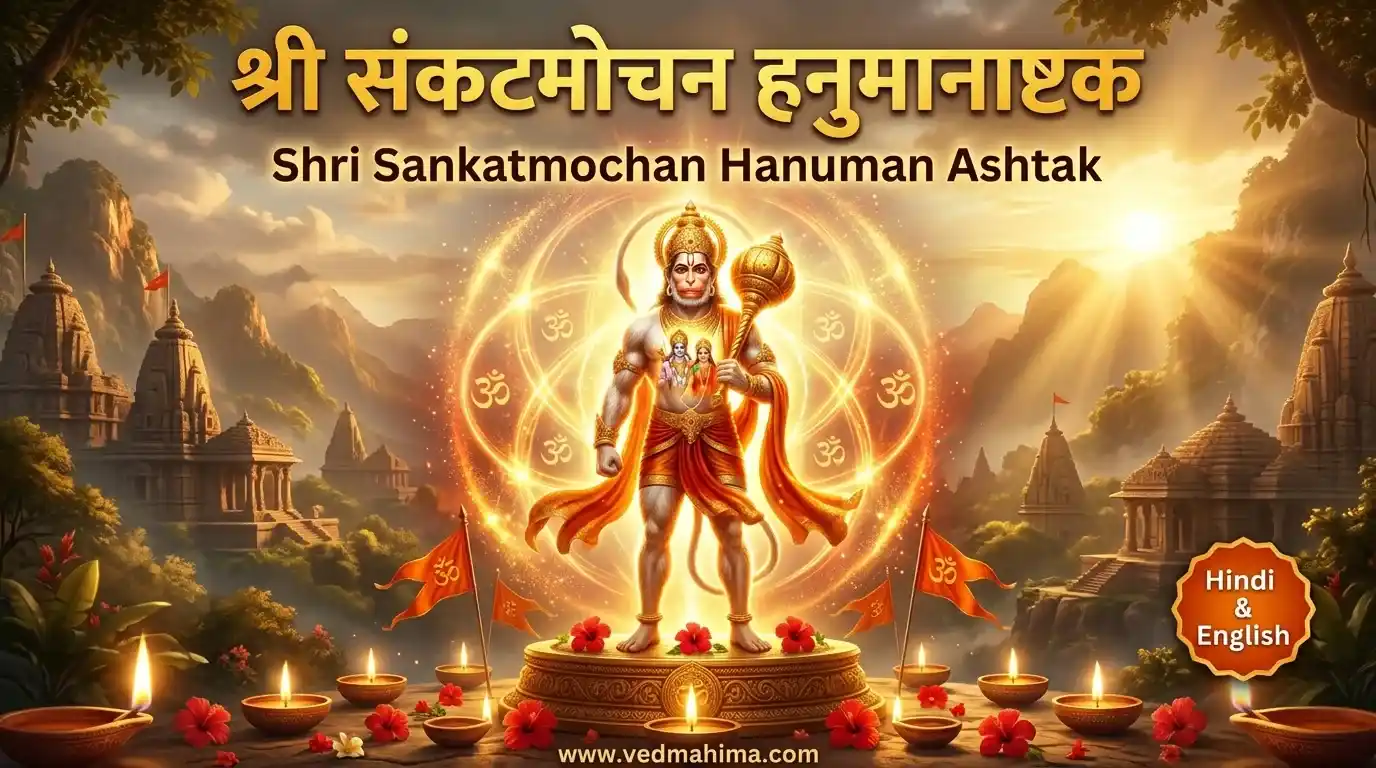
Shri Sankat Mochan Hanumanashtakam
"Baal samay ravi bhakshi liyo," Sanjeevani for Lakshman, Ahiravan vadh, "Ko nahi jaanat hai jag mein Kapi" refrain
Baal samay ravi bhakshi liyo tab,
teeno lok bhayo andhiyaaro.
Taahi son traas bhayo jag ko,
yah sankat kaahu son jaat na taaro.
Devan aani kari binati tab,
chhaandi diyo ravi kasht nivaaro.
Ko nahi jaanat hai jag mein Kapi,
Sankat Mochan naam tihaaro॥1॥
Baali ki traas Kapis basai giri,
jaat mahaaprabhu panth nihaaro.
Chaunki maha muni shaap diyo tab,
chaahiye kaun bichaar bichaaro.
Kai dwij roop livaay mahaaprabhu,
so tum daas ke shok nivaaro.
Ko nahi jaanat hai jag mein Kapi,
Sankat Mochan naam tihaaro॥2॥
Angad ke sang len gaye Siy,
khoj Kapis yeh bain uchaaro.
Jeevat na bachihon hum son ju,
bina sudhi laaye ihaan pagu dhaaro.
Heri thake tat sindhu sabai tab,
laay Siya-sudhi praan ubaaro.
Ko nahi jaanat hai jag mein Kapi,
Sankat Mochan naam tihaaro॥3॥
Raavan traas di Siy ko tab,
raakshasi son kahi shok nivaaro.
Taahi samay Hanuman Mahaaprabhu,
jaay maha rajaneechara maaro.
Chaahat Siy Ashok son aagi su,
dai prabhu mudrika shok nivaaro.
Ko nahi jaanat hai jag mein Kapi,
Sankat Mochan naam tihaaro॥4॥
Baan lagyo ur Lakshman ke tab,
praan taje sut Raavan maaro.
Lai grih vaidy Sushen samet,
tabai giri Dron suveer upaaro.
Aani sanjeevan haath dai tab,
Lakshman ke tum praan ubaaro.
Ko nahi jaanat hai jag mein Kapi,
Sankat Mochan naam tihaaro॥5॥
Raavan yuddh ajaan kiyo tab,
naag ki faans sabai sir daaro.
Shri Raghunath samet sabai dal,
mohe bhayo yah sankat bhaaro.
Aani Khagesh tabai Hanuman ju,
bandhan kaati sutas nivaaro.
Ko nahi jaanat hai jag mein Kapi,
Sankat Mochan naam tihaaro॥6॥
Bandhu samet jabai Ahiraavan,
lai Raghunath paataal sidhaaro.
Devahi pooji bhali vidhi son bali,
dev sabai mili mantr vichaaro.
Jaay sahaay bhayo tab hi,
Ahiraavan sainya samet sanhaaro.
Ko nahi jaanat hai jag mein Kapi,
Sankat Mochan naam tihaaro॥7॥
Kaaj kie bad devan ke tum,
veer Mahaaprabhu dekh bichaaro.
Kaun so sankat mor gareeb ko,
jo tumson nahi jaat hai taaro.
Begi haro Hanuman Mahaaprabhu,
jo kachu sankat hoy hamaaro.
Ko nahi jaanat hai jag mein Kapi,
Sankat Mochan naam tihaaro॥8॥
॥ Doha ॥
Laal deh laali lase,
aru dhari laal langoor.
Vajr deh daanav dalan,
jai jai jai Kapi soor.
About Shri Sankat Mochan Hanumanashtakam
Verse 1: the sun swallowed as a child. The verse says that as a child Hanuman swallowed the sun, the three worlds went dark, the world was afraid and no one could remove the trouble. The gods came and begged, and he let the sun go. In the tradition, the child Hanuman, son of Anjana and the wind god Vayu, saw the red sun at dawn and mistook it for a fruit. He leapt up toward it, and Rahu, who was about to meet the sun that day, was frightened. Indra struck the child on the jaw (hanu) with his thunderbolt, which is how he got the name Hanuman. Vayu, in grief, withdrew the wind from the world, and all beings suffered. The gods then gave the child boons and Vayu returned. The point of the verse is that even in childhood, his power was beyond what the world could handle, and it was released only by the gods'' request.
Verse 2: Sugriva and Bali. The second verse says that Sugriva, in fear of Bali, lived on a mountain and watched the road for the Lord. Bali had been cursed by a sage so that he could not come to that mountain (Rishyamook) without dying. When the king of the monkeys saw two warriors coming, he was afraid and sent Hanuman, who came in the form of a Brahmin, spoke gently, and brought Ram and Lakshman to Sugriva. This was the start of the friendship that led to the search for Sita. The verse says: you removed the sorrow of your servant. It shows Hanuman''s wisdom: he tested the strangers with words and, once sure, brought them in friendship.
Verse 3: the search for Sita. The third verse says that when Angad''s party went to look for Sita, the king of the monkeys had said: do not return alive without news. They searched everywhere and, tired, sat at the shore of the sea. Hanuman then brought Sita''s news and saved their lives. In the tradition, Sampati the vulture told the party that Sita was in Lanka, and Jambavan reminded Hanuman of his strength. Hanuman leapt over the ocean, passed the obstacles of Surasa and Simhika, and found Sita in Lanka. His return with news not only saved the mission, but also the lives of the monkeys who had sworn to give up their lives if they failed.
Verse 4: Sita in Ashok Vatika. The fourth verse says that when Ravan terrified Sita and the rakshasis threatened her, Hanuman came at that time, killed many of the demons and, since Sita in her grief wished for fire from the Ashoka tree, gave her the ring of the Lord and removed her sorrow. In Valmiki''s Ramayana, Sita, in despair, thought of ending her life, and Hanuman, hidden in a tree above, sang the story of Ram softly to bring her comfort. He then dropped Ram''s signet ring, which she recognised, and gave her Ram''s message. He later fought the guards and burned Lanka. The verse celebrates his gentleness with the grieving as well as his valour.
Verse 5: the Sanjeevani herb for Lakshman. The fifth verse says that when Lakshman was struck in the chest by Ravan''s son and lay as if lifeless, Hanuman brought the physician Sushen with his house, then uprooted the mountain, and, bringing the Sanjeevani herb, saved Lakshman''s life. In Valmiki''s Ramayana, Sushen told Hanuman to bring four herbs from the Himalaya, including Sanjeevani, before dawn. Since he could not tell which plant was the herb, Hanuman lifted the whole mountain, and returned in time. Ram embraced him. This is the most famous of the stories, and shows the quality that makes him Sankat Mochan: he does not stop at the limit of what seems possible.
Verse 6: freed from the serpent noose. The sixth verse says that in the war, Ravan''s son bound the whole army, including Ram, with a noose of serpents (Nagapasha), and a great crisis arose. Hanuman brought Khagesh (Garuda, the lord of birds) and the bonds were cut. The Nagapasha is a weapon of serpents, and Garuda, being the enemy of serpents, frees all of them. The verse teaches that the right person for a problem is sometimes someone else, and that a true helper knows whom to call.
Verse 7: Ahiravan in Patal. The seventh verse says that Ahiravan took Ram and Lakshman to Patal, the netherworld, to offer them as a sacrifice to a goddess, and the gods, after worshipping, consulted together. Hanuman went and was a help, and destroyed Ahiravan along with his army. This story is found in later Ramayana traditions and folk retellings, not in Valmiki. In it, Ahiravan (or Mahiravan), a demon king and friend of Ravan, took the brothers by deceit, and Hanuman followed them to Patal, took the form of Panchmukhi (five-faced) Hanuman, put out the five lamps that held the demon''s life and killed him, bringing the brothers back. The verse shows his strength used for the protection of his Lord.
Verse 8: the devotee''s plea. The last verse turns to the devotee. It says: you have done great works for the gods, so what trouble of this poor one can you not remove? Remove quickly, O Hanuman, whatever trouble is ours. It is a short, personal prayer after seven stories of help, and the refrain asks one more time: who in the world does not know your name, Sankat Mochan?
The doha. The closing couplet praises Hanuman as red in body, with a red glow, with a red tail, with a body strong as a thunderbolt, a destroyer of demons, and cries "jai, jai, jai" to the Kapi, the brave one. The red colour is linked to the sindoor that Hanuman is offered.
The wider message. The hymn moves from the child who held the sun, to friend-maker, messenger, healer, rescuer and finally the helper of the devotee. It shows that Hanuman''s strength is always used in service, and that his power is joined with humility, wisdom and devotion to Ram. The word "sankat" means trouble, and the Ashtak is a prayer for courage in difficulty. It is different from the Hanuman Chalisa, which has forty verses of praise, and it pairs well with the Ram Chalisa.
A note on benefits. Tradition holds that Hanuman''s worship brings courage and calm, including in difficult planetary periods such as those linked to Shani. These are matters of faith and a devotional focus, not guarantees. Reading can steady the mind but is not a medical treatment. If fear or anxiety lasts, please also speak to a doctor or a trusted person, and use prayer alongside that help.
How to read it. Read it slowly after a bath, on Tuesday or Saturday, on Hanuman Jayanti, or at a time of worry. Even if you cannot read all eight verses, one or two with attention are enough.
❓ Frequently Asked Questions
Question: What is Sankat Mochan Hanumanashtak?
Answer: It is an eight-verse hymn to Hanuman in the Hindi savaiya style, traditionally attributed to Goswami Tulsidas. Each verse tells one Ramayana story and ends with the refrain "Ko nahi jaanat hai jag mein Kapi, Sankat Mochan naam tihaaro" (who in the world does not know your name, Sankat Mochan). It ends with a short doha.
Question: What is the meaning of Hanumanashtak?
Answer: The eight verses recall: (1) swallowing the sun as a child and the gods'' plea, (2) bringing Ram to Sugriva, who hid from Bali, (3) the search for Sita across the ocean, (4) Sita at Ashok Vatika and Ram''s ring, (5) the Sanjeevani herb for Lakshman, (6) freeing Ram and Lakshman from Nagapasha with Garuda, (7) rescuing them from Ahiravan in Patal, and (8) a plea to remove one''s own troubles. The doha praises Hanuman''s red form and thunderbolt body.
Question: When should I read Hanumanashtak?
Answer: Many people read it after the morning bath, on Tuesday and Saturday, and on Hanuman Jayanti. Some read it in the evening or when they feel worried. Offer a lamp, sindoor or flowers, and read the Hanuman Chalisa with it if you like.
Question: How many times should I recite it?
Answer: The text gives no fixed count. Reading once a day is common, and some read it 8 or 11 times on Tuesdays and Saturdays. Steady, sincere reading matters more than the number.
Question: Is Sankat Mochan Hanumanashtak the same as Hanuman Chalisa?
Answer: No. The Chalisa has forty verses in praise of Hanuman. The Ashtak has eight verses, each recalling a particular rescue, which is why it is called Sankat Mochan, "remover of troubles." Read together, they complement each other (see also the Ram Chalisa).
Question: Does it remove fear, Shani dosha and troubles?
Answer: Tradition holds that Hanuman worship gives courage and calm, including in difficult planetary periods. This is a matter of faith. Reading can steady the mind, but it is not a medical treatment. If fear or anxiety is persistent, please speak to a doctor or a trusted person, and use prayer alongside that help.


