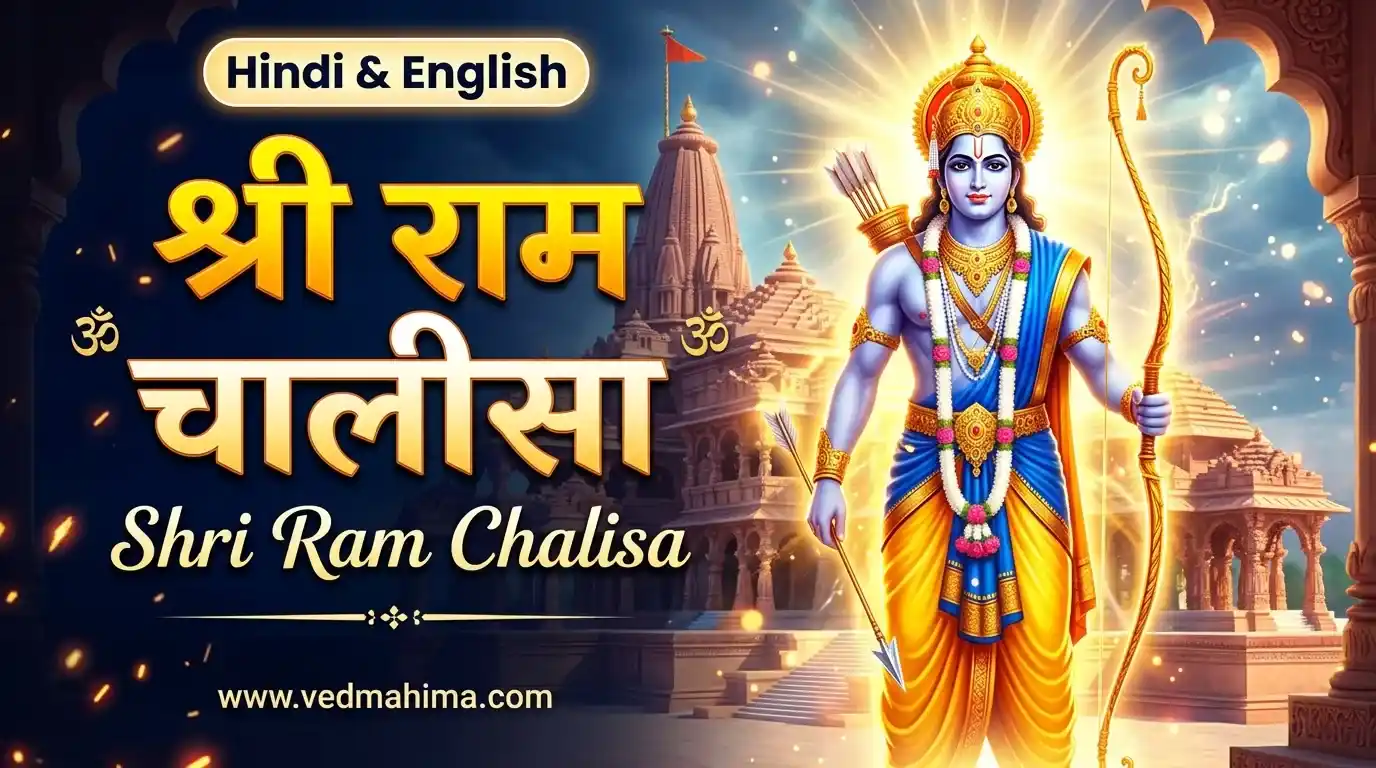
Shri Ram Chalisa
Divinity, Dharma, Truth, Courage, Protection, Devotion
Aadau Ram tapovanadigaman,
hatva mrigam kanchanam.
Vaidehi haranam Jatayu maranam,
Sugriv sambhaashanam.
Bali nigrahanam samudra taranam,
Lanka puri daahanam.
Pashchaat Ravan Kumbhkaran hananam,
etad hi Ramayanam.
॥ Chaupai ॥
Shri Raghuveer bhakt hitkaari,
sun lije prabhu araj hamari.
Nishidin dhyaan dharai jo koi,
ta sam bhakt aur nahin hoi.
Dhyaan dhare Shivji man maahin,
Brahma Indra paar nahin paahin.
Jai jai jai Raghunath kripala,
sada karo santan pratipala.
Doot tumhar veer Hanumana,
jaasu prabhav tihun pur jaana.
Tab bhuj dand prachand kripala,
Ravan maari suran pratipala.
Tum anath ke naath gunsaai,
deenan ke ho sada sahaai.
Brahmadik tav paar na paavain,
sada Ish tumharo yash gaavain.
Chariu ved Bharat hain saakhi,
tum bhaktan ki lajja raakhi.
Gun gaavat Sharad man maahin,
Surpati taako paar na paahin.
Naam tumhar let jo koi,
ta sam dhanya aur nahin hoi.
Ram naam hai aparampaara,
charihu vedan jaahi pukaara.
Ganpati naam tumharo leenho,
tinako pratham pujya tum keenho.
Shesh ratat nit naam tumhara,
mahi ko bhaar sheesh par dhaara.
Phool samaan rahat so bhaara,
paavat kou na tumharo paara.
Bharat naam tumharo ur dhaaro,
taason kabahun na ran mein haaro.
Naam Shatrughan hriday prakaasha,
sumirat hot shatru kar naasha.
Lakhan tumhare aagyaakaari,
sada karat santan rakhwaari.
Taate ran jeete nahin koi,
yuddh jure Yamahu kin hoi.
Mahalakshmi dhar avataara,
sab vidhi karat paap ko chaara.
Sita Ram puneeta gaayo,
Bhuvaneshwari prabhav dikhaayo.
Ghaat son prakat bhai so aai,
jaako dekhat chandra lajai.
So tumre nit paanv palotat,
nav nidhi charanan mein lotat.
Siddhi atharah mangalkaari,
so tum par jaavai balihaari.
Aurahu jo anek prabhutaai,
so Sitapati tumhi banaai.
Ichha te kotin sansaara,
rachat na laagat pal ki baara.
Jo tumhe charanan chit laavai,
taaki mukti avasi ho jaavai.
Jai jai jai prabhu jyoti swaroopa,
nirgun Brahm akhand anoopa.
Mahaty satya jai satyavrat swami,
satya sanatan antaryaami.
Satya bhajan tumharo jo gaavai,
so nishchay chaaron phal paavai.
Satya shapath Gauripati keenhi,
tumne bhaktihin sab siddhi deenhi.
Sunahu naath tum taat hamaare,
tumhi Bharat kul poojya prachaare.
Tumhi dev kul dev hamaare,
tum guru dev praan ke pyaare.
Jo kuchh ho so tum hi raaja,
jai jai jai prabhu raakho laaja.
Ram aatma poshan haare,
jai jai Dashrath raaj dulaare.
Gyaan hriday do gyaan swaroopa,
namo namo jai jagpati bhoopa.
Dhanya dhanya tum dhanya prataapa,
naam tumhaar harat santaapa.
Satya shuddh devan mukh gaaya,
baji dundubhi shankh bajaaya.
Satya satya tum satya sanatan,
tum hi ho hamre tan man dhan.
Yaako paath kare jo koi,
gyaan prakat taake ur hoi.
Aavaagaman mitai tihi kera,
satya vachan maane Shiv mera.
Aur aas man mein jo hoi,
manvaanchhit phal paave soi.
Teenahu kaal dhyaan jo laavai,
Tulsi dal aru phool chadhaavai.
Saag patra so bhog lagaavai,
so nar sakal siddhata paavai.
Ant samay Raghuvarpur jaai,
jahan janam Hari bhakt kahaai.
Shri Haridas kahai aru gaavai,
so Baikunth dhaam ko paavai.
॥ Doha ॥
Saat divas jo nem kar,
paath kare chit laay.
Haridas Hari kripa se,
avasi bhakti ko paay.
Ram Chalisa jo padhe,
Ram charan chit laay.
Jo ichha man mein karai,
sakal siddh ho jaay.
About Shri Ram Chalisa
The Chalisa opens by praising Hanuman as Rama''s devoted messenger (doot), whose influence was felt across all three worlds — a reference to his pivotal role in locating Sita in Lanka and helping secure Rama''s victory over Ravana. It then describes how the mighty and compassionate arms of Rama slew Ravana and protected the gods.
Several verses highlight how Rama''s glory extends even to other deities: Lord Ganesha is said to have taken Rama''s name and was granted the status of Pratham Pujya (first to be worshipped), while Shesh Naga is described as constantly chanting Rama''s name while bearing the entire weight of the earth upon his head — a burden made to feel as light as a flower through devotion to Rama.
The Chalisa also praises Rama''s brothers for their unwavering devotion: Bharata who keeps Rama''s name in his heart and never loses in battle, Shatrughna whose remembrance of Rama destroys enemies, and Lakshmana who remains ever obedient, protecting saints and devotees.
A particularly striking section describes Mata Sita as an incarnation of Mahalakshmi (Bhuvaneshwari), whose radiant presence put even the moon to shame and whose very form destroyed sin. The eighteen auspicious siddhis (spiritual powers) and the nine nidhis (treasures) are described as rolling at Rama''s feet, symbolizing that all prosperity and accomplishment serve him.
Regular recitation of the Shri Ram Chalisa with faith and devotion is believed to bring deep mental peace, emotional stability, and inner strength. It helps remove fear, anxiety, and negative thoughts, while guiding a person toward a more disciplined and righteous life. It is considered especially powerful when recited in the early morning after bathing or during evening Aarti, with Ram Navami and Monday regarded as particularly auspicious occasions.
❓ Frequently Asked Questions
Question: Why is Hanuman called "Doot" (messenger) in this Chalisa?
Answer: The Chalisa refers to Hanuman as Lord Rama''s valiant messenger whose influence was known across all three worlds, reflecting his role in finding Sita and aiding Rama''s victory over Ravana.
Question: Why does the Chalisa say Lord Ganesha took Rama''s name?
Answer: It states that Ganesha adopted Rama''s name and was made "Pratham Pujya" (worshipped first) by him, linking Rama''s glory to the tradition of worshipping Ganesha before any auspicious task.
Question: What does the reference to Shesh Naga bearing the earth mean?
Answer: The Chalisa describes Shesh Naga constantly chanting Rama''s name while carrying the weight of the earth on his head, with that burden feeling as light as a flower because of his devotion.
Question: Why is Sita called an incarnation of Mahalakshmi in this Chalisa?
Answer: The Chalisa describes Sita as a form of Mahalakshmi (Bhuvaneshwari) who emerged with radiance that put even the moon to shame, destroying sin through her divine presence.
Question: What are the 18 siddhis and nine treasures mentioned in the Chalisa?
Answer: The Chalisa states that the eighteen auspicious siddhis (spiritual powers) and nine nidhis (treasures) roll at Lord Rama''s feet, symbolizing that all forms of prosperity serve him.
Question: When should the Ram Chalisa be recited?
Answer: It is most auspicious in the early morning after bathing or during evening Aarti, with Ram Navami and Monday considered especially significant days.


