Shri Ram Stuti (Shri Ramachandra Kripalu Bhaju Mana)
Navkanj-lochan, Khar-Dushan, Sita prayer to Gauri, Tulsidas Vinay Patrika, left-limb omen
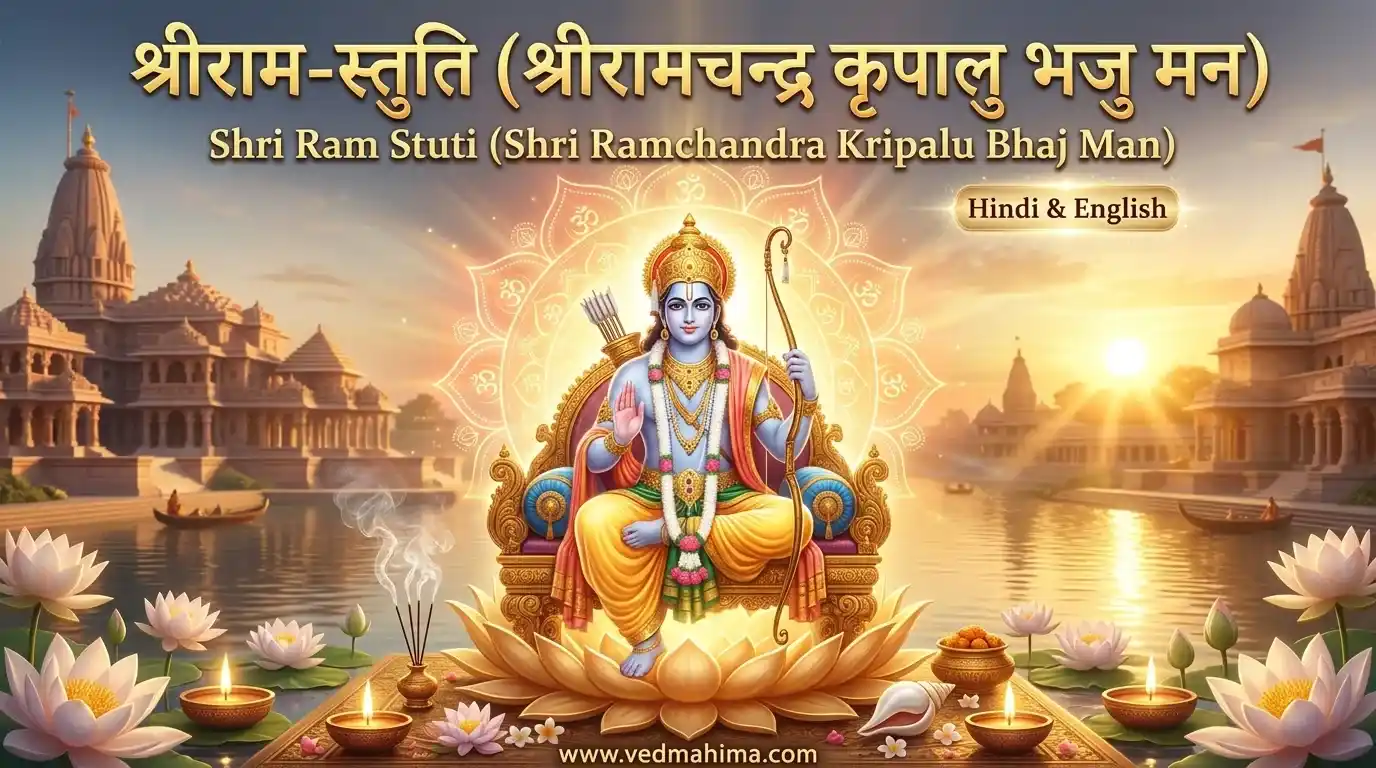
Shri Ramachandra kripalu bhaju man,
haran bhav-bhay daarunam.
Navkanj-lochan, kanj-mukh,
kar-kanj, pad-kanjaarunam.
Kandarp aganit amit chhavi,
nav-neel-neeraj sundaram.
Patpeet maanahun tadit ruchi,
shuchi naumi Janak-sutavaram.
Bhaju deenbandhu dinesh,
daanav-daityavansh nikandanam.
Raghunand anandakand,
Kaushalchandra Dasharath-nandanam.
Sir mukut kundal tilak chaaru,
udaar ang vibhushanam.
Aajaanubhuj shar-chaapdhar,
sangramjit khar-dooshanam.
Iti vadati Tulsidas,
Shankar-Shesh-muni-man-ranjanam.
Mam hriday-kanj nivas kuru,
kaamaadi-khaldal ganjanam.
Manu jahi raacheu milahi so baru,
sahaj sundar saanvaro.
Karuna nidhaan sujaan,
seelu sanehu jaanat raavaro.
Yahi bhaanti Gauri asees suni,
Siy sahit hiy harshi ali.
Tulsidas Bhavani hi pooji puni-puni,
mudit man mandir chali.
॥ Sortha ॥
Jaani Gauri anukool,
Siy hiy harshu na jaai kahi.
Manjul mangal mool,
baam ang pharkan lage.
About Shri Ram Stuti (Shri Ramachandra Kripalu Bhaju Mana)
Verse 1: "Shri Ramchandra kripalu bhaju man." The poet tells his own mind: worship merciful Ramchandra, who removes the dreadful fear of worldly life (bhav-bhay). The Lord has eyes like a fresh lotus (navkanj-lochan), a face, hands and feet like lotus, with the soft red of the dawn lotus (kanj-arunam). The verse sets the aim: to worship with the mind, which is the part that is restless.
Verse 2: his beauty. His beauty is beyond countless Kamadevas (gods of love), and he is as lovely as a fresh blue lotus or dark cloud. His yellow garment shines like lightning against the cloud, and the poet bows to the pure husband of Janaka''s daughter (Sita). The dark body and yellow cloth are the best-known image of Ram.
Verse 3: friend of the lowly. Worship the friend of the humble (deenbandhu), who is like the sun, the destroyer of the lineage of danavas and daityas. He is the joy of the Raghus (Raghunand), the source of bliss (anandkand), the moon of Kaushalya''s line and the son of Dasharath. It shows him as both a protector and a loving son.
Verse 4: his form and his victory. His crown, earrings, tilak and fine ornaments adorn the body. His arms reach his knees (aajanubhuj), he holds an arrow and bow, and he won the battle against Khara and Dushana, the demon brothers of Panchavati. The long arms are a classic mark of a great person in the Indian tradition.
Verse 5: the prayer. "Iti vadati Tulsidas" says: thus says Tulsidas. The Lord delights Shankar, Shesha and the sages, and the poet asks: make your home in the lotus of my heart, and crush the band of wicked foes, desire and the rest (kaamadi khal-dal). The inner enemies of lust, anger, greed, pride and delusion are meant. This is the real request of the hymn.
Verses 6 and 7: Sita''s prayer to Gauri (Balkand). In the Ramcharitmanas, before the swayamvar in Janakpur, Sita goes to the garden to worship Goddess Gauri (Parvati) (see the Gauri Chalisa and Parvati Chalisa). Gauri blesses her: "Manu jahi racheu milahi so baru, sahaj sundar savaro," the groom on whom your heart has settled will be yours, naturally handsome and dark, an ocean of compassion, wise, who knows your character and love. Hearing the blessing, Sita and her companions rejoice, and Tulsi says they worshipped Bhavani again and again and went to the palace happily.
The sortha. Knowing Gauri was favourable, Sita''s joy could not be told, and her left limbs began to throb, which in the traditional reading is a good omen for a woman and the root of lovely auspiciousness (manjul mangal mool).
The wider message. The hymn moves from the mind''s restless worship, to the Lord''s beauty and strength, to a prayer for the heart, and then to the example of Sita''s own pure prayer. Its idea is that steady devotion calms inner enemies and that a pure wish, offered with faith, is heard. The benefits, such as freedom from fear and peace of mind, are matters of faith and a devotional focus. Reading can give calm, but it is not a treatment for illness or anxiety. See also the Ram Chalisa, Sita Chalisa and Hanuman Chalisa.
❓ Frequently Asked Questions
Question: Who wrote Shri Ramchandra Kripalu Bhaju Man?
Answer: It is by Goswami Tulsidas, who names himself in the fifth verse ("Iti vadati Tulsidas"). It is commonly given as a pad from the Vinay Patrika. The last verses, beginning "Manu jahi racheu milahi so baru," are from the Balkand of the Ramcharitmanas and are usually added when the stuti is sung.
Question: What is the meaning of Shri Ramchandra Kripalu Bhaju Man?
Answer: It tells the mind to worship merciful Ramchandra, who removes the fear of worldly life. It praises his lotus-like eyes, face, hands and feet, his beauty beyond countless Kamadevas, his dark cloud-like body and yellow garment, his crown, earrings and long arms, his victory over Khara and Dushana, and asks him to live in the lotus of the heart.
Question: When should I read Ram Stuti?
Answer: Many read it in the morning, at the evening aarti, on Tuesday and Saturday, on Ram Navami (Chaitra Shukla Navami) and on Vivah Panchami (Margashirsha Shukla Panchami). It is also commonly sung as a bhajan.
Question: What is the Gauri prayer part at the end?
Answer: It is from the Balkand. Before the swayamvar, Sita prays to Goddess Gauri in the garden. Gauri blesses her that the groom her heart has chosen will be hers. Sita and her friends rejoice, and Sita feels good omens. See the Gauri Chalisa and Sita Chalisa.
Question: Is Ram Stuti the same as Ram Chalisa or Ram aarti?
Answer: No. The Ram Chalisa has forty verses, and aarti is sung with a lamp. This stuti is a short hymn of praise and prayer, usually sung slowly with a tune.
Question: What are the benefits of reading Ram Stuti?
Answer: The hymn itself asks for freedom from fear and for the Lord to live in the heart, and crush desire and other inner enemies. These are matters of faith and a devotional focus. Reading can bring calm, but it is not a treatment for illness or anxiety, so take proper help for those alongside prayer.


