Shri Banke Bihari Temple Vrindavan
Shri Banke Bihari Temple Vrindavan Darshan Guide
🙏 Devotional
🔥 Powerful
📿 Daily Prayer
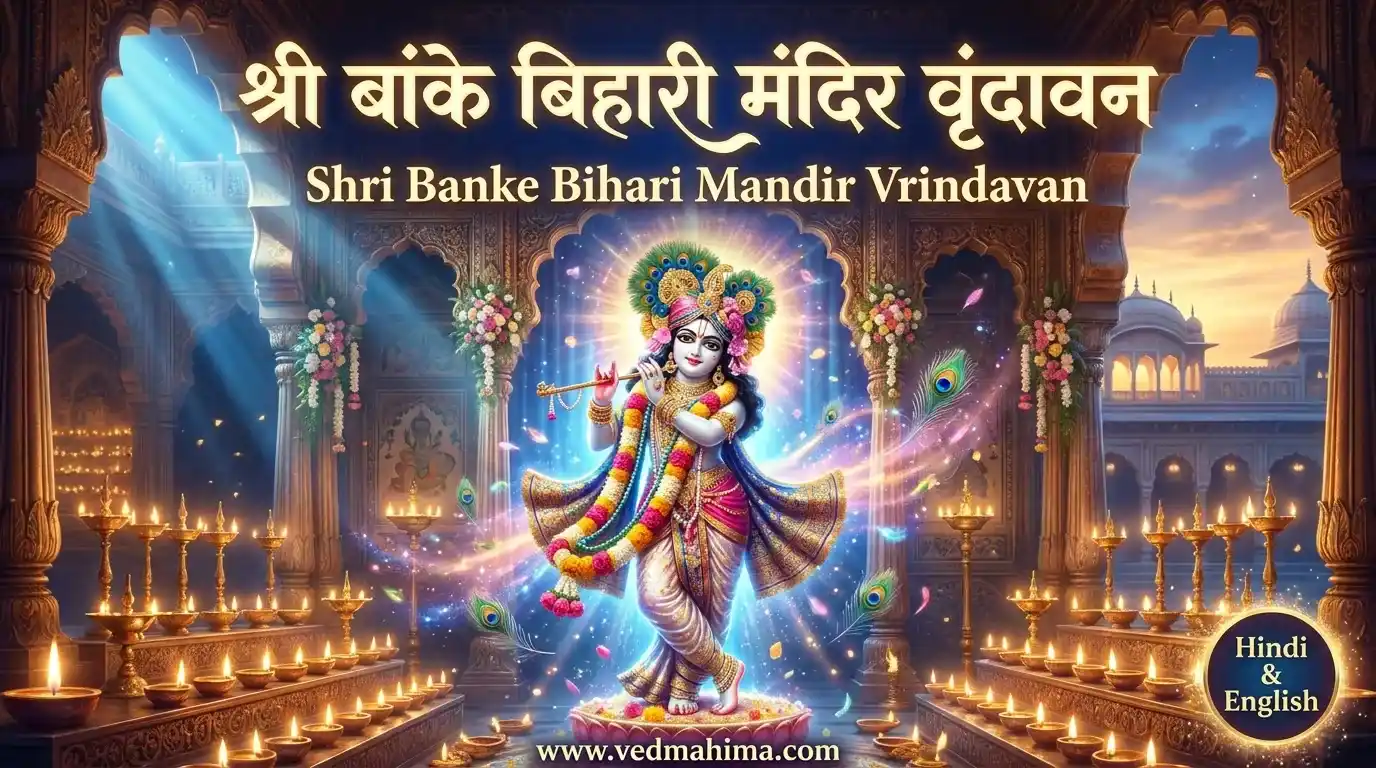
॥ Temple Overview & Divine Glory ॥
Shri Banke Bihari Mandir stands as the radiant, beating spiritual heart of Vrindavan and one of the most intensely revered, historically profound temples of Sanatan Dharma. Located deeply within the narrow, vibrant, mystical lanes of the sacred town of Vrindavan in the Mathura district of Uttar Pradesh, India, this holy shrine is dedicated to Lord Krishna in his combined form with Radharani. The name Banke scripturally signifies bent in three places (the iconic tribhanga posture of Lord Krishna playing the flute—bent at the knees, waist, and neck), while Bihari denotes the supreme enjoyer or wanderer who revels in the divine groves of Braj. The unique monolithic black stone deity housed within the inner sanctum was not carved by human hands; instead, it was miraculously manifested from the spiritual ether by the sheer devotional power of Swami Haridas, the legendary saint-musician and spiritual preceptor of Hindustani classical music. A deeply rooted spiritual protocol dictates that no bells, gongs, or conch shells are ever sounded inside this temple, as they would disturb the tender, child-like tranquility of Bihari Ji. Instead, the atmosphere is continuously electrified by the sweet, thunderous choral chants of Radhe Radhe from millions of ecstatic devotees. A fundamental belief holds that capturing even a single, pure-hearted glance of Banke Bihari Ji's mystical eyes dissolves accumulated material karma, fills the human heart with transcendental divine love, and grants spiritual liberation.॥ Key Spiritual & Structural Aspects ॥
* The Miracle of the Shifting Curtains: The most unique and famous feature of the temple is the continuous closing and opening of the inner sanctum curtains every few minutes by the priests (Goswamis). It is firmly believed that Banke Bihari Ji is so deeply affectionate and responsive that if a devotee looks into his highly expressive, absolute liquid eyes continuously for too long, the Lord will be cast under an intense spell of love and magically leave his altar to follow that devotee home.* The Jhanki (Glance) Darshan Style: Because bells and loud instrumentation are completely forbidden to protect the delicate senses of the deity, the ritualistic adoration happens through rapid, dynamic Jhanki (short glimpses). The priests keep the curtains in perpetual, rhythmic motion, creating a high-energy environment of anticipation and ecstatic devotion.
* The Divine Charanamrit (Sacred Nectar): The holy feet of Banke Bihari Ji remain hidden behind heavy silk curtains and floral ornamentation throughout the entire year. Devotees can only catch a glimpse of the Lord's sacred feet on the auspicious day of Akshaya Tritiya. The liquid nectar used to wash the deity is distributed as a powerful spiritual medicine that cures inner afflictions.
* The Eternal Flute Display: Unlike other traditional Krishna temples, the deity here does not hold a permanent flute. Banke Bihari Ji is offered and holds his special golden flute exclusively on the single night of Sharad Purnima (the autumn full moon night), accompanied by special royal white attire and multi-tier crown crowns.
॥ The Detailed Divine Ritual & Aarti Cycle ॥
The daily administrative timeline of Banke Bihari Mandir is split into two primary phases (Morning and Evening), varying precisely across the summer and winter solstices under centuries-old Braj traditions:1. Shringar Aarti (07:45 AM - 08:00 AM in Summer / 08:45 AM - 09:00 AM in Winter): The beautiful morning awakening and ornamentation ritual. The Lord is dressed in magnificent seasonal garments and adorned with fresh, heavy garlands of roses, jasmine, and tulsi. It is highly unique because there is no Mangala Aarti (early pre-dawn aarti) here; Swami Haridas established that waking a child-form Lord too early would cause him physical strain.
2. Rajbhog & Main Aarti (11:55 AM - 12:30 PM in Summer / 12:55 PM - 01:30 PM in Winter): The grand midday royal feast offering. A highly rich assortment of traditional sweets, pure milk cakes, kheer, saffron rice, and specialized Braj delicacies is formally presented to the Lord, followed by a grand musical aarti before the afternoon closure.
3. Utthapan & Evening Opening (05:30 PM - 09:30 PM in Summer / 04:30 PM - 08:30 PM in Winter): The dynamic evening twilight assembly. The temple gates re-open to a massive influx of global travelers, featuring continuous short-interval aartis, heavy incense waving, and mass devotional singing.
4. Shayan Aarti (09:25 PM - 09:30 PM in Summer / 08:25 PM - 08:30 PM in Winter): The final night ritual. A special bedside offering of refreshing betel leaves (Paan) and water is kept on the altar, and soothing lullabies are sung by the Goswami clan to ease the Lord into deep celestial rest before the outer heavy doors are locked.
॥ Deep Architectural Landscape & Layout ॥
The temple structure standing today was constructed in 1862 AD, presenting a brilliant and grand example of the traditional Rajasthani and contemporary North Indian architectural styles. Built using premium quality red sandstone, the building features beautifully arched entryways, intricately carved stone balconies, and broad, open-faced interior courtyards designed to accommodate massive crowds. The inner sanctum is lined with premium white marble and mirrors that reflect the brilliant gold and diamond jewelry of the deity. Due to its location in the historic heritage core of Vrindavan, the temple is surrounded by narrow pedestrian-only alleys. The temple management trust has established dedicated entry and exit pathways (Gates 1 to 5) to systematically regulate high-volume pedestrian circulation and prevent overcrowding during peak rush hours.॥ Major Festivals Celebrated ॥
* Braj Ki Holi (The Ultimate Color Festival): Banke Bihari Mandir is the absolute global epicenter of Holi celebrations. Spanning several days during Spring, the Goswami priests shower millions of devotees with pure herbal gulal, saffron water, and fresh rose petals directly from the inner sanctum, accompanied by specialized Samaj Gayan (classical folk singing).* Hariyali Teej: Celebrated during the peak monsoon season, the entire temple is decorated in a breathtaking emerald-green theme. Banke Bihari Ji is brought out of the sanctum and placed on a magnificent, massive golden-silver swing (Jhula) in the outer courtyard, drawing millions of international travelers.
* Bihar Panchami (Prakatotsav): The grand anniversary of the day the deity miraculously manifested before Swami Haridas in the holy grove of Nidhivan. The day is celebrated with a massive royal procession from Nidhivan to the main temple, continuous Chhappan Bhog offerings, and distribution of special milk sweets.
॥ How to Reach Shri Banke Bihari Mandir Vrindavan ॥
Vrindavan is highly accessible and perfectly linked to major national transport networks via extensive modern expressways and railways:* By Air (Flights): The closest international and domestic gateway is the Indira Gandhi International Airport (DEL) in New Delhi, located approximately 165 kilometers away, which connects directly to Vrindavan via the high-speed 6-lane Yamuna Expressway. The upcoming Noida International Airport at Jewar will reduce this distance to just 75 kilometers. High-grade prepaid airport taxis and state luxury tourist coaches operate continuously from the terminals to Vrindavan entry zones.
* By Train (Railways): The primary rail gateway is the Mathura Junction Railway Station (MTJ), located barely 12 kilometers away from Vrindavan. Mathura is a massive central railway hub connected to New Delhi, Mumbai, and Kolkata via high-speed Shatabdi, Vande Bharat, and superfast express lines. From Mathura Junction, eco-friendly e-rickshaws, shared auto-rickshaws, and private cabs are available round-the-clock to drop pilgrims directly at the Vrindavan multi-level parking complex.
* By Road (Highways): Vrindavan sits beautifully just off the world-class Yamuna Expressway and National Highway 19 (Delhi-Agra Highway). Regular air-conditioned luxury Volvo sleeper coaches run non-stop from New Delhi (Anand विहार), Agra, Lucknow, and Jaipur directly to the Chatikara and Vrindavan entry points. To maintain peace and cleanliness, all private outstation vehicles are rerouted to mega parking grounds at the city periphery, from where eco-friendly e-rickshaws drop pilgrims directly outside the temple lanes.
🙏 ॥ Thus completed ॥ 🙏
The Hindi text has been compiled based on original and authentic sources. If there is any difference,
error, or inconsistency between the Hindi and English versions, the Hindi text shall be considered the
authoritative version. If there are any errors or copyright-related concerns regarding this content,
please contact us.
📜 प्रामाणिक स्रोत:
📖 सार्वजनिक रूप से उपलब्ध स्रोत
📖 आधिकारिक मंदिर रिकॉर्ड
📖 सरकारी पोर्टल
📖 सत्यापित ऑनलाइन संदर्भ
About Shri Banke Bihari Temple Vrindavan
The history of Shri Banke Bihari Mandir is a divine chronicle steeped in classical music, high mysticism, and absolute devotion. The holy deity originally manifested in the early 16th century in the sacred, dense forest of Nidhivan before Swami Haridas, a topmost saint of the Nimbarka Sampradaya and the musical guru of royal singer Tansen. Swami Haridas used to sit in Nidhivan and sing divine classical verses praising the celestial couple Radha-Krishna. Moved by his sublime musical meditation, the Divine Couple physically appeared before him. To protect the mortal world from being blinded by their combined cosmic effulgence, Swami Haridas requested them to merge into a single form. Thus, the black stone deity of Banke Bihari Ji manifested. For over three centuries, the deity was served in a hidden format inside Nidhivan. In 1862 AD, with the financial contribution of wealthy devotees and under the direct supervision of the Goswami clan, the present magnificent temple was constructed, and the Lord was formally shifted from his sylvan grove to this grand urban palace.