Shri Dwarkadhish Temple Dwarka
Shree Dwarkadhish Temple Dwarka Darshan Guide
🙏 Devotional
🔥 Powerful
📿 Daily Prayer
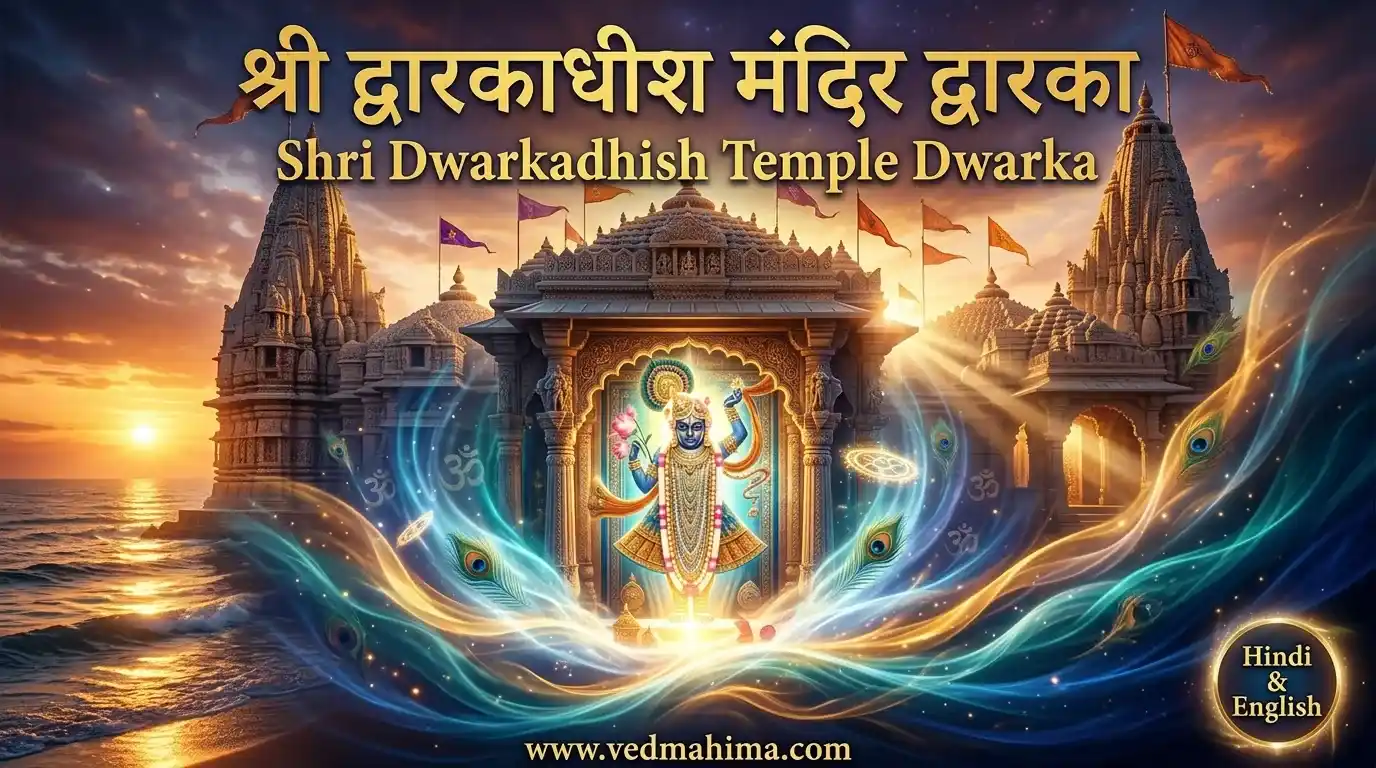
॥ Temple Overview & Divine Glory ॥
Shri Dwarkadhish Temple, also universally celebrated as Jagat Mandir (Universal Shrine), stands majestically on the banks of the holy Gomti River where it merges into the vast Arabian Sea in Dwarka, Gujarat. As an essential and highly sacred pillar of the pan-Indian Char Dham circuit, this 2500-year-old architectural masterpiece is dedicated to Lord Krishna, who is worshipped here as the ultimate King of Dwarka (Dwarkadhish). The inner sanctum houses a magnificent, four-armed deity of Lord Krishna carved out of premium black marble, holding the cosmic conch, discus, mace, and lotus. Revered in the Puranas as the ancient capital of Krishna's terrestrial empire, Dwarka is an intense vortex of pure spiritual liberation. Taking a complete Darshan of the Lord standing under the majestic multi-pillared dome is believed to cut through deep lifetimes of worldly attachment, eliminate all financial delays, and bestow immediate inner peace and ultimate salvation.॥ Key Spiritual & Structural Aspects ॥
* The Chalukyan Architecture & Spire: The main 5-story temple structure is supported by 72 heavy sandstone pillars, constructed without any structural iron elements. The towering 78-meter-high spire (Shikhara) dominates the coastal skyline.* The Divine 52-Yard Flag (Dhvajaji): The massive silk flag fluttering atop the spire is precisely 52 yards in length, representing the 56 principal administrative dynasties of Yadav clans (minus the 4 divine forms). The flag features symbols of the sun and moon and is ritually changed 5 times daily by hereditary climbers using complex pulley networks.
* The Two Swarg and Moksha Gateways: Pilgrims traditionally enter the temple through the northern Moksha Dwara (Gateway to Liberation) and exit down toward the Gomti River ghats via the southern 56-step Swarga Dwara (Gateway to Heaven).
* Submerged Kingdom Context: The modern temple sits adjacent to the profound archaeological marine site where the original golden city of Dwarka, built by the divine architect Vishwakarma, sank beneath the sea after Lord Krishna left his mortal body.
॥ The Actual Ritualistic Cycle: Authentic Daily Pujas & Schedules ॥
The daily worship protocol at Dwarka follows ancient Vaishnavite traditions with deep royal court decorum. The established public and spiritual windows are:1. Mangla Aarti (06:30 AM): The highly auspicious first morning prayer where the Lord is gently awakened. The main gates open and camphor lamps are lit to grant the initial grand dynamic view to thousands of waiting pilgrims.
2. Snan Bhog & Shringar Aarti (08:00 AM - 11:00 AM): The daily ritualistic bath of the deity, followed by a formal royal wardrobe change and the Shringar Aarti where the Lord is adorned with flawless diamonds and fresh garlands.
3. Gval Bhog & Rajbhog Closure (11:30 AM - 01:00 PM): The primary noon feast containing continuous courses of traditional sweets and grains. The temple gates close at 01:00 PM for the Lord's afternoon rest.
4. Utthapan & Sandhya Aarti (05:00 PM - 07:30 PM): The evening reopening ritual where the Lord wakes from rest. This is followed by the spectacular twilight Sandhya Aarti accompanied by the deep ringing of bronze gongs and blowing of traditional conches.
5. Shayan Aarti & Night Lock (08:30 PM - 09:30 PM): The final night ritual where the Lord is offered sweet milk, dressed in light comfortable garments, and put to rest as the inner sanctum doors lock for the night.
॥ Detailed Code of Conduct & Pilgrimage Guidelines ॥
* Strict Dress Code Mandate: To preserve the historical decorum and high spiritual energy of the Jagat Mandir, all visiting pilgrims must dress in traditional and decent clothing. Men must wear a Dhoti-Kurta or a standard Kurta with Pajamas/Trousers. Women must wear a traditional Saree, Half-Saree, or a modest Salwar-Kameez with a compulsory Dupatta. Contemporary Western casuals like short trousers, ripped jeans, miniskirts, or sleeveless tops are strictly banned inside the main entry checkpoints.* Absolute Mobile Phone & Camera Prohibition: To safeguard the high-security coastal border infrastructure and maintain inner peace, mobile phones, cameras, smartwatches, and all electronics are completely banned inside the temple walls. Pilgrims must safely deposit all gadgets at the secure free locker counters operating right outside the main Moksha Dwara entry point.
* Footwear Protocol: Shoes and sandals must be completely removed and kept at the centralized shoe stands near the entrance gates before climbing the holy steps.
॥ Major Festivals Celebrated In Colossal Scale ॥
* The Janmashtami Maha-Utsav: This marks the absolute peak of grand celebrations in Dwarka during August–September. The entire coastal city is illuminated in gold, and over half a million global devotees arrive to witness the grand midnight birth celebration, special historical Mahabhog, and the unique change of the golden Dhvajaji.* Holi / Dhuleti Utsav: Celebrated with massive spiritual fervor as the Festival of Colors where thousands of devotees from Rajasthan and Gujarat walk hundreds of kilometers on foot to play colors with their King, Dwarkadhish.
॥ Comprehensive Routing Guide: How to Reach Dwarka Dham ॥
* By Air (Detailed Flight Route): The closest commercial air gateway is Jamnagar Airport (JGA), located approximately 137 kilometers east of Dwarka. It hosts regular direct flights from major Indian hubs like Mumbai and New Delhi. Alternatively, Rajkot International Airport (HSR) is situated 230 kilometers away. From either airport, pilgrims can easily hire pre-paid luxury SUVs or private air-conditioned cabs that travel down the smooth 4-lane Jamnagar-Dwarka National Highway (NH-947) in roughly 2.5 to 4 hours.* By Train (Detailed Railway Network): Dwarka Railway Station (DWK) is a highly central junction situated on the broad-gauge railway network. It is directly connected via long-distance superfast expresses and high-speed Vande Bharat Express trains from Mumbai, New Delhi, Ahmedabad, Kolkata, and Jamnagar. The station is located just 2.5 kilometers away from the main temple, with 24/7 availability of auto-rickshaws and local shared eco-vans.
* By Road (Detailed Highway Navigation): Dwarka is connected via the beautifully maintained National Highway 947. The Gujarat State Road Transport Corporation (GSRTC) runs a continuous fleet of luxury AC Volvo, sleeper, and express buses from Ahmedabad, Rajkot, Jamnagar, and Somnath directly to the Dwarka central bus stand.
🙏 ॥ Thus completed ॥ 🙏
The Hindi text has been compiled based on original and authentic sources. If there is any difference,
error, or inconsistency between the Hindi and English versions, the Hindi text shall be considered the
authoritative version. If there are any errors or copyright-related concerns regarding this content,
please contact us.
📜 प्रामाणिक स्रोत:
📖 सार्वजनिक रूप से उपलब्ध स्रोत
📖 आधिकारिक मंदिर रिकॉर्ड
📖 सरकारी पोर्टल
📖 सत्यापित ऑनलाइन संदर्भ
About Shri Dwarkadhish Temple Dwarka
The celestial history of Dwarka is deeply rooted in the Dwapara Yuga of sanatan tradition. To protect his citizens from the continuous, ruthless attacks of King Jarasandha of Magadha, Lord Krishna left Mathura and established a majestic, heavily fortified naval kingdom here named Dwarka, fully reclaimed from the Arabian Sea. Following the departure of Lord Krishna from the earthly realm and the subsequent submergence of the golden city, his great-grandson, Vajranabh, constructed the original stone temple over the Lord's residential palace site (Hari Griha) around 2500 years ago. Historically, the temple structure was expanded by subsequent dynasties. In the 8th century AD, the great philosopher-saint Adi Shankaracharya visited the temple and established the famous Dwarka Sharada Peetham here, making it one of the four absolute seats of Hindu monastic order. Despite facing historical foreign invasions, the temple was consistently rebuilt and fortified by the local rulers and devotees, standing today as an immortal capital of global Krishna consciousness.