Goddess Revati
Goddess Revati, wife of Lord Balarama, Brahmaloka and the mystery of time, marriage story, Revati Nakshatra and temple in Baldev
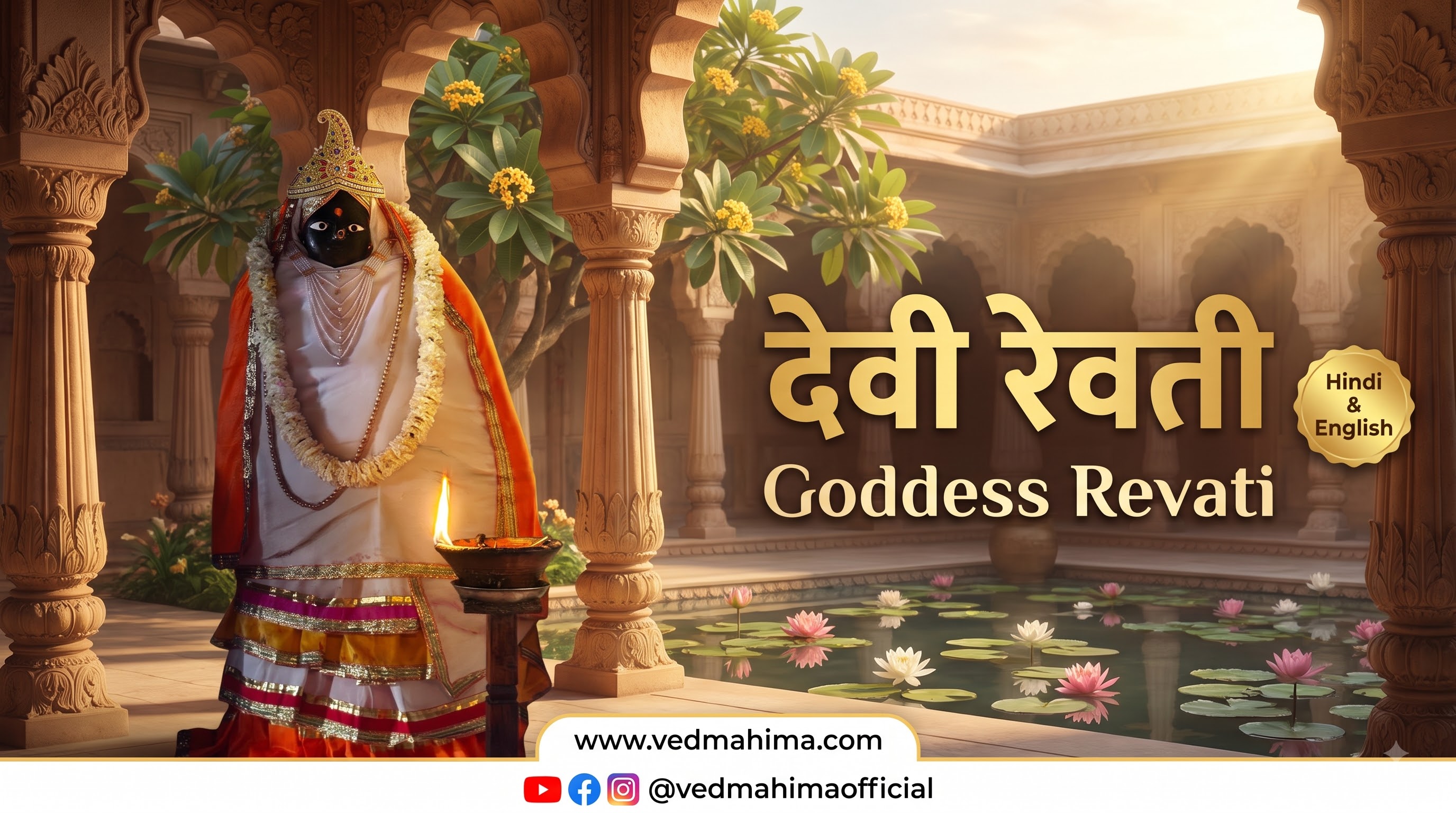
Goddess Revati holds special religious and cultural significance in Sanatan Hindu Dharma and Indian mythological traditions. Goddess Revati is known as the consort of Lord Balarama. Lord Balarama, also known as Balabhadra and Sankarshana, is the elder brother of Lord Shri Krishna and one of the most revered figures in Hinduism. The relationship between Lord Balarama and Goddess Revati holds an important place in Hindu mythology. Goddess Revati is particularly mentioned in the mythological account associated with King Kakudmi, the journey to Brahmaloka, and the passage of time across different Yugas. Therefore, her story is not limited to her marriage to Lord Balarama; it also explores the concept of time, the differences between Yugas, and important aspects of ancient Indian religious beliefs.
In Hindu mythological traditions, Goddess Revati is associated with devotion to her husband, righteousness, dedication, and family values. As the wife of Lord Balarama, she holds an important place in accounts related to his life and associated mythological events. Her character provides a traditional reference for understanding the significance of marriage, married life, and religious duties in Indian culture. Stories associated with Goddess Revati also illustrate how Hindu scriptures describe Dharma, time, duty, and various aspects of life through the accounts of deities and other revered figures.
Principal Names and Forms of Goddess Revati
Goddess Revati is well known in Sanatan Hindu mythological traditions as the wife of Lord Balarama. Her significance is associated with her marriage, family relationships, and the story of King Kakudmi''s journey to Brahmaloka. In religious and mythological accounts, Goddess Revati is identified through the following names and descriptions that reflect her traditional identity:
- Revati: Revati is the commonly used name of the goddess. In Hindu mythology, she is known as the daughter of King Kakudmi and the wife of Lord Balarama. Her story particularly includes the journey to Brahmaloka, the difference in the passage of time, and her marriage to Lord Balarama.
- Wife of Lord Balarama: Goddess Revati is primarily identified as the wife of Lord Balarama. Lord Balarama is also known by names such as Balabhadra and Sankarshana. Consequently, Goddess Revati is mentioned in accounts concerning Lord Balarama''s marriage and related mythological traditions.
- Daughter of King Kakudmi: Goddess Revati is also identified through her father, King Kakudmi. According to the traditional account, King Kakudmi travelled to Brahmaloka in search of a suitable groom for his daughter. This story includes the episode of Goddess Revati''s marriage to Lord Balarama.
The Marriage of Goddess Revati and Lord Balarama
The marriage of Goddess Revati and Lord Balarama (Baladau Ji) is described in Hindu mythological literature, particularly the Srimad Bhagavata Mahapurana and the Vishnu Purana, as a remarkable and extraordinary episode.
According to the traditional account, King Kakudmi (Raivata) ruled the kingdom of Anarta, associated with the present-day Gujarat and Dwarka region. His daughter Revati was renowned for her beauty, good conduct, and admirable qualities. When Princess Revati reached marriageable age, King Kakudmi began searching for a suitable and worthy groom for her. He considered numerous kings and princes across the Earth but could not find anyone whom he considered a suitable match for Revati''s exceptional qualities and upbringing.
To seek guidance in choosing a suitable groom, King Kakudmi travelled directly to Brahmaloka, the abode of Lord Brahma, accompanied by his daughter Revati. At that time, the celestial musicians Haha and Huhu were presenting a melodious musical performance and dance in Brahmaloka. King Kakudmi respectfully waited until the performance had concluded.
After the performance, King Kakudmi bowed before Lord Brahma and presented the names of several eligible kings and princes on Earth. He then asked Lord Brahma which of them would be a suitable husband for his daughter Revati.
Lord Brahma smiled gently upon hearing King Kakudmi''s question and explained that the kings, their sons, and their grandsons whose names he had mentioned had already passed away due to the influence of time. A moment in Brahmaloka corresponded to many Chaturyugas, or Mahayugas, on Earth. While King Kakudmi had been listening to the celestial music, vast periods of time had passed on Earth, and the world had changed considerably. The rulers he had considered were no longer alive, and their dynasties and societies had undergone profound changes.
King Kakudmi was astonished and concerned upon hearing Lord Brahma''s explanation. Lord Brahma then reassured him and advised him that Lord Balarama (Balabhadra), regarded in this tradition as an incarnation of Ananta Shesha and associated with Lord Vishnu, had appeared on Earth. He recommended Lord Balarama as a suitable husband for Revati and instructed King Kakudmi to return to Earth and arrange their marriage.
Change in Height and the Marriage Ceremony
Following Lord Brahma''s advice, King Kakudmi returned to Earth with his daughter Revati during the Dvapara Yuga. Upon their return, they found that human height, strength, and lifespan had diminished with the passage of ages. Since Goddess Revati belonged to an earlier age, her height and physical stature were much greater than those of ordinary people living during the Dvapara Yuga.
King Kakudmi met Lord Balarama and, following Lord Brahma''s advice, proposed that he marry his daughter. Lord Balarama gladly accepted the proposal. However, when he noticed that Revati''s stature was unusually large compared with that of people of the Dvapara Yuga, he performed a divine act.
According to the traditional account, Lord Balarama used his plough to gently press Revati''s shoulders, bringing her stature into proportion with the people of the Dvapara Yuga. Thereafter, King Kakudmi arranged the marriage of Goddess Revati and Lord Balarama according to the prescribed rituals and Vedic customs. After the marriage, King Kakudmi departed for Badarikashrama to undertake austerities.
Goddess Revati''s Sons and Daughter
After their marriage, Goddess Revati lived with Lord Balarama in Dwarka and fulfilled her traditional role as his wife. Some mythological and regional traditions describe two sons and a daughter associated with Lord Balarama and Goddess Revati:
- Son Nishatha: Nishatha is identified in some traditional accounts as a son of Lord Balarama and Goddess Revati. He is described as a powerful warrior. Details about his role and activities should be understood according to the particular scriptural or regional source being followed.
- Son Ulmuka: Ulmuka is also identified in traditional accounts as a son of Lord Balarama and Goddess Revati. Some accounts associate him with the Yadava lineage. Specific claims about his military achievements depend on the source.
- Daughter Sulekha: Some regional folk traditions identify a daughter of Lord Balarama and Goddess Revati by the name Sulekha, while certain retellings use the name Shashirekha. These names are associated with regional narrative traditions and should not be treated as universally established across all Hindu scriptures.
Temple of Goddess Revati and Major Religious Sites
Shri Dauji Maharaj Temple, Baldev: Located in Baldev in the Mathura district of Uttar Pradesh, Shri Dauji Maharaj Temple is an important religious site associated with Lord Balarama and his consort, Goddess Revati. Images of Lord Dauji Maharaj and Goddess Revati are enshrined in the temple. The nearby Kshirsagar Kund, also known as Balabhadra Kund, is an important part of Baldev''s religious identity. The temple''s major celebrations include Dauji Huranga and the festival commemorating the birth of Lord Balarama, both of which attract large numbers of devotees.
Revati Kund, Junagadh: Revati Kund is an ancient religious site located near Mount Girnar in Junagadh, Gujarat. Local mythological traditions associate it with King Revata and his daughter, Goddess Revati. Nearby Damodar Kund and Shri Radha Damodar Temple are also important religious sites in the area. Mount Girnar and the surrounding pilgrimage sites form an important part of Gujarat''s religious and cultural heritage.
Religious Content Related to Goddess Revati and Lord Balarama
The following stotras, devotional hymns, and mantras are associated with the worship of Lord Balarama and related devotional traditions:
About Goddess Revati
Revati is remembered as a model of patience, dignity and family devotion. To read about the discovery of the deities of Dauji Maharaj and Mata Revati at Baldev, see Goswami Shri Kalyan Devacharya Ji. Accounts of temples, holy places and local hymns vary across sources, so details should be read in their religious and cultural context.
❓ Frequently Asked Questions
Question: Who is Goddess Revati?
Answer: Goddess Revati is the wife of Lord Balarama, the elder brother of Lord Krishna, and the daughter of King Kakudmi (Raivata). Some traditions see her as a form or companion of Goddess Lakshmi, while the Bhagavata and Vishnu Puranas present her mainly as the princess whose marriage story shows how differently time flows in different realms.
Question: Why did King Kakudmi take Revati to Brahmaloka?
Answer: He could not find a groom worthy of his daughter among the kings he knew, so he went to Lord Brahma for guidance. He waited politely while Brahma listened to the Gandharvas'' music, and only then asked his question.
Question: What was the mystery of time that Brahma revealed?
Answer: Brahma told him that during that short wait, twenty-seven Chaturyugas had passed on Earth, so every king he had in mind was gone. The Bhagavata Purana (Ninth Canto) tells this story to show that time does not move the same way in every realm.
Question: How did Balarama adjust Revati''s height?
Answer: Revati came from an earlier age and was much taller than the people of Dvapara Yuga. According to the Puranic story, Lord Balarama used the end of his plough (hala) to bring her to the stature of that age, after which the marriage took place. This is symbolic Puranic storytelling about the difference between ages.
Question: Who were the children of Balarama and Revati?
Answer: The Bhagavata tradition names two sons, Nishatha and Ulmuka. Other texts and local traditions give different names, so the details depend on the source.
Question: Is Goddess Revati the same as Revati Nakshatra?
Answer: They share a name but are treated separately. In Vedic astrology Revati is the 27th and last nakshatra, ruled by Mercury (Budh), with Pushan as its deity. Beliefs about its effects are part of astrological tradition and are not scientifically established.
Question: Where is Goddess Revati worshipped along with Dauji Maharaj?
Answer: At the Dauji Maharaj Temple in Baldev, Mathura, Dauji Maharaj and Mata Revati are worshipped together. Their discovery and first installation are told on the page of Goswami Shri Kalyan Devacharya Ji. Some local traditions also link Junagadh and a Revati Kund with her story, which is best checked with local sources.