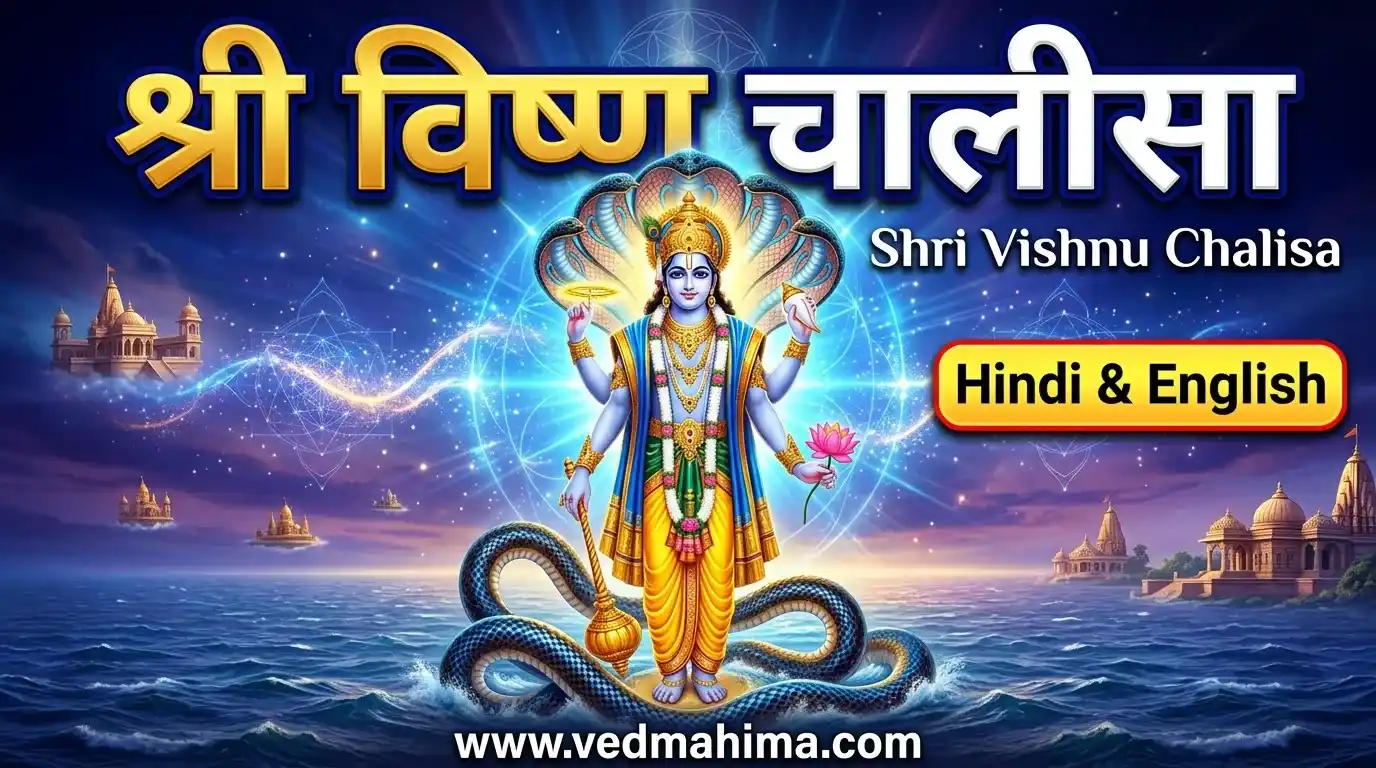
Shri Vishnu Chalisa
Preservation, Protection, Peace, Prosperity, Divine Grace
Vishnu suniye vinay,
sevak ki chitalay.
Kirat kuchh varnan karun,
deeje gyaan batay.
॥ Chaupai ॥
Namo Vishnu Bhagwan Kharari,
kasht nashaavan akhil bihari.
Prabal jagat mein shakti tumhari,
tribhuvan phail rahi ujiyari.
Sundar roop manohar surat,
saral swabhav mohni moorat.
Tan par peetambar ati sohat,
baijanti mala man mohat.
Shankh chakra kar gada biraaje,
dekhat daitya asur dal bhaaje.
Satya dharm mad lobh na gaaje,
kaam krodh mad lobh na chhaaje.
Sant bhakt sajjan manranjan,
danuj asur dushtan dal ganjan.
Sukh upjaay kasht sab bhanjan,
dosh mitaay karat jan sajan.
Paap kaat bhav sindhu utaaran,
kasht nashkar bhakt ubaaran.
Karat anek roop Prabhu dhaaran,
keval aap bhakti ke kaaran.
Dharani dhenu ban tumhi pukaara,
tab tum roop Ram ka dhaara.
Bhaar utaar asur dal maara,
Ravan aadik ko sanhaara.
Aap Varaah roop banaaya,
Hiranyaksha ko maar giraaya.
Dhar matsya tan sindhu majhaaya,
chaudah ratnan ko nikalaaya.
Amilakh asuran dvand machaaya,
roop Mohini aap dikhaaya.
Devan ko amrit paan karaaya,
asuran ko chhavi se bahlaaya.
Kurm roop dhar sindhu majhaaya,
Mandarachal giri turat uthaaya.
Shankar ka tum phand chhudaaya,
bhasmasur ko roop dikhaaya.
Vedon ko jab asur dubaaya,
kar prabandh unhe dhoondhavaaya.
Mohit bankar khalahi nachaaya,
ushi kar se bhasm karaaya.
Asur Jalandhar ati baldaayi,
Shankar se un keenh ladai.
Haar paar Shiv sakal banaayi,
keen sati se chhal khal jaayi.
Sumiran keen tumhein Shivrani,
batlaayi sab vipat kahani.
Tab tum bane Muneeshwar gyani,
Vrinda ki sab surati bhulaani.
Dekhat teen danuj shaitani,
Vrinda aay tumhein laptaani.
Ho sparsh dharm kshati maani,
hana asur ur Shiv shaitani.
Tumne Dhruv Prahlad ubaare,
Hiranyakush aadik khal maare.
Ganikaa aur Ajaamil taare,
bahut bhakt bhav sindhu utaare.
Harahu sakal santaap hamaare,
kripa karahu Hari sirjan haare.
Dekhahun main nij darash tumhaare,
deen bandhu bhaktan hitkaare.
Chahat aapka sevak darshan,
karahu daya apni Madhusudan.
Jaanun nahin yogya jap poojan,
hoy yagya stuti anumodan.
Sheel daya santosh sulakshan,
vidit nahin vratbodh vilakshan.
Karahun aapka kis vidhi poojan,
kumati vilok hot dukh bheeshan.
Karahun pranam kaun vidhi sumiran,
kaun bhaanti main karahun samarpan.
Sur muni karat sada sewaai,
harshit rahat param gati paai.
Deen dukhin par sada sahaayi,
nij jan jaan lev apnaai.
Paap dosh santaap nashaao,
bhav-bandhan se mukt karaao.
Sukh sampatti de sukh upjaao,
nij charanan ka daas banaao.
Nigam sada ye vinay sunaavai,
padhai sunai so jan sukh paavai.
॥ Doha ॥
Bhakt hriday mein vaas karein,
poorn keejiye kaaj.
Shankh chakra aur gada padma,
he Vishnu Maharaj.
About Shri Vishnu Chalisa
It describes how he assumed the Varaha (boar) form to slay the demon Hiranyaksha, who had dragged the earth into the depths of the cosmic ocean. As Matsya (fish), he retrieved fourteen precious jewels from the ocean, and as Kurma (tortoise), he supported Mount Mandarachal on his back during the great churning of the cosmic ocean (Samudra Manthan). When the demons and gods fought over the resulting nectar of immortality (amrita), Vishnu took the enchanting Mohini form to ensure the nectar reached only the gods, charming the demons with her beauty.
The Chalisa also recounts the complex episode of the demon Jalandhara, whose invincibility stemmed from the unbroken chastity of his wife Vrinda. To make his defeat possible, Vishnu assumed the form of Vrinda''s husband, an act the hymn describes with reverence for its difficult moral complexity, after which Jalandhara was finally overcome.
Beyond these avatars, the Chalisa honors Vishnu as the eternal protector of his devotees, naming Dhruva, Prahlada, the courtesan Ganika, and Ajamila as examples of those he redeemed and carried across the ocean of worldly suffering, regardless of their past.
Regular and sincere recitation of the Shri Vishnu Chalisa is believed to remove negativity, fear, obstacles, and difficulties from life, bringing mental peace, stability, and devotion. It is considered especially powerful when recited during Ekadashi, particularly Vaikuntha Ekadashi, and during the early morning or evening prayer hours.
❓ Frequently Asked Questions
Question: Why did Lord Vishnu take the Varaha (boar) form according to this Chalisa?
Answer: The Chalisa describes that he assumed the Varaha form to slay the demon Hiranyaksha, who had dragged the earth to the depths of the cosmic ocean.
Question: What happened in the Matsya and Kurma avatars mentioned in the Chalisa?
Answer: As Matsya (fish), he retrieved the fourteen jewels from the ocean, and as Kurma (tortoise), he supported Mount Mandarachal on his back during the churning of the cosmic ocean (Samudra Manthan), through which the gods obtained amrita.
Question: Why did Lord Vishnu take the Mohini form?
Answer: The Chalisa explains that he took the enchanting Mohini form to ensure the nectar (amrita) churned from the ocean was given only to the gods, distracting the demons with her beauty.
Question: What is the story of Vrinda mentioned in the Chalisa?
Answer: To break the invincibility of the demon Jalandhara, which came from his wife Vrinda''s chastity, Vishnu disguised himself as her husband, after which the demon could finally be defeated — an episode the Chalisa references with care for its complexity.
Question: Which devotees are named in the Chalisa as being saved by Lord Vishnu?
Answer: The Chalisa names Dhruva, Prahlada, the courtesan Ganika, and Ajamila as devotees whom Vishnu redeemed and carried across the ocean of worldly existence.
Question: When should the Vishnu Chalisa be recited?
Answer: It is most beneficial in the early morning after bathing or during evening prayer, with Ekadashi, especially Vaikuntha Ekadashi, considered the most sacred occasion.