Shri Jagannath Temple Puri
Shree Jagannath Temple Puri Darshan Guide
🙏 Devotional
🔥 Powerful
📿 Daily Prayer
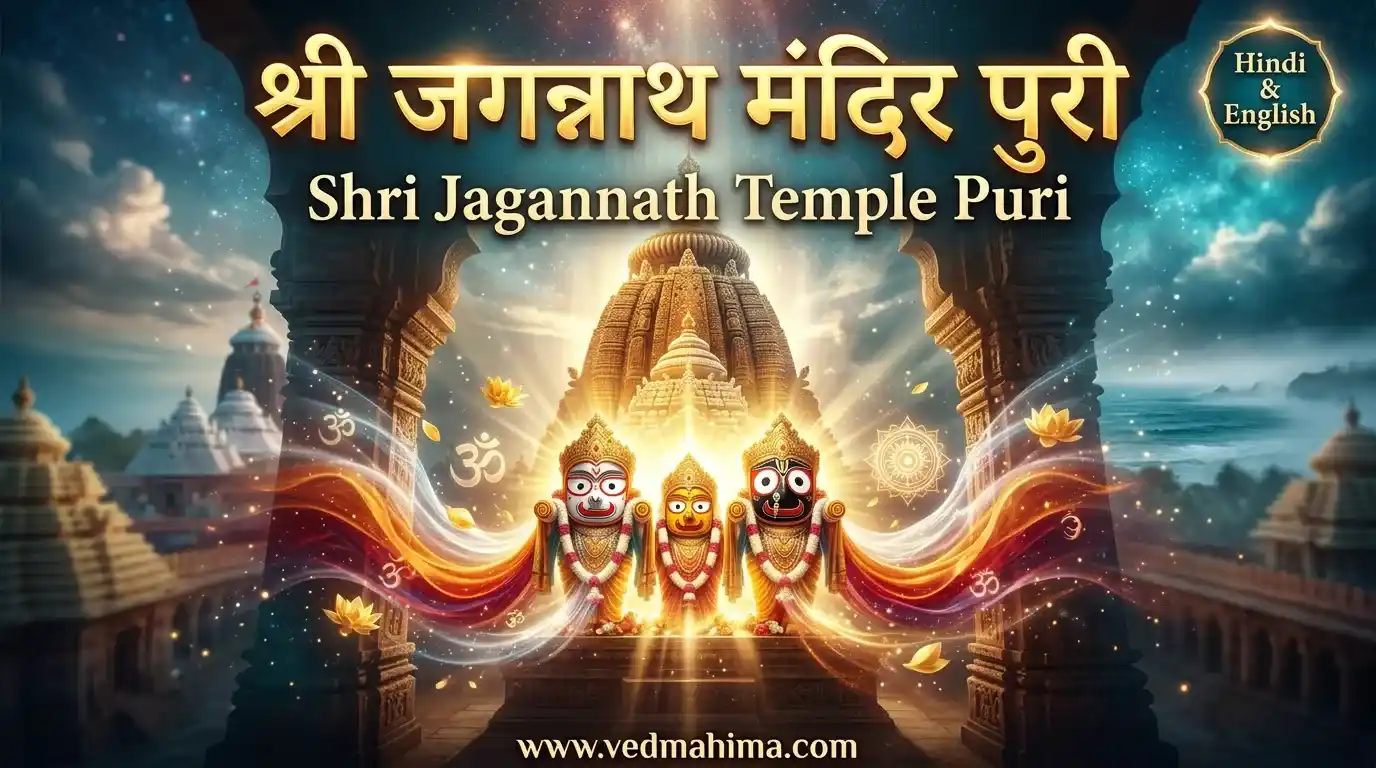
॥ Temple Overview & Divine Glory ॥
Shri Jagannath Temple, located on the serene coast of Puri in Odisha, is one of the most sacred and structurally magnificent monuments of sanatan tradition. As an essential pillar of the pan-Indian Char Dham circuit, this 12th-century coastal fortress is dedicated to Lord Jagannath (the Lord of the Universe, a compassionate manifestation of Lord Krishna), alongside His elder brother Lord Balabhadra and sister Devi Subhadra. Unlike typical stone or metal deities, the central idols here are intricately carved from sacred Neem logs (Daru), featuring large, mesmerizing round eyes that symbolize the Lord's omnipresent gaze over creation. Hailed in the Puranas as Shankha Kshetra and Martya Vaikuntha (the earthly paradise of Vishnu), it is a cosmic spiritual center where taking a single complete visual glance (Darshan) of the holy triad atop the golden platform (Ratnavedi) is believed to dissolve lifelong bad karma and grant immediate spiritual liberation.॥ Key Spiritual & Structural Aspects ॥
* The Miracle of the Nilachakra & Flag: The massive metal wheel (Nilachakra) atop the main 214-foot-tall spire is engineered such that it looks identical from any direction in Puri. The holy flag attached to it uniquely flutters against the wind direction, and is replaced daily by hereditary climbers without any safety gear.* The Grand Mahaprasad & Anand Bazar: Prepared daily inside the world's largest ancient earthen kitchen using only seven clay pots placed on top of one another over firewood, the holy food (Mahaprasad) is cooked purely by the grace of Goddess Bimala. It is served to lakhs of devotees daily at the open-air food market called Anand Bazar.
* The Sound of the Ocean: As you take your first step inside the primary eastern gateway (Singhadwara), the sound of the roaring ocean waves completely vanishes due to a mystical structural echo cancellation, returning only when you step back outside.
* The Absence of Shadows: The architectural geometry of the main temple structure is so mathematically profound that at no time of the day does the main dome cast a visible shadow on the ground.
॥ The Actual Ritualistic Cycle: Authentic Daily Nitis & Schedules ॥
The daily worship at Puri is a continuous flow of highly complex, hereditary servitor services known as 'Nitis'. The primary public and core spiritual windows are:1. Mangala Alati (05:00 AM - 06:00 AM): The highly auspicious, early morning awakening prayer. The main gates are opened, and camphor lamps are lit to offer the first dynamic view of the deities to the public.
2. Mailam & Abhasha (06:00 AM - 07:00 AM): The ritualistic removal of the previous night's clothes, followed by a fresh morning dress change and the formal decoration of flowers on the deities.
3. Gopal Ballav Bhog (08:30 AM): The first official morning breakfast offered to the holy triad, consisting of fresh sweet puffed rice, coconut scrapings, ripe bananas, and fresh curd.
4. The Grand Madhyanha Dhupa (11:00 AM - 01:00 PM): The highly formal afternoon royal feast where multiple courses of the cooked Mahaprasad are systematically offered behind closed inner doors.
5. Pahuda (01:00 PM - 04:00 PM): The scheduled afternoon rest window where the inner sanctum remains closed to preserve the divine tranquility.
6. Sandhya Alati (07:00 PM - 08:00 PM): The mesmerizing evening light ceremony where massive oil and camphor lamps are waved before the grand deities amidst the deep drumming of gongs and blowing of conch shells.
7. Badasinghar Vesha & Shayan Niti (11:00 PM - 12:00 AM): The final night ritual where the deities are adorned beautifully in fragrant heavy jasmine and marigold flowers (Badasinghar dress), offered sweet milk, and put to rest as soft Gita Govinda stanzas are recited.
॥ Detailed Code of Conduct & Pilgrimage Guidelines ॥
* Strict Dress Code Mandate: To honor the centuries-old cultural values of the temple, all pilgrims must wear modest, traditional attire. Men must wear a traditional Dhoti-Gorta or a formal Kurta with Pajama/Trousers. Women must wear a Saree, Half-Saree, or a modest Salwar-Kameez with a mandatory Dupatta. Modern Western apparel such as ripped jeans, shorts, sleeveless tops, short skirts, or tight gym leggings are strictly forbidden inside the four main entry gates.* Absolute Electronic Device Prohibition: The entire inner stone complex of the temple is a highly secured zone. Mobile phones, digital cameras, smartwatches, recording gadgets, and leather items (like belts and wallets) are completely banned. Pilgrims must safely store these items inside their hotel rooms or deposit them at the secure, free TTD-style luggage counters maintained by the temple administration outside the Singhadwara.
* Strict Security Checkpoints: Only practicing Hindus are historically and culturally permitted inside the main temple complex. All foreign tourists and non-Hindu visitors can view the exact top architecture and the replacement of the flag from the roof of the adjacent Raghunandan Library.
॥ The Globally Celebrated Rath Yatra Festival ॥
* The Chariot Festival (Rath Yatra): Celebrated in the Hindu month of Ashadha (June–July), this is the grandest festival of Odisha. The three deities step out of the sanctum to visit their aunt's house at the Gundicha Temple. They travel on three massive, newly constructed wooden chariots pulled by millions of ecstatic devotees. The festival features the iconic 'Chhera Pahanra' ritual, where the royal King of Puri sweeps the chariot platforms with a golden broom, proving that everyone is equal before the Lord of the Universe.॥ Comprehensive Routing Guide: How to Reach Puri Dham ॥
* By Air (Detailed Flight Route): The nearest airport is Biju Patnaik International Airport (BBI) in Bhubaneswar, located roughly 60 kilometers away. It operates frequent daily flights connecting major Indian cities like New Delhi, Mumbai, Kolkata, Chennai, and Hyderabad. From the airport, pilgrims can hire pre-paid luxury taxis or air-conditioned SUVs that travel down the beautiful 4-lane Puri-Bhubaneswar National Highway (NH-316) in approximately 1.5 hours.* By Train (Detailed Railway Network): Puri Railway Station (PURI) is a major terminal hub excellently connected via direct express, superfast, and super-luxury Vande Bharat trains from Kolkata, New Delhi, Mumbai, Ahmedabad, and Patna. The station is located just 3 kilometers from the main beach and temple complex, with 24/7 availability of auto-rickshaws, battery-operated e-rickshaws, and local taxis.
* By Road (Detailed Highway Navigation): Puri is smoothly accessible via the perfectly maintained National Highway 316. Regular inter-state and deluxe government buses run frequently from the central bus stand at Baramunda (Bhubaneswar) and Cuttack directly to the Puri bus stand every 10 to 15 minutes.
🙏 ॥ Thus completed ॥ 🙏
The Hindi text has been compiled based on original and authentic sources. If there is any difference,
error, or inconsistency between the Hindi and English versions, the Hindi text shall be considered the
authoritative version. If there are any errors or copyright-related concerns regarding this content,
please contact us.
📜 प्रामाणिक स्रोत:
📖 सार्वजनिक रूप से उपलब्ध स्रोत
📖 आधिकारिक मंदिर रिकॉर्ड
📖 सरकारी पोर्टल
📖 सत्यापित ऑनलाइन संदर्भ
About Shri Jagannath Temple Puri
The glorious history of Puri Jagannath Temple dates back to the eras of Satyug. According to the Skanda Purana, King Indradyumna of Avanti wanted to worship the highest form of Lord Vishnu (Nila Madhava). Following a divine dream, he discovered a sacred floating wooden log on the sea coast. The divine architect Vishwakarma arrived in disguise to carve the idols, on the condition that he should not be disturbed for 21 days. However, out of intense anxiety, Queen Gundicha opened the doors prematurely on the 14th day, causing the architect to vanish, leaving the hands and feet of the idols incomplete. The king established these unique, raw forms. Historically, the construction of the present grand stone temple was initiated by the powerful ruler King Anantavarman Chodaganga Deva of the Eastern Ganga Dynasty in the 12th century, and was beautifully completed by King Anangabhima Deva, standing today as an eternal fortress of unyielding global faith.