Maa Saraswati Temple Bhojshala Dhar Madhya Pradesh
Maa Saraswati Temple Bhojshala Dhar Pilgrimage & Architecture Guide
🙏 Devotional
🔥 Powerful
📿 Daily Prayer
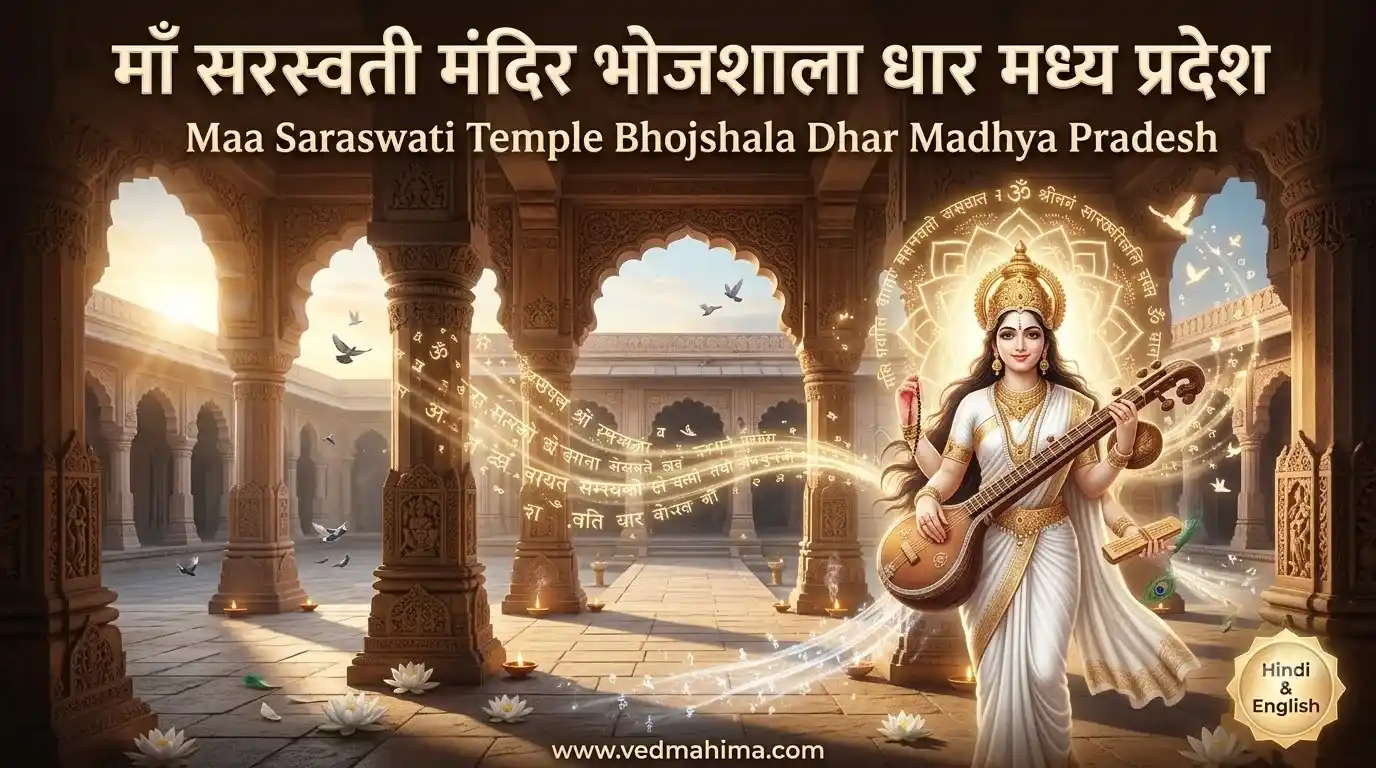
॥ Temple Overview & Divine Glory ॥
Maa Saraswati Temple Bhojshala, located in the historic city of Dhar in the Malwa region of Madhya Pradesh, is an extraordinary symbol of ancient Indian knowledge, Sanatana heritage, and architectural brilliance. Established in the 11th century (1034 CE) by the legendary Paramara Dynasty ruler Raja Bhoj—a great scholar, polymath, and patron of arts—Bhojshala was originally founded as a world-renowned University (Saraswati Sadan) dedicated to Goddess Vagdevi (Maa Saraswati). For centuries, this sacred institution served as a global center for learning literature, astronomy, philosophy, architecture, music, and Vedic sciences. The sanctuary housed the breathtaking white marble idol of Goddess Vagdevi, sculpted by the royal artist Manthal. Replete with intricately carved stone pillars, Sanskrit inscriptions on grammar and poetics, and an expansive courtyard, Bhojshala stands today as a monumental tribute to the Golden Age of Malwa and the eternal seat of learning.॥ Key Spiritual & Structural Aspects ॥
* The Seat of Goddess Vagdevi: Dedicated to Goddess Saraswati as Vagdevi (the Goddess of Speech, Knowledge, and Arts), the temple served as the divine inspiration for scholars, poets, and philosophers across ancient India.* Historic University & Literary Inscriptions: Bhojshala was not merely a shrine but an ancient university. The stone slabs and pillars throughout the complex are engraved with classical Sanskrit and Prakrit inscriptions containing treatises on grammar, poetics (Kurmashataka), and astronomical charts.
* Paramara Architectural Mastery: Built using local red and grey sandstone, the complex features massive carved pillars, ornate bracket capitals, open colonnaded halls, and a spacious central courtyard designed to facilitate vast academic and spiritual gatherings.
* The Vasant Panchami Festival & Divine Splendor: Vasant Panchami (the festival of Goddess Saraswati) is celebrated here with immense spiritual fervor, attracting thousands of devotees who gather to perform special Havans, Saraswati Pujan, and cultural recitations.
॥ The Detailed Divine Ritual & Worship Protocol ॥
The devotional practices at Bhojshala reflect its heritage as a sanctuary of wisdom and spiritual discipline:1. Pratah Vasant Pujan & Saraswati Vandana (06:00 AM to 08:00 AM): Devotees gather early morning to recite the Saraswati Stotram, Vagdevi Suktam, and Vedic mantras, seeking blessings for wisdom, education, and artistic mastery.
2. Midday Archana & Bhog Seva (12:00 PM to 01:00 PM): Traditional offerings of yellow rice, saffron sweets, seasonal fruits, and white flowers are presented to Goddess Saraswati.
3. Sandhya Maha Aarti (06:30 PM to 07:30 PM): The evening lights illuminate the carved stone pillars while traditional brass oil lamps, incense, and soul-stirring chants echo across the open courtyard.
4. Vasant Panchami Mahotsav Rituals: On the sacred occasion of Vasant Panchami, a day-long grand Havan, continuous chanting of Saraswati Chalisa, and cultural classical musical performances take place.
॥ Deep Architectural Landscape & Layout ॥
The architectural structure of Bhojshala showcases the height of 11th-century Paramara-style temple design combined with structural elegance. The complex spans a vast rectangular perimeter enclosed by stone walls. Pilgrims enter through an arched gateway leading into a large open-air central courtyard surrounded by carved stone cloisters (pillared corridors). Over 84 grand pillars support the roofed pavilions, each pillar meticulously carved with geometric patterns, floral motifs, and figures of deities. The walls feature embedded stone tablets inscribed with ancient Sanskrit literature, serving as an open-air library. The inner sanctum area originally held the celebrated marble statue of Maa Vagdevi, designed on a raised pedestal to capture natural ambient sunlight.॥ Major Festivals Celebrated ॥
* Vasant Panchami Mahotsav: The grandest festival at Bhojshala, celebrating the appearance day of Goddess Saraswati. Thousands of pilgrims, students, and scholars gather from across Madhya Pradesh to perform yellow flower offerings, Havan, and classical music programs.* Navratri (Chaitra & Sharad): During both Navratris, special prayers and Durga Saptashati recitations are organized, honoring Goddess Saraswati as the embodiment of Mahasaraswati.
* Raja Bhoj Jayanti: Commemorating the visionary Paramara king, a grand cultural festival is organized celebrating the literary and architectural legacy of Raja Bhoj.
॥ How to Reach Maa Saraswati Temple Bhojshala Dhar ॥
Situated in the historic city of Dhar in Madhya Pradesh, Bhojshala is conveniently accessible from major transit hubs in Malwa:* By Train (Railways): Indore Junction (INDB) is the principal railway hub located approximately 60 km from Dhar. Indore is connected via direct express and superfast trains to all major Indian cities. Taxis, private cars, and regular buses run continuously from Indore Railway Station to Dhar.
* By Air (Flights): Devi Ahilya Bai Holkar International Airport, Indore (IDR) is the nearest airport, located around 55 km away. Daily direct flights connect Indore to Delhi, Mumbai, Bengaluru, Hyderabad, and Ahmedabad. Prepaid airport taxis reach Dhar in under 1.5 hours via the highway.
* By Road & City Transport: Dhar is well connected by National Highway 47 (NH-47) and state highways. Regular government (MPRSTC) and private bus services operate between Dhar, Indore (60 km), Ujjain (90 km), Ratlam (95 km), and Bhopal (250 km). Local auto-rickshaws and e-rickshaws easily connect Dhar Bus Stand to Bhojshala.
🙏 ॥ Thus completed ॥ 🙏
The Hindi text has been compiled based on original and authentic sources. If there is any difference,
error, or inconsistency between the Hindi and English versions, the Hindi text shall be considered the
authoritative version. If there are any errors or copyright-related concerns regarding this content,
please contact us.
📜 प्रामाणिक स्रोत:
📖 सार्वजनिक रूप से उपलब्ध स्रोत
📖 आधिकारिक मंदिर रिकॉर्ड
📖 सरकारी पोर्टल
📖 सत्यापित ऑनलाइन संदर्भ
📖 भारतीय पुरातत्व सर्वेक्षण (ASI) रिपोर्ट
About Maa Saraswati Temple Bhojshala Dhar Madhya Pradesh
The glorious foundation, historical brilliance, and divine lineage of Maa Saraswati Temple Bhojshala are deeply rooted in the golden era of the Paramara Dynasty of Malwa during the 11th century. Founded in 1034 CE by the celebrated King Raja Bhoj—one of the greatest royal scholars, polymaths, and warriors in Indian history—Bhojshala was established as a premier academy of learning named "Saraswati Sadan" (the Abode of Goddess Saraswati).
Raja Bhoj, who authored more than 84 scholarly treatises on subject matters ranging from Sanskrit grammar, poetics, architecture (Samarangana Sutradhara), astrology, medicine, and engineering, envisioned Bhojshala as the intellectual and spiritual beating heart of his kingdom. Scholars, mathematicians, and poets from all corners of the Indian subcontinent gathered at Bhojshala to debate, study, and create literary masterpieces under the patronage of Raja Bhoj.
At the center of this academic sanctuary, Raja Bhoj consecrated a breathtaking, life-sized white marble idol of Goddess Saraswati as "Vagdevi" (Goddess of Speech). Sculpted by the famed royal artisan Manthal in 1034 CE, the idol depicted Goddess Saraswati holding sacred scriptures, a rosary, and divine attributes, radiating sublime artistic perfection. The complex was meticulously designed so that the stone walls themselves functioned as giant slates where complex rules of Sanskrit grammar, poetic meters, and astronomical charts were permanently carved.
Over subsequent centuries, amidst changing political dynasties in Medieval India, the original marble idol of Goddess Vagdevi was moved during the British colonial era and currently resides in the British Museum in London. Despite historical shifts, Bhojshala remains an enduring symbol of India's profound educational heritage, literary mastery, and devotion to Goddess Saraswati. Today, protected by the Archaeological Survey of India (ASI), Bhojshala continues to inspire millions of visitors, scholars, and devotees who revere it as the eternal seat of learning and culture in Central India.