Ashadha Maas Shukla Paksha Devshayani Ekadashi Vrat Katha
Start of Chaturmas, Vishnu yog nidra, Chaturmas food rules, Ashadha Shukla
॥ Introduction ॥
Ashadha Shukla Ekadashi, universally celebrated as Dev Shayani Ekadashi or Shayani Ekadashi, is one of the most spiritually profound and structurally important fasting days in Sanatan Dharma. Dedicated to Lord Shri Hari Vishnu, this holy day marks the cosmic beginning of ''Chaturmas''—the sacred four-month period of intense spiritual penance. Observing this fast with clean intent washes away the heaviest of past sins, grants material abundance, and smoothly paves the ultimate path toward spiritual awakening and liberation (Moksha).
॥ Importance ॥
The supreme importance of Dev Shayani Ekadashi is directly proclaimed by Lord Shri Krishna Himself. He emphasizes that anyone who worships the lotus-eyed Lord Vishnu with fresh lotus flowers on this day automatically obtains the cosmic merit of worshipping all three worlds and the eternal Trinity (Brahma, Vishnu, and Shiva). It is the ultimate destroyer of sins and a divine giver of celestial rewards. From this day until Prabodhini Ekadashi, the divine cosmic energies transition into a state of spiritual rest, making it crucial for humans to practice immense righteousness.
॥ Puranic Reference ॥
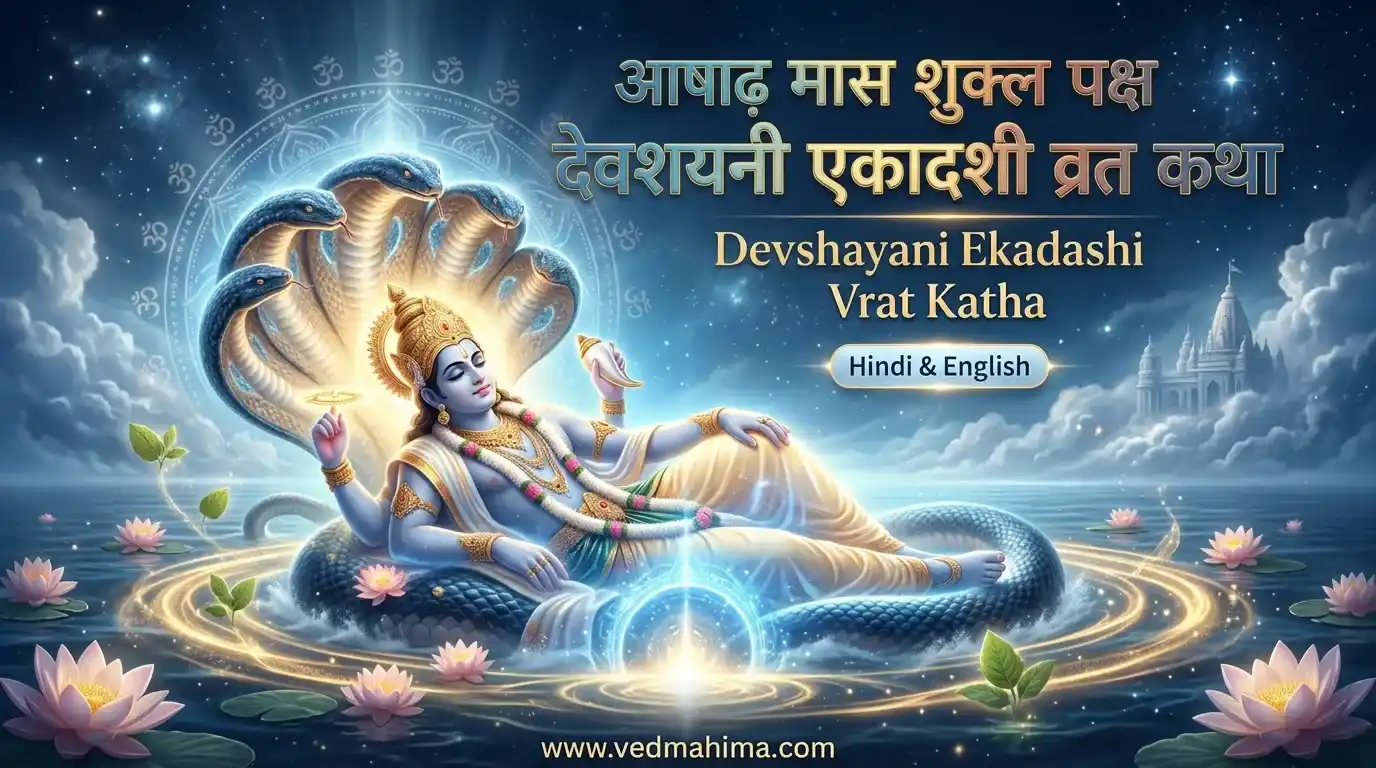
The divine reference of this holy day is documented in ancient texts through a sacred dialogue between King Yudhishthira and Lord Shri Krishna. When Yudhishthira eagerly inquired about the name and exact rituals of the fast falling during the bright fortnight (Shukla Paksha) of Ashadha month, Lord Krishna revealed the ancient mystery of His cosmic sleep. He explained how one of His divine forms resides with King Bali in the netherworld, while another form rests on the holy Sheshnag in the cosmic ocean (Ksheersagar), establishing the spiritual foundation of Chaturmas vows.
॥ Story ॥
Yudhishthira asked—O Bhagavan! Which Ekadashi occurs during the bright fortnight (Shukla Paksha) of the month of Ashadha? What is its name and the exact method to observe it? Please be kind enough to describe this to me.
Lord Shri Krishna replied—O King! The Ekadashi of the bright fortnight of Ashadha is famously known as ''Dev Shayani''. I shall describe its glory to you. It is immensely meritorious, bestows both worldly enjoyments and salvation (Moksha), destroys all sins, and stands as the supreme vow.
O Rajan! Those who observe the excellent fast of Dev Shayani Ekadashi and worship the lotus-eyed Lord Vishnu using fresh lotus flowers on this day, effectively worship all three worlds and the three eternal deities. On this auspicious day of Hari Shayani Ekadashi, one of My divine forms goes to reside at the palace of King Bali, while My second form sleeps peacefully on the bed of Sheshnag in the milk ocean (Ksheersagar). I remain in this cosmic sleep until the upcoming Ekadashi of the bright fortnight of Kartik month arrives.
Therefore, from the bright fortnight of Ashadha until the bright fortnight of Kartik, a human being must meticulously practice righteous deeds and follow spiritual discipline. Anyone who executes the rituals of this fast attains the supreme spiritual destination; hence, this Ekadashi fast must be observed with ultimate effort.
During the sacred night of Ekadashi, devotees must remain awake (Jagaran) and perform the loving worship of Lord Vishnu, who holds the holy conch (Shankha), discus (Chakra), and mace (Gada). Even the four-faced Lord Brahma is entirely incapable of counting the cosmic merits of a person who performs night vigil on this day. O Rajan! One who observes this supreme sin-destroying Ekadashi fast that grants both bhoga (enjoyment) and moksha (liberation) remains exceptionally dear to Me, even if that person belongs to the lowest strata of society.
Those who spend the four months of Chaturmas offering lamps (Deepdan), eating food on Palasha leaves, and observing strict fasts are immensely dear to Me. Since Lord Vishnu remains asleep during these four months, a human being should sleep on the bare ground. One must renounce green leafy vegetables in the month of Shravan, curd in Bhadrapada, milk in Ashwin, and pulses (lentils) in the month of Kartik. Alternatively, anyone who strictly practices absolute celibacy (Brahmacharya) during these four months attains the highest state. O Rajan! A person gets instantly liberated from all past sins merely by observing the Ekadashi fast; therefore, one must always keep this fast and never forget it.
Between ''Dev Shayani'' and ''Bodhini'', the Ekadashis that fall during the dark fortnight (Krishna Paksha) are highly recommended for householders (Grihasthas) to fast. The dark fortnight Ekadashis of other months are not mandatory for householders, but the Ekadashis of the bright fortnight (Shukla Paksha) must be observed by everyone without exception.
॥ Moral of the Story ॥
- The universe operates on cosmic cycles of rest and activity, and aligning our lifestyle with these cycles through Chaturmas brings physical and mental harmony.
- True devotion transcends social status; anyone who cleanses their heart through fasting and righteous deeds becomes dear to the Almighty.
- Sacrificing specific foods and physical comforts (like sleeping on the floor) strengthens willpower, purifies the physical body, and builds ultimate self-control.
- Spiritual discipline is an ongoing journey; consistency in observing vows like Ekadashi acts as a continuous shield against negative karmas.
॥ Vrat & Worship Method ॥
- Begin the fast on Ashadha Shukla Ekadashi by waking up during Brahma Muhurta, cleansing your house, and taking a purifying bath.
- Take a solemn vow (Sankalpa) of fasting before the idol of Lord Vishnu, promising to maintain physical purity and follow Chaturmas rules.
- Worship Lord Shri Hari Vishnu with absolute devotion, specially offering Him yellow flowers, lotus flowers, incense, sandalwood, and fresh Tulsi leaves.
- Observe a partial (Phalahar) or complete waterless fast based on your physical capacity, avoiding grains and beans strictly.
- Perform night vigil (Jagaran) by singing bhajans, playing musical instruments, and chanting sacred mantras like ''Om Namo Bhagavate Vasudevaya''.
- On Dwadashi morning, perform prayers, offer food and charity to deserving Brahmins, and break the fast (Parana) within the auspicious time.
॥ Rules for Chaturmas & Fasting Food ॥
- What to eat during the fast: On the day of Ekadashi, only pure Satvik fast-friendly foods (Phalahar) like fruits, milk, makhana, and buckwheat (kuttu) can be consumed. Grains, pulses, rice, garlic, and onions are strictly prohibited.
- Chaturmas Food Restrictions: As instructed by Lord Krishna, abandon leafy vegetables (Saag) in Shravan, curd (Dahi) in Bhadrapada, milk (Doodh) in Ashwin, and lentils/pulses (Daal) in the month of Kartik.
- Lifestyle Rules: Practice celibacy (Brahmacharya), sleep on the bare floor, offer lamps (Deepdan) daily, and prefer eating on Palasha leaves if possible.
- Rules for Householders (Grihasthas): Householders must observe all Shukla Paksha Ekadashis throughout the year. However, for the Krishna Paksha (dark fortnight), they should specifically fast only on those Ekadashis that fall between Dev Shayani and Prabodhini (during Chaturmas).
॥ Parana (Breaking the Fast) Method ॥
- The fast of Dev Shayani Ekadashi must be formally broken on the next day, Dwadashi Tithi, after sunrise.
- It is mandatory to complete the Parana before the Dwadashi Tithi ends and outside the period of Hari Vasara (the first quarter of Dwadashi).
- Break the fast by consuming the sacred water offered to Lord Vishnu or by eating a light Satvik meal consisting of rice and seasonal vegetables (ensuring it complies with Shravan Chaturmas restrictions if Shravan has commenced).
॥ Benefits ॥
- Erases all past negative karmas and cleanses the soul, granting rewards equivalent to observing vows across all three worlds.
- Bestows an abundance of material pleasures (Bhoga) in the current life and guarantees ultimate spiritual liberation (Moksha) after death.
- Improves physical health, cures internal digestive ailments, and boosts mental clarity through the scientifically structured Chaturmas diet.
- Brings immense domestic peace, wards off negative energies from the household, and attracts the permanent protective gaze of Lord Vishnu.
About Ashadha Maas Shukla Paksha Devshayani Ekadashi Vrat Katha
Krishna then says that on this day one of his forms goes to live with King Bali and another sleeps on Sheshnag in the milk ocean until the Ekadashi of Kartik. So from Ashadha Shukla to Kartik Shukla, one should follow dharma carefully, keep a night vigil with worship of Vishnu, and know that one who keeps this vrat is dear to the Lord, whatever their birth.
The Katha gives the Chaturmas rules: offer lamps, eat on a palash leaf, sleep on the floor, and leave leafy greens in Shravan, curd in Bhadrapada, milk in Ashwin and dal in Kartik, or keep celibacy. It ends with a note for householders: keep every Shukla Paksha Ekadashi, and of the Krishna Paksha ones only those between Devshayani and Bodhini.
These are matters of faith and tradition. The food rules follow the purnimanta calendar of North India, and customs differ by region, so please follow your own tradition. Fasting and diet changes are best done according to health, with a doctor''s advice for any medical condition. The page also gives the vrat method, Chaturmas food rules, parana and a short FAQ. Related: Vishnu Chalisa, Tulsi Chalisa (for Devutthani and Tulsi Vivah) and Ekadashi Ki Aarti.
❓ Frequently Asked Questions
Question: When is Devshayani Ekadashi kept?
Answer: On the Shukla Paksha Ekadashi of Ashadha (usually June or July). Shukla Paksha months carry the same name in the purnimanta and amanta calendars, so only the date needs checking in a local panchang.
Question: Why is it called Devshayani or Hari Shayani?
Answer: The Katha says that from this day one form of Lord Vishnu stays with King Bali and another sleeps on Sheshnag in the cosmic milk ocean until Kartik Shukla Ekadashi (Devutthani). Chaturmas, the four-month period of vows, starts from this day.
Question: What are the Chaturmas food rules in the Katha?
Answer: Leave leafy greens in Shravan, curd in Bhadrapada, milk in Ashwin and dal in Kartik, or keep celibacy. Sleep on the floor, give lamps (deepdan) and eat on a palash leaf if you can. These follow the purnimanta month names of North India, so please check your local tradition. They are also best followed according to health.
Question: What does the Katha say about householders?
Answer: Householders should keep every Shukla Paksha Ekadashi, but only the Krishna Paksha Ekadashis that fall between Devshayani and Bodhini (Devutthani) are for them.
Question: What is the Ekadashi vrat food?
Answer: Fruit, milk, makhana and kuttu or singhara flour are common in North Indian homes, with no grain or pulses. Customs differ, so follow your family tradition. People with medical conditions should follow a doctor''s advice.
Question: When does Vishnu wake?
Answer: On Devutthani (Prabodhini) Ekadashi, Kartik Shukla Ekadashi, when Tulsi Vivah is held in many homes (see the Tulsi Chalisa). See also the Ekadashi Ki Aarti and the Yogini Ekadashi Katha.