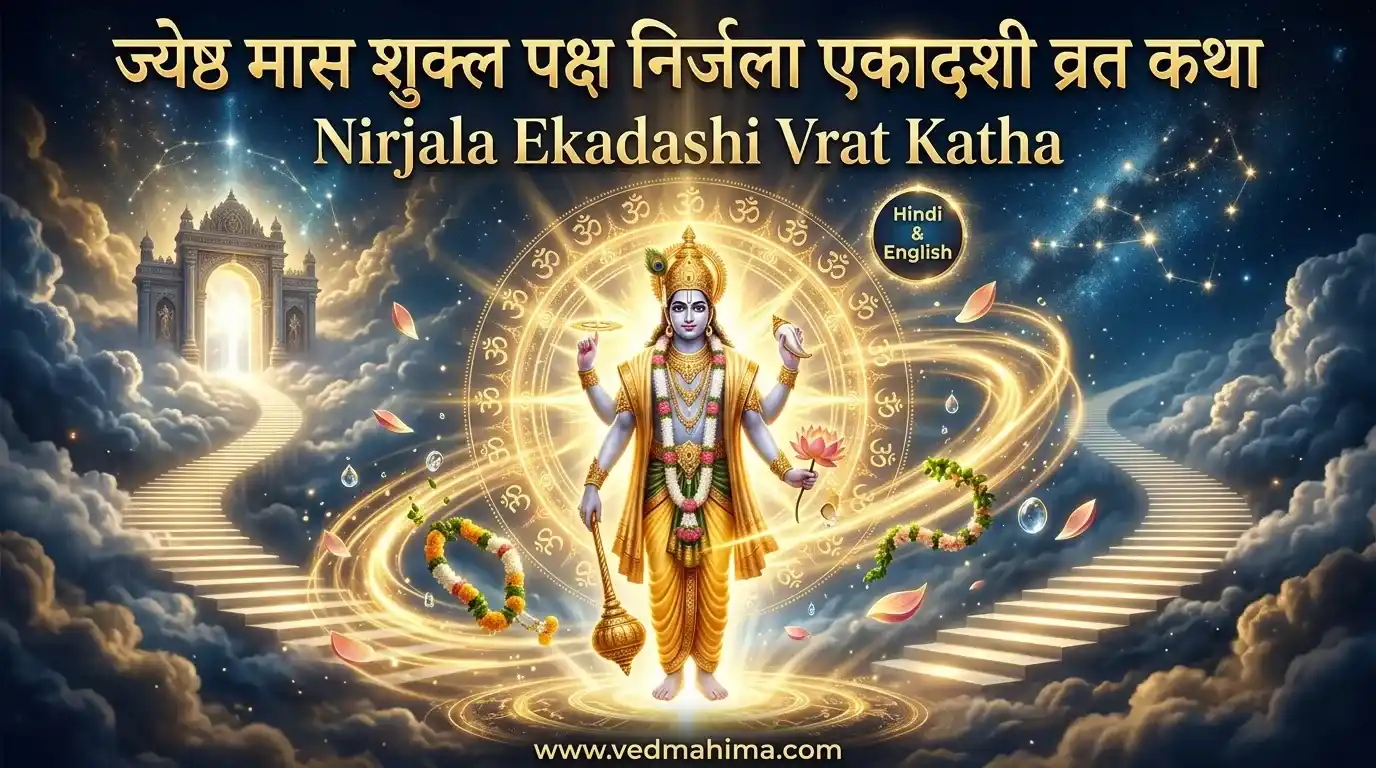
Jyeshtha Maas Shukla Paksha Nirjala Ekadashi Vrat Katha
Nirjala Ekadashi, Bhima Ekadashi, Lord Vishnu, Vrat Katha, Ekadashi Story, Moksha
॥ Introduction ॥
Jyeshtha Shukla Ekadashi, famously known as Nirjala Ekadashi or Bhimseni Ekadashi, is considered the most rigorous and spiritually rewarding fast among all the twenty-four Ekadashis of the year. Dedicated to Lord Shri Vishnu, this sacred fast requires devotees to fully abstain from both food and water from the sunrise of Ekadashi until the sunrise of Dwadashi. It is uniquely structured for those who cannot fast twice a month but seek the ultimate grace of the Supreme Lord through supreme penance and dedication.
॥ Importance ॥
The significance of Nirjala Ekadashi lies in its absolute demand for self-control and endurance. Falling in the peak of summer (Jyeshtha month), giving up water serves as a powerful test of a devotee’s mental fortitude and spiritual devotion. According to the Padma Purana and Mahabharata, observing this single fast with complete austerity provides the collective spiritual benefits of all individual Ekadashis celebrated throughout the year, making it a golden opportunity for spiritual cleansing and gaining righteousness.
॥ Puranic Reference ॥
The divine reference of this day is beautifully captured in the Mahabharata during a conversation between Sage Vyasa and Bhimasena. Bhima, known for his insatiable hunger powered by the Vrika fire in his stomach, confessed his inability to observe the bi-monthly Ekadashi fasts. Sage Vyasa, understanding his dilemma, revealed the immense power of Jyeshtha Shukla Ekadashi. He assured Bhima that by observing this one waterless fast with utmost discipline, he would effortlessly attain the ultimate merits of all annual fasts combined. Hence, it earned the name Bhima Ekadashi.
॥ Story ॥
Yudhishthira said—O Janardana! I have heard the complete glory of Apara Ekadashi. Now, please be kind enough to describe the Ekadashi that falls during the bright fortnight (Shukla Paksha) of the month of Jyeshtha.
Lord Shri Krishna replied—O King! The description of this sacred Ekadashi will be narrated by the supreme righteous Sage Vyasa, the son of Satyavati, as he is the ultimate knower of the essence of all scriptures and a scholar well-versed in the Vedas and Vedangas.
Then Sage Vedavyasa began to speak—A person should not consume food on the Ekadashis of both fortnights (Krishna and Shukla Paksha). On the day of Dwadashi, after purifying oneself by taking a bath, one should worship Lord Keshava with fresh flowers and complete their daily rituals. After that, one must first offer food to learned Brahmins and only then consume food themselves. O King! Even during periods of birth impurity (Jananshauch) and death impurity (Marananshauch), food must not be consumed on the day of Ekadashi.
Hearing this, Bhimasena spoke—O profoundly wise grandfather! Please listen to my genuine dilemma. King Yudhishthira, Mother Kunti, Draupadi, Arjun, Nakul, and Sahadev—all of them never consume food on Ekadashi and they always tell me, Bhima! You should also fast on Ekadashi. But I always tell them frankly that I cannot tolerate hunger at all.
Hearing Bhimasenas words, Sage Vyasa said—If the attainment of heaven is desired by you and if you consider hell as a defiled place, then you must not consume food on the Ekadashi of both fortnights.
Bhima said—O highly wise grandfather! I tell you the absolute truth, I cannot even observe a fast where one eats only once a day. Then how can I possibly survive a complete fast? The digestive fire named Vrika is always blazing inside my stomach; it is appeased only when I eat a large quantity of food. Therefore, O great sage! I can observe only one single complete fast in the entire year, through which the attainment of heaven becomes easy and by doing which I can become a partaker of ultimate welfare. Please determine and tell me about one such vow, and I shall follow it with proper devotion.
Sage Vyasa said—O Bhima! In the month of Jyeshtha, whether the Sun is in Taurus (Vrishabha) or Gemini (Mithuna) sign, you must diligently observe the fast of the Ekadashi that falls in the bright fortnight (Shukla Paksha) without drinking any water (Nirjala). Only for rinsing (Kulla) or sipping for purification (Aachaman) may you put water in the mouth, but apart from that, no other water should enter the throat, otherwise, the fast gets broken. If a man renounces water from the sunrise of Ekadashi until the sunrise of the next day (Dwadashi), then this fast is completed successfully. Thereafter, bathing in the pure dawn of Dwadashi, one should methodically donate water and gold to Brahmins. After completing all these rituals, a self-controlled man should eat food along with the Brahmins. A man reaps the entire fruit of all the Ekadashis of the year simply by observing this single Nirjala Ekadashi; there is absolutely no doubt about this. Lord Keshava, who holds the conch, discus, and mace, had told me that if a human being leaves everything and surrenders completely to Me alone and remains without food on Ekadashi, he gets liberated from all sins.
The terrifying, massive, and dark-complexioned Yamadootas (messengers of death) carrying staffs and nooses never approach a person who observes the Ekadashi fast. At the end of life, the gentle-natured Vishnudootas (messengers of Lord Vishnu), clad in yellow garments, holding the Sudarshana Chakra, and moving with the speed of the mind, arrive to take this Vaishnava devotee to the divine abode of Lord Vishnu. Therefore, one must put total effort into fasting on Nirjala Ekadashi. You too must fast and worship Shri Hari with utmost effort for the pacification of all your sins. Whether a woman or a man, even if they have committed sins as massive as Mount Meru, everything is burnt to ashes by the profound influence of this Ekadashi. The person who follows the rules of water restriction on this day becomes a partaker of immense merit; it is heard that they receive the reward of donating millions of gold coins in every single quarter of the day. Whatever a person performs on the day of Nirjala Ekadashi—be it bathing, charity, chanting, or performing rituals over the sacred fire—everything becomes imperishable (Akshaya), this is the divine statement of Lord Shri Krishna Himself. By observing this fast methodically and in the finest manner, a human being effortlessly attains the supreme Vaishnava state. A person who eats food grains on the day of Ekadashi consumes nothing but sin. In this world, such a person is like an outcast (Chandala) and meets an unfortunate fate after death.
Those who fast and offer charity on the Ekadashi of the bright fortnight of Jyeshtha month will surely reach the supreme abode. Those who have fasted on this day become free from all gravest sins, even if they were previously burdened with terrible past wrongdoings. O son of Kunti! Listen to the special charities and duties prescribed for devoted men and women on the day of Nirjala Ekadashi. On that day, one must worship Lord Vishnu, who reclines upon the cosmic waters, and perform the symbolic donation of a water-filled cow (Jalamayi Dhenu), or an actual cow, or a cow made of clarified butter (Ghritamayi Dhenu). One should satisfy learned Brahmins with ample dakshina and various kinds of sweets. By doing so, the Brahmins are pleased, and upon their satisfaction, Shri Hari bestows liberation (Moksha). Those who, engaged in self-control and charity, have worshipped Shri Hari and kept a night vigil while observing this Nirjala Ekadashi fast, have successfully uplifted a hundred generations of their past and a hundred generations of their future to the supreme abode of Lord Vasudeva. On the day of Nirjala Ekadashi, one should donate grains, clothes, cows, water, beds, beautiful seats, water pots (Kamandalu), and umbrellas. A person who donates footwear to an excellent and deserving Brahmin rides a golden celestial chariot and gets established in the heavenly realm. Both the person who listens to the glory of this Ekadashi with devotion and the one who narrates it with a pure heart reach the heavenly realm. The same fruit that a man obtains by performing a Shraddha during a solar eclipse on a New Moon day (Amavasya) joined with Chaturdashi is obtained simply by listening to this sacred text. First, after brushing the teeth, one should take the formal vow: O Lord Keshava! For Your divine pleasure, I shall remain without food on Ekadashi and shall renounce all water except for the minimal requirement of Aachaman. On Dwadashi, one must worship the supreme Lord of lords, Vishnu. After methodically worshipping Him with fragrance, incense, flowers, and beautiful garments, one should consecrate a water-filled pitcher while chanting the following sacred mantra:
Devadeva Hrishikesha Samsaraarnavataraka ।
Udakumbhapradanena Naya Mam Paramam Gatim ॥
Meaning: O Lord of lords, Hrishikesha! O Savior from the ocean of worldly existence! By donating this water-filled pitcher, please guide me to the supreme spiritual destination.
O Bhimasena! One must observe the waterless fast on the auspicious Ekadashi of the bright fortnight in the month of Jyeshtha and donate pitchers filled with sweet sugar-water to noble Brahmins on that day. By doing so, a human being reaches near Lord Vishnu and experiences eternal bliss. Following that, on Dwadashi, after feeding the Brahmins, one should consume their own food. The one who completely observes this sin-destroying Ekadashi fast becomes free from all bondages and attains the flawless, sorrow-free state.
Hearing this, Bhimasena also commenced the observance of this auspicious Ekadashi fast. Since that time, this sacred day became universally renowned in the world by the name of Pandava Dwadashi or Bhima Ekadashi.
॥ Moral of the Story ॥
- True devotion and willpower transcend physical limitations, as seen through Bhima’s rigorous penance.
- A single act of supreme sacrifice and complete sensory control can balance past spiritual shortcomings.
- Scriptural guidance from an enlightened Guru (like Sage Vyasa) can help devotees find practical paths to liberation.
- Giving up basic necessities like water during peak summer cultivates deep humility and breaks egoistic tendencies.
॥ Vrat & Worship Method ॥
- Begin the fast on Jyeshtha Shukla Ekadashi by waking up during Brahma Muhurta, cleansing your space, and taking a purifying bath.
- Perform a solemn resolution (Sankalpa) before Lord Vishnu, promising to observe the fast completely without food and water (Nirjala).
- Worship Lord Vishnu (specifically in His Trivikrama or Vamana form) with yellow flowers, incense, sandalwood paste, and Tulsi leaves.
- Throughout the day and night, refrain from swallowing water (except for essential drops during Aachaman) and engage in night vigil (Jagran) chanting Lord Hari’s name.
- On Dwadashi morning, donate a water-filled pitcher (Udakumbha) covered with cloth, along with sweets, sugar, umbrellas, or fans to a pious Brahmin before opening the fast (Parana).
॥ Benefits ॥
- Bestows the mystical benefit and spiritual merit of keeping all twenty-four Ekadashis of the year in one single day.
- Uplifts and liberates one hundred past and one hundred future generations of the devotee’s lineage into Vaikuntha Dham.
- Clears severe karmic debts, including grave sins equivalent to the size of Mount Meru, transforming the soul’s spiritual path.
- Provides exceptional rewards for summer charity—such as donating water pots, fans, and umbrellas, bringing immense material and spiritual abundance.
- Grants protection from Yamadootas at the time of death, ensuring safe passage to the divine realm via Vishnu’s messengers.
॥ Frequently Asked Questions (FAQ) ॥
Can we drink water during Nirjala Ekadashi fasting?
Strictly speaking, drinking water is prohibited from the sunrise of Ekadashi until the sunrise of Dwadashi. Only a minimal amount of water is allowed for mouth rinsing (Kulla) and ritual sipping (Aachaman) without letting it pass down the throat.
Why is Nirjala Ekadashi also known as Bhima Ekadashi or Pandava Ekadashi?
It gained this name because Bhimasena, who could not control his immense appetite to observe regular fasts, successfully completed this specific waterless fast under Sage Vyasa’s direct instructions to gain the merits of all Ekadashis.
What is the significance of donating a water pitcher (Ghada) on this day?
Donating a water pitcher (Udakumbha) filled with sweet water and sugar during the scorching summer month of Jyeshtha is considered an act of supreme virtue, which directly pleases Lord Vishnu and secures a place in His divine abode.