Bhadrapada Maas Shukla Paksha Padma Ekadashi Vrat Katha
Parivartini Ekadashi, King Mandhata and drought, Vishnu changes side, ghada daan
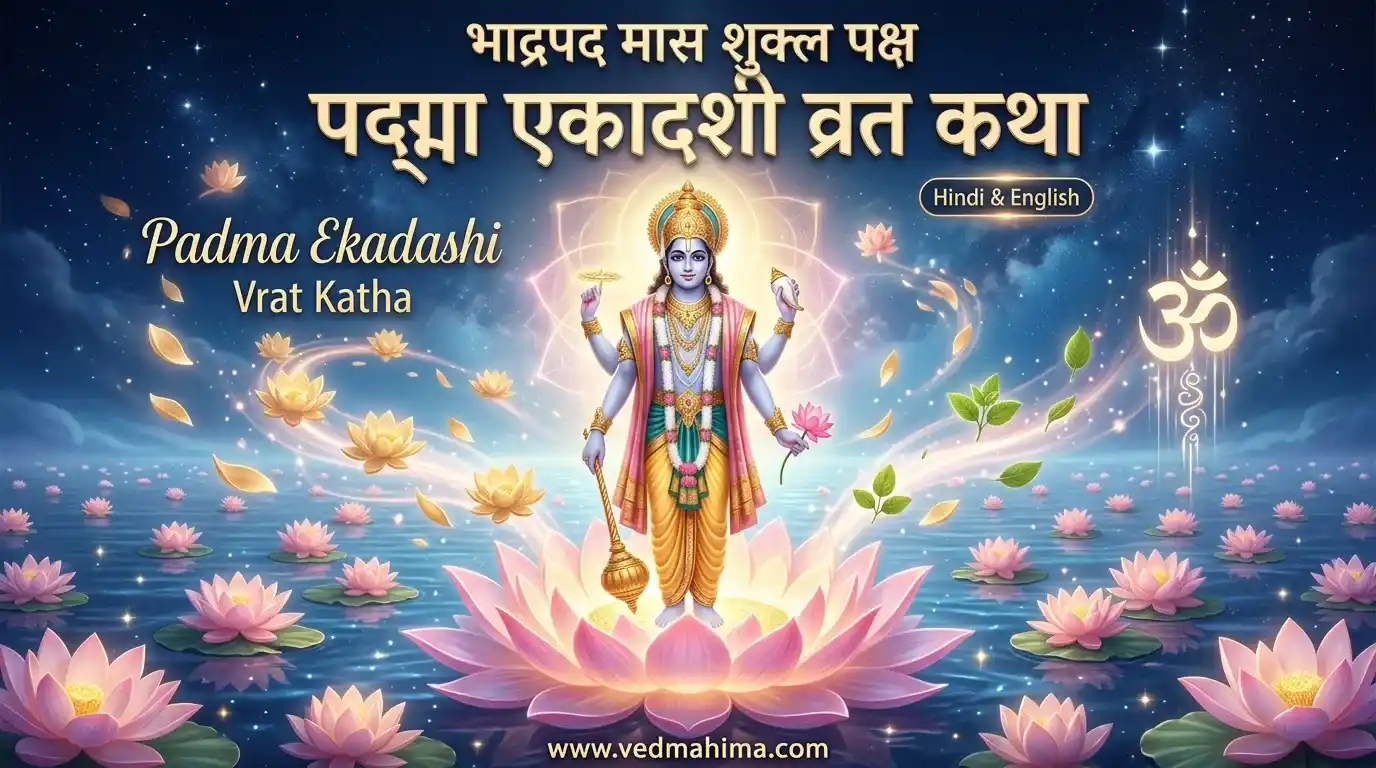
॥ Introduction ॥
Bhadrapada Shukla Ekadashi, widely celebrated across sacred scriptures as Padma Ekadashi (also profoundly known as Parivartini or Parsva Ekadashi), holds an exceptionally divine status in Sanatan Dharma. Falling during the holy bright fortnight of Bhadrapada month, this auspicious day marks the cosmic event where Lord Shri Hari Vishnu, residing in His mystic slumber (Yoga Nidra) during Chaturmas, takes a turn from His left side to the right. Observing this fast completely eradicates heavy accumulated sins, removes devastating natural calamities, and blesses the kingdom with abundant rainfall and material prosperity.
॥ Importance ॥
The supreme spiritual importance of Padma Ekadashi is direct, unique, and magnificent. Lord Shri Krishna states that reading, hearing, or meditating upon the holy chronicle of this fast thoroughly cleanses the sub-conscious mind of all structural impurities. On this specific day, performing the grand ritualistic worship of Lord Hrishikesh and executing specific acts of charity before worthy Brahmins rewards the devotee with ultimate material enjoyments (Bhukti) and guarantees absolute liberation (Mukti) from the mortal cycle of birth and death.
॥ Puranic Reference ॥
The divine reference of this holy katha is rooted in an ancient celestial conversation between Lord Brahma and Narada Muni, later beautifully narrated by Lord Shri Krishna to King Yudhishthira during the Dwapar Yuga. The narrative details the history of King Mandhata of the Solar Dynasty, an unyielding drought that paralyzed his kingdom for three consecutive years, and the supreme cosmic solution provided by Sage Angira, the glorious son of Lord Brahma, to completely restore the lost balance of nature.
॥ Story ॥
King Yudhishthira asked—O Keshava! What is the name of the Ekadashi that occurs during the bright fortnight (Shukla Paksha) of the month of Bhadrapada? Who is its governing deity, and what is the exact method of its observance? Please tell me all of this.
Lord Shri Krishna replied—O King! In this regard, I shall narrate to you an astonishing history, which was originally spoken by Lord Brahma to the great soul Narada.
Narada Muni had questioned—O Chaturmukha (four-faced Lord)! I bow down to you. For the precise adoration of Lord Vishnu, I deeply desire to hear from your holy mouth about which Ekadashi falls during the bright fortnight of the month of Bhadrapada?
Lord Brahma replied—O best among sages! You have asked an exceptionally excellent question, which is quite natural for you, being an exalted Vaishnava. The Ekadashi of Bhadrapada Shukla Paksha is highly famous by the name of ''Padma''. On that holy day, the ritualistic worship of Lord Hrishikesh is performed. This supreme fast is absolutely worthy of being executed by all human beings.
In ancient times, in the glorious Solar Dynasty (Suryavamsha), there lived a wheel-turning monarch (Chakravarti King) named Mandhata, who was a royal seer of absolute truth and immense prowess. He protected his subjects with righteousness, treating them exactly like his own biological children. In his kingdom, famine never occurred, mental anxieties never tormented the citizens, and diseases never manifested. His subjects were entirely fearless and highly prosperous with wealth and food grains. The treasury of the Maharaja gathered only righteously earned wealth. People of all varnas (classes) and ashrams remained strictly dedicated to their respective duties. The very earth under Mandhata''s rule yielded fruits like the celestial wish-fulfilling cow (Kamadhenu). The subjects experienced ultimate bliss during his reign.
However, at one time, due to the fruit-bearing manifestation of some past actions (Karma), no rain fell in the King''s realm for three consecutive years. Due to this severe drought, his subjects began to perish out of intense hunger. Then, the entire assembly of subjects approached the Maharaja and spoke thus—
The subjects pleaded—O best among kings! You must listen to the critical grievance of your subjects. In the ancient Puranas, wise men have defined water as ''Nara''; and that Nara (water) is the eternal abode (Ayana) of the Supreme Lord; hence He is called Narayana. Lord Vishnu in the form of Narayana resides everywhere in a pervasive form. He alone transforms into clouds and sends down rain; from rain, food grain is produced, and from food grain, all subjects sustain their physical lives. O King! At this moment, due to the absolute absence of food grain, the subjects are facing total destruction; therefore, please execute a remedy that can sustain our well-being (Yogakshema).
The King replied—What you all say is absolutely true, because food grain is indeed called Brahma. From food grain, living beings are generated, and through food grain alone, the entire cosmos sustains its life. It is widely heard in the material world, and detailed extensively in the Puranas, that the subjects face intense suffering due to the tyrannies and crimes committed by their kings. However, when I critically examine my own actions with deep intellect, I do not find any sin committed by me. Even so, I shall put my entire effort into securing the complete welfare of my subjects.
Having made this firm resolve, King Mandhata took a few chosen individuals along with him, offered his profound respects to the Creator (Vidhatu), and departed into the dense forest. There, he wandered through the sacred hermitages of principal sages and ascetics. One day, he caught sight of Maharshi Angira, the glorious son of Lord Brahma. As soon as his eyes fell upon the seer, the King, filled with immense joy, descended from his vehicle, and controlling his senses, bowed down at the feet of the Muni with folded hands. The sage greeted the King with the word ''Svasti'' (welfare) and inquired about the structural well-being of the seven limbs of his kingdom. The King stated his welfare and asked about the sage''s spiritual health. The Muni offered a comfortable seat and arghya to the King. Accepting them, when the King sat close to the sage, the Muni asked the reason for his arrival.
Then the King said—O Bhagavan! I was ruling over the earth strictly according to the systems of righteousness. Yet, an absolute absence of rain has occurred in my kingdom. I do not know the hidden reason behind this catastrophe.
The Rishi spoke—O King! This is Satyayuga, the best among all ages. In this age, all individuals remain continuously absorbed in the contemplation of the Supreme Consciousness, and righteousness stands firm on all four of its limbs. In this specific age, only Brahmins are entitled to practice heavy ascetic penances, no other persons. But, O Maharaja! Within your kingdom, a Shudra is executing intense ascetic penances; due to this unscriptural deviation, the clouds refuse to pour down water. You must make an effort to counter this, so that this defect of drought gets completely pacified.
The King replied—O best among sages! On one hand, he is deeply absorbed in ascetic penance, and on the other hand, he is completely innocent of any worldly crime; therefore, I shall not bring any harm or injury to him. Please instruct me on an alternative religious practice that has the power to pacify this great defect.
The Rishi spoke—O King! If that is the case, then observe the sacred fast of Ekadashi. The Ekadashi that falls in the bright fortnight of Bhadrapada month is highly famous by the name of ''Padma''. By the divine influence of its vow, excellent rain will definitely pour down. O Ruler of men! You must execute this fast along with your subjects, relatives, and family members.
Hearing these words of the Rishi, the King returned to his palace. Along with the subjects of all four varnas, he strictly observed the fast of Bhadrapada Shukla ''Padma'' Ekadashi. As a result of performing this fast, the clouds instantly began to pour down heavy water. The entire earth became completely flooded and beautifully adorned with green agricultural crops. By the absolute power of that fast, all subjects became intensely happy and prosperous.
Lord Shri Krishna said—O King! For this reason, the performance of this excellent fast must be executed without fail. On the day of Padma Ekadashi, a large pitcher filled with pure water must be beautifully covered with a clean cloth and donated to a worthy Brahmin along with curd and rice. Along with it, an umbrella and shoes must also be gifted. While making this donation, the devotee must reverently chant the following sacred mantra:
Namo namaste Govind Budhshravan Sanjnak ॥
Aghaugh sankshayam kritva sarva saukhyaprado bhav ।
Bhukti mukti pradashchaiva lokanam sukhdayakah ॥
''O Lord Govinda, who assumes the name of Budhashravana [on the day of Dwadashi when combined with Wednesday and Shravana Nakshatra]! Salutations to You, salutations to You over and over again. By completely destroying the massive pile of my sins, please become the bestower of all happiness to me. You are the direct granter of material enjoyment and ultimate liberation, and the supreme bringer of joy to all the worlds.''
O King! By reading and hearing this holy glory, a human being becomes entirely liberated from all sins.
॥ Moral of the Story ॥
- Nature balances itself through righteousness; when the king and his entire population united in a single, selfless spiritual practice, the severe drought was immediately lifted.
- Compassion over severe punishment preserves cosmic merit; King Mandhata chose not to harm an innocent ascetic, and instead sought an alternative spiritual solution through Ekadashi.
- True leadership means taking personal responsibility for the suffering of others; the king went deep into the forest to seek a remedy for his starving subjects.
- Systematic scriptural charity (Dan) done with the right mantra carries the immense power to transform material lack into infinite spiritual abundance.
॥ Vrat & Worship Method ॥
- On Bhadrapada Shukla Ekadashi, wake up early in Brahma Muhurta, perform internal cleansing, and take a holy bath.
- Set up an altar facing East or North, place an image of Lord Hrishikesh (Vishnu), and make a firm resolve (Sankalpa) to fast along with family members.
- Worship the Lord by offering seasonal fruits, yellow flowers, sweetmeats, incense, and fresh Tulsi leaves to please Him.
- Since the Lord changes His side (Parivartan) on this day, spend the day chanting the holy names of Vishnu and performing meditation.
- Maintain a complete fast or take only simple fruit-based meals (Phalahar), strictly avoiding all grains, rice, beans, and sea salt.
- Perform a dedicated night vigil (Jagaran), remaining awake to sing bhajans, read scriptures, and express deep gratitude.
- On Dwadashi morning, execute the specific scriptural donation: cover a pitcher filled with water with a clean cloth, and gift it to a worthy Brahmin along with curd, rice, an umbrella, and shoes while chanting the sacred Budhashravana mantra.
- Conclude the fast by taking charanamrit or a light Satvik meal within the designated auspicious Parana timing.
॥ Rules for Charity & Ritual Donation ॥
- The Pitcher Donation (Ghada Dan): A large pot filled to the brim with pure water must be covered with a new cloth and gifted along with white rice and fresh curd to a learned Brahmin.
- Additional Items: Gifting a functional umbrella (Chhata) and comfortable shoes (Juta) is highly emphasized in the text to alleviate physical hardships of the receiver.
- The Budhashravana Mantra: The donation becomes structurally complete and spiritually powerful only when the specified Sanskrit mantra addressing Lord Govinda is chanted with deep faith.
॥ Parana (Breaking the Fast) Method ॥
- The fast of Padma Ekadashi must be broken on the next calendar day, Dwadashi Tithi, strictly after sunrise.
- Ensure the Parana occurs before the official end of the Dwadashi Tithi and strictly after the duration of Hari Vasara has passed.
- Break the fast by consuming holy Tulsi water or a light grain-free meal, keeping the sanctity of the continuous Chaturmas vows.
॥ Benefits ॥
- Completely eliminates severe famines, water crises, unyielding droughts, and negative natural imbalances from the surroundings.
- Dissolves the heaviest accumulations of personal and ancestral sins, bringing absolute clarity and peace to the mind.
- Grants the synchronized twin blessings of material enjoyment (Bhukti) in the physical world and ultimate liberation (Mukti) in the spiritual world.
- Ensures that the devotee and their entire family or community transcend lower existential planes and enter the eternal realm of Vishnu.
About Bhadrapada Maas Shukla Paksha Padma Ekadashi Vrat Katha
The subjects come to him and say that water is Nara, the home of Narayana, who becomes the clouds that give rain, from which grain grows, and ask him to do something. The king goes to the forest and meets Sage Angira, who explains the drought with an idea about a Shudra performing tapas. This reflects older social ideas and is not a view we hold. In the same passage the king refuses to harm an innocent ascetic and asks for another remedy. The sage tells him to keep Padma Ekadashi with his people. They do, rain falls, the earth turns green and the people become happy.
Krishna adds that on this day a water pitcher covered with cloth should be given with curd, rice, an umbrella and shoes, with the mantra "Namo namaste Govinda Budhashravana," and that hearing the Katha frees one from sin. In tradition, this is also the day Vishnu is said to turn on his side in his Chaturmas sleep, hence the name Parivartini. These are matters of faith. The most practical thread is community effort and the daan of water and footwear. The page also gives the vrat method, benefits believed in tradition and a short FAQ. Related: Vishnu Chalisa, Ekadashi Ki Aarti, Devshayani Ekadashi and Indira Ekadashi.
❓ Frequently Asked Questions
Question: When is Padma Ekadashi kept?
Answer: On the Shukla Paksha Ekadashi of Bhadrapada (usually September), during Chaturmas. Shukla Paksha months carry the same name in the purnimanta and amanta calendars, so only the date needs checking in a local panchang.
Question: Why is it also called Parivartini or Parsva Ekadashi?
Answer: In tradition, Vishnu, asleep in the milk ocean during Chaturmas, is believed to turn from one side to the other on this day. Parivartini means "the one that turns."
Question: What is the story of King Mandhata?
Answer: In the Katha, Mandhata is a just emperor in whose land no rain falls for three years, and the people starve. He goes to the forest and meets Sage Angira, who tells him to keep Padma Ekadashi with his people. They do, and heavy rain falls. The story is a devotional narrative.
Question: Does the Katha contain anything that should be read with care?
Answer: Yes. In one passage the sage links the drought to a Shudra performing tapas, which reflects older social ideas and is not a view we hold. In the same passage the king refuses to harm an innocent ascetic and chooses the Ekadashi instead, which is the message to take from the story.
Question: What is donated on this day?
Answer: The Katha says to cover a water-filled pitcher with cloth and give it with curd, rice, an umbrella and shoes, with the mantra "Namo namaste Govinda Budhashravana." Giving water, an umbrella or footwear to those in need is a natural form of this daan.
Question: How is the vrat kept?
Answer: Take a sankalp, worship Lord Hrishikesh (Vishnu) with tulsi and yellow flowers, read the Katha, keep a night vigil and break the fast on Dwadashi after sunrise within the parana window (see the Vishnu Chalisa). Fast according to health. Sing the Ekadashi Ki Aarti after the puja.