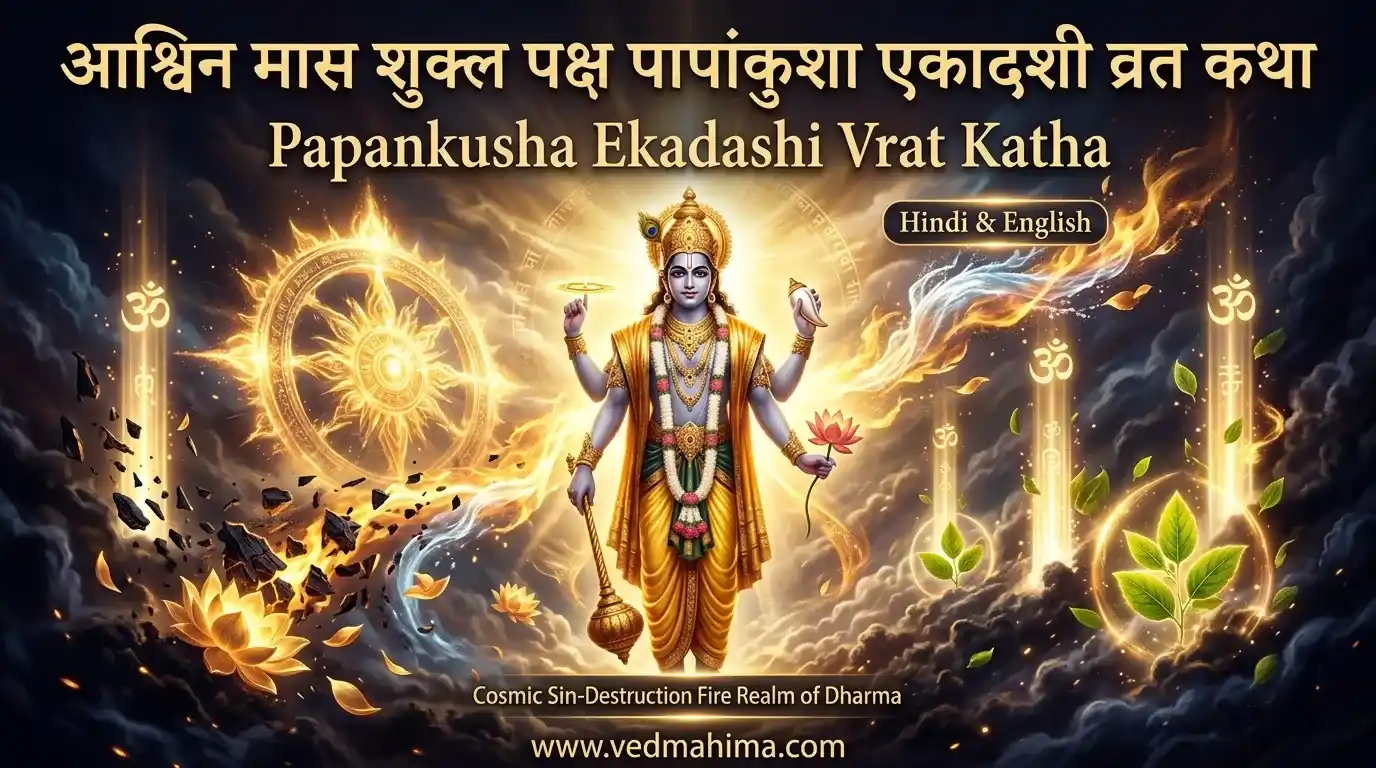
Ashvin Maas Shukla Paksha Papankusha Ekadashi Vrat Katha
Padmanabha puja, Hari-Har ekta, charity capacity rule, Ashvin Shukla vidhi
॥ Introduction ॥
Ashvin Shukla Ekadashi, widely celebrated across sacred scriptures as Papankusha Ekadashi, holds an exceptionally divine and highly powerful status in Sanatan Dharma. Falling during the holy bright fortnight of Ashvin month, this auspicious day acts as a sharp prod (Ankusha) to completely destroy all stubborn elephant-like accumulated sins (Papa). Observing this supreme fast burns away critical karmic impurities and instantly grants the synchronized twin blessings of heavenly comforts and absolute liberation (Mukti).
॥ Importance ॥
The cosmic importance of Papankusha Ekadashi is direct, unique, and immense. Lord Shri Krishna states that on this specific day, a devotee must worship Lord Vasudeva under His holy name ''Padmanabha''. The spiritual merit obtained by merely bowing down to the glorious carrier bird Garuda on this day equals the reward of executing rigid, long-term ascetic penances in dense forests. Furthermore, this single fast carries the unique power to deliver thirty generations of a devotee''s family lineage directly to Vishnu Dham.
॥ Puranic Reference ॥
The divine reference of this holy katha is derived from the eternal conversation between Lord Shri Krishna and King Yudhishthira during the Dwapar Yuga. Lord Krishna beautifully highlights the absolute unity between Lord Vishnu and Lord Shiva, warning humanity against the severe spiritual mistake of sectarian criticism. The text also explains how even the poorest individual can make their physical life structurally successful by executing daily scriptural bath and charity rituals according to their financial capacity.
॥ Story ॥
King Yudhishthira asked—O Madhusudana! Now, please be merciful and tell me which name of Ekadashi occurs during the bright fortnight (Shukla Paksha) of the month of Ashvin?
Lord Shri Krishna replied—O King! The Ekadashi that takes place in the bright fortnight of Ashvin is highly famous by the name of ''Papankusha''. It is the ultimate destroyer of all sins and is exceedingly excellent. On that holy day, for the complete attainment of all desires, human beings must perform the grand worship of Me, Vasudeva, under My cosmic name ''Padmanabha'', who is the absolute bestower of heaven and liberation.
The supreme spiritual fruit that a self-controlled sage obtains after executing rigid and severe ascetic penances for a long period, is easily attained on this day by merely bowing down with deep devotion before Lord Garudadhwaja (the Lord whose flag bears the symbol of Garuda). Whatever fruits exist across all holy pilgrimage sites and sacred temples on this earth, a human being effortlessly obtains all of them by merely performing the name-sankirtan (chanting the holy names) of Lord Shri Vishnu. Those who take absolute refuge in the all-pervading Lord Janardana, who holds the majestic Sharnga bow, never have to experience the agonizing torments of Yamaloka (the realm of death). If a person observes this Ekadashi fast even coincidentally or under the pretext of some other work, they never receive the painful punishments of Yamaraj.
O King! Listen to a critical spiritual truth: a person who claims to be a devotee of Lord Vishnu but systematically criticizes or insults Lord Shiva, never finds a place in the eternal spiritual realm of Lord Vishnu; he must definitely fall into the dark dimensions of hell. Similarly, if a follower of Shiva (Shaiva or Pashupata) criticizes or insults Lord Vishnu, he is thrown into the terrifying Raurava hell and is continuously cooked there until the total lifespan of fourteen Indras is completely exhausted. Therefore, there is absolute non-duality between Hari and Hara.
This sacred Papankusha Ekadashi is the direct bestower of heaven and salvation, a provider of perfect disease-free physical health, and a granter of a beautiful wife, abundant wealth, and loyal friends. O King! By fasting completely during the day and performing vigilant spiritual awakening (Jagaran) during the night on this Ekadashi, a human being effortlessly attains Vishnu Dham. O Ruler of men! The performer of this fast successfully delivers ten generations from his mother''s side, ten generations from his father''s side, and ten generations from his wife''s side—thus rescuing thirty generations in total. Such devotees, assuming a divine four-armed spiritual form, adorned with sacred garlands, wearing bright yellow silken garments (Pitambara), and riding the celestial carrier bird Garuda, enter the eternal spiritual realm of Lord Vishnu.
By merely observing the fast of Papankusha Ekadashi in the bright fortnight of Ashvin, a human being becomes entirely liberated from all sins and ascends to the planet of Shri Hari. Any individual who executes the donation of gold (Suvarna), sesame seeds (Til), land (Bhumi), cows (Gau), food grains (Anna), pure water (Jala), shoes (Jute), and umbrellas (Chhate) on this day, never has to see the terrifying face of Yamaraj. O best among men! Even a poor person must make his each day structurally successful by executing holy baths and scriptural charities according to his maximum capacity. Those who continuously perform sacred fire sacrifices (Homa), holy baths, mantra chanting (Japa), internal meditation (Dhyan), and standard Yagnas, never have to face the terrifying torments of death. Those individuals who are seen in this world as long-lived, highly wealthy, born in noble families, and entirely free from diseases, are actually the highly pious souls of past lifetimes. What is the use of speaking more on this subject? In short, human beings fall into degraded existences due to sin and ascend to heaven through righteousness (Dharma). O King! Whatever you had asked Me, I have beautifully detailed the complete glory of Papankusha Ekadashi accordingly.
॥ Moral of the Story ॥
- Absolute non-duality of Shiva and Vishnu is mandatory; criticizing one deity while claiming to worship the other leads directly to spiritual downfall and heavy hellish reactions.
- Spiritual practice is a shield against deathly fears; even an accidental or casual alignment with the rules of Ekadashi removes the painful torments of Yamaloka.
- Lineage redemption is a collective blessing; a single sincere devotee has the structural power to deliver thirty generations of ancestors to the higher spiritual realm.
- Charity is not limited by wealth but by intention; even a poor person must utilize their physical capacity to perform daily acts of scriptural bathing and giving to ensure structural success.
॥ Vrat & Worship Method ॥
- On Ashvin Shukla Ekadashi, wake up early in Brahma Muhurta, perform internal purification, and take a holy bath.
- Set up a beautiful altar, place an image of Lord Padmanabha (Vasudeva), and take a firm resolve (Sankalpa) to fast for the eradication of all sins.
- Perform the grand ritualistic worship using yellow cloth, fresh seasonal fruits, incense, lamps, and sacred Tulsi leaves.
- Bow down with immense devotion before the Garudadhwaja form of the Lord to absorb the equivalent merit of long-term ascetic penances.
- Chant the sacred names of Vishnu (Vishnu Sahasranama) and listen to the holy Papankusha text attentively during the day.
- Maintain a strict fast throughout the day, avoiding all forms of grains, rice, heavy salt, and unscriptural food items.
- Spend the entire night of Ekadashi in absolute spiritual vigil (Jagaran), remaining awake to sing bhajans and meditate on Lord Padmanabha.
- On Dwadashi morning, execute the morning prayers, perform the mandatory eight major charities (Ashtamahadan), feed the worthy Brahmins, and break the fast within the auspicious time.
॥ Rules for the Eight Great Charities (Ashtamahadan) ॥
- The Items for Liberation: Devotees must try to donate Gold, Sesame seeds, Land, Cows, Food grains, Water, Shoes, and Umbrellas to worthy Brahmins.
- Capacity-Based Rule: The text strictly clarifies that if a person is poor, they are not exempt; they must still donate smaller portions or execute maximum possible physical service to clear their daily karmic debt.
- Result: Executing these specific eight charities on Papankusha Ekadashi entirely shuts the gates of Yamaloka for the performer.
॥ Parana (Breaking the Fast) Method ॥
- The fast of Papankusha Ekadashi must be systematically broken on the Dwadashi Tithi, strictly after sunrise and after honoring the Brahmins with donations.
- Ensure that the specific duration of Hari Vasara has completely passed before breaking the fast.
- Consume holy water or simple Satvik food items to formally end the fast, keeping the continuous spiritual vibration secure.
॥ Benefits ॥
- Acts as a powerful cosmic prod to instantly destroy the most stubborn, heavy elephant-like sins accumulated over lifetimes.
- Guarantees the complete elevation and salvation of 30 generations (10 maternal, 10 paternal, and 10 from the spouse''s side).
- Grants absolute disease-free physical health, long life, immense wealth, noble lineage, and a beautiful harmonious family life.
- Completely removes the fear of death, shields the soul from the tortures of Yamaraj, and ensures direct entry into Vaikuntha Dham.
About Ashvin Maas Shukla Paksha Papankusha Ekadashi Vrat Katha
The Katha then gives a moral lesson: a Vishnu devotee who criticises Shiva, or a Shiva devotee who criticises Vishnu, falls, because Hari and Har are not different (see the Shiv Chalisa). It says the vrat gives health, family and friends, that fasting by day and a vigil by night gives Vishnu''s abode, and that ten generations each of the mother''s, father''s and wife''s side are uplifted.
It lists charities (gold, sesame, land, cow, grain, water, shoes, umbrella) and adds that even a poor person should make each day meaningful with bathing, giving and good deeds as far as they can. It ends by saying that people fall through sin and rise through dharma. These are matters of faith. The warmest lessons are respect for all forms of the divine and giving according to one''s means. The page also gives the vrat method, benefits believed in tradition and a short FAQ. Related: Vishnu Chalisa, Ekadashi Ki Aarti and Rama Ekadashi.
❓ Frequently Asked Questions
Question: When is Papankusha Ekadashi kept?
Answer: On the Shukla Paksha Ekadashi of Ashwin (usually October), the day after Dussehra in many years. Shukla Paksha months carry the same name in the purnimanta and amanta calendars, so only the date needs checking in a local panchang.
Question: What does Papankusha mean?
Answer: Ankusha is the goad used to control an elephant. The name suggests that the vrat controls the "elephant" of sin.
Question: Which form of Vishnu is worshipped?
Answer: Vasudeva as Padmanabha (see the Vishnu Chalisa).
Question: What does the Katha say about Vishnu and Shiva?
Answer: It warns against a Vishnu devotee criticising Shiva or a Shiva devotee criticising Vishnu, and teaches that Hari and Har are not apart (see the Shiv Chalisa). The message is respect for all forms of the divine.
Question: What charity does the Katha name, and what if I am poor?
Answer: Gold, sesame, land, cow, grain, water, shoes and umbrella. It adds that even a poor person should make each day meaningful by giving and doing good as far as they can, so a glass of water or a pair of shoes given with love counts.
Question: Does the vrat really free thirty generations?
Answer: The Katha says ten generations each of the mother''s, father''s and wife''s side. This is a matter of faith and a devotional way of honouring family. Fast according to health. Sing the Ekadashi Ki Aarti after the puja.