Shri Amarnath Cave Temple Kashmir
Shri Amarnath Cave Temple Kashmir Complete Yatra Guide
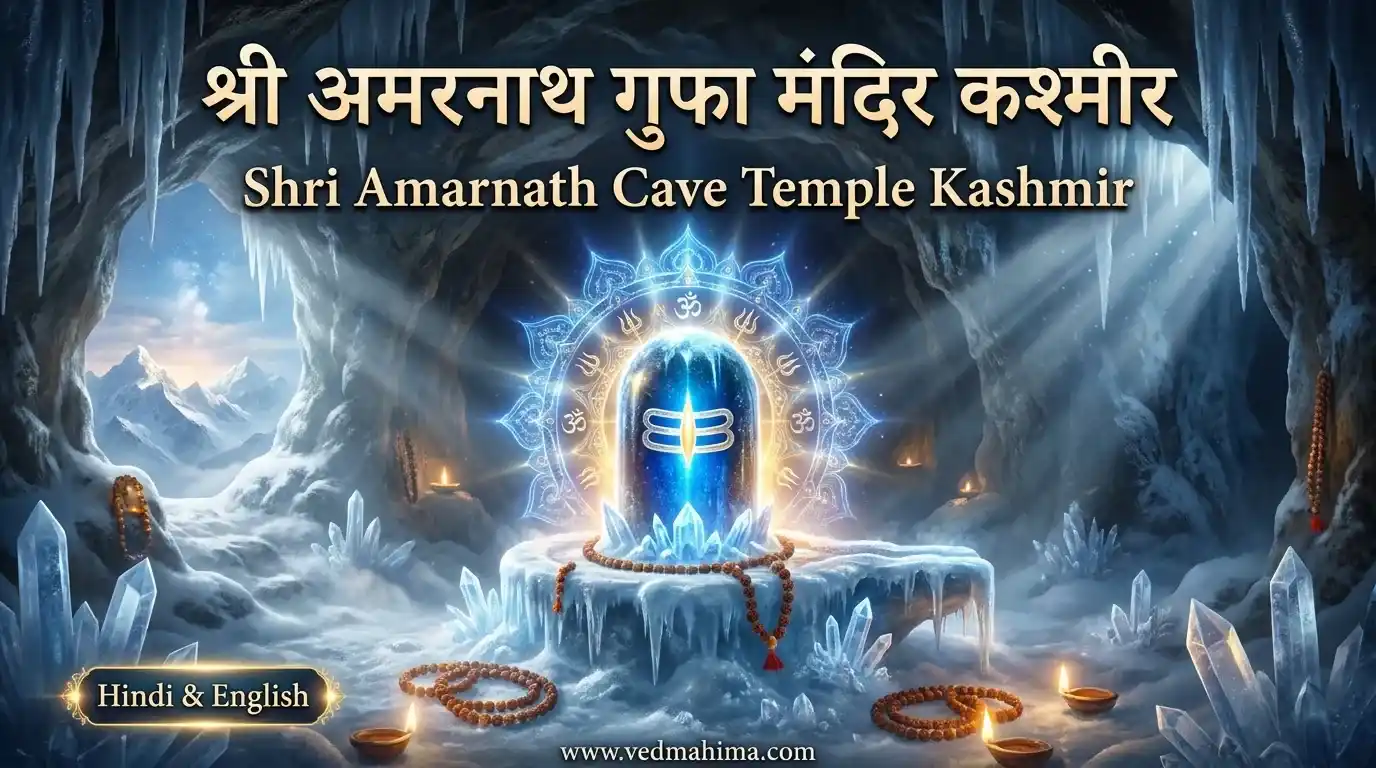
* The Request of Mata Parvati: According to the Amar Katha, Goddess Parvati asked her divine consort, Lord Shiva, to reveal the secret of his immortality (Amar Katha) and why he wears a necklace of skulls, representing her many short human rebirths while he remains eternal.
* Seeking Absolute Isolation: Lord Shiva agreed to narrate the supreme secret but insisted on finding an absolute, uninhabited space where no living mortal or creature could overhear the cosmic words, as anyone who heard it would become immortal instantly. He chose the remote, ice-locked cave of Amarnath.
* Leaving Behind Worldly Elements: On his way to the cave, Shiva left his earthly companions at various transit points to ensure absolute purity: his bull Nandi at Pahalgam, the crescent moon from his hair at Chandanwari, his snake necklace at Sheshnag, his son Lord Ganesha at Mahagunas Top, and the five fundamental elements (Pancha-Bhoota) at Panjtarni. He then entered the cave with the Goddess.
* The Tale of the Two Pigeons: To ensure complete isolation, Lord Shiva created a divine fire circle around the cave to destroy all signs of life. However, beneath a deerskin rug inside the cave lay a pair of unhatched pigeon eggs. As Shiva narrated the Amar Katha, the eggs hatched, and the twin pigeons overheard the cosmic secret. They achieved absolute immortality and are still seen by fortunate pilgrims flying inside the sub-zero cave complex today.
* The Shravani Mela & Annual Yatra Launch: The core celebration of Amarnath spans a rigorous 45 to 60 days during the summer months of Shravan (July-August). The festival officially kicks off with the highly auspicious Pratham Puja (First Prayer), conducted inside the cave by top Vedic seers and board officials to seek Lord Shiva's permission and protection for the incoming waves of lakhs of pilgrims. The entire mountain tracks from Baltal and Pahalgam turn into a vibrant spiritual highway, echoing with continuous chants of Bam Bam Bhole and Har Har Mahadev.
* The Tradition of Chhari Mubarak: The absolute spiritual high point and conclusion of the Mahotsav is centered around the Chhari Mubarak—the holy saffron-cloaked silver mace of Lord Shiva. This ancient holy mace is traditionally kept at the Dashnami Akhara in Srinagar. Led by the custodian saint (Mahant), a grand religious procession carries the Chhari Mubarak on foot across the traditional Pahalgam route. Along the track, grand prayers and Vedic rituals are performed at various base camps. The mace finally enters the Amarnath Cave on the auspicious day of Raksha Bandhan (Shravan Purnima), marking the official culmination of the annual pilgrimage cycle.
* A Living Miracle of Communal Brotherhood: A deeply unique and beautiful aspect of the Amarnath Mahotsav is its structural reliance on local Kashmiri Muslims, primarily belonging to the Malik clan of Batakot. Historically rediscovered by a Muslim shepherd named Buta Malik in the 15th century, the local community plays an indispensable role today. They manage horse tracks, carry elder pilgrims on palanquins (pithoos), set up tented townships, and offer continuous support to Hindu sadhus and devotees, standing as India's finest living model of inter-faith harmony.
* Massive Bhandara Infrastructure & Spiritual Seva: Across both the Baltal and Pahalgam axes, non-profit spiritual organizations from all over India set up massive, highly organized community kitchens (Bhandaras). These kitchens operate 24/7 throughout the festival, providing free hot vegetarian meals, medical aid, warm clothing, and shelter to thousands of pilgrims daily, turning the rugged Himalayan wilderness into a giant sanctuary of selfless service.
* By Road (The Twin Yatra Axes): Pilgrims must first reach either Jammu or Srinagar via national expressways. From Srinagar, the Yatra bifurcates into two distinct routes: 1. The Traditional Pahalgam Axis: Srinagar to Pahalgam (95 km) via NH-1, followed by a 45 km mountain trek passing through Chandanwari, Sheshnag, and Panjtarni. This route is gradual but takes 3 to 4 days. 2. The Steep Baltal Axis: Srinagar to Baltal (92 km) via Sonamarg, followed by a steep, challenging 14 km single-day trek directly to the cave. The Jammu-Srinagar National Highway (NH-44) serves as the primary road lifeline for all long-distance travelers driving up from northern India.
* By Train (Rail Link Infrastructure): The nearest pan-India railhead is the Jammu Tawi Railway Station (JAT), located approximately 290 km from the base camps. Jammu Tawi receives ultra-premium, high-speed trains like the Vande Bharat Express, Rajdhani Express, and Duronto from Delhi and Mumbai. From Jammu, the Shri Amarnathji Shrine Board and state transport operate highly coordinated, security-escorted bus convoys and private tourist vehicles to transport pilgrims safely to the Pahalgam or Baltal base stations.
* By Air & Helicopter Access (Fastest Transit): The absolute fastest route is flying into the Sheikh ul-Alam International Airport in Srinagar (SXR), which is linked via multiple daily flights to Delhi, Mumbai, and Jammu. From the airport, travelers can hire private tourist cabs to reach the base camps. To bypass the grueling multi-day foot trek, official Helicopter Services operate continuously from both Baltal (to Panjtarni) and Pahalgam (to Panjtarni), subject to clear Himalayan weather conditions. From the Panjtarni helipad, the holy cave is a manageable 6 km trek.
⏰ Best Time
The Amarnath Cave Temple is legally open to mankind for only a brief window of 45 to 60 days annually, during the mid-summer months of July and August (corresponding to the Hindu Shravan month). Therefore, the absolute best and only time to visit the shrine is during this designated government window. For an optimal experience, completing the yatra in the first few weeks of July is highly recommended to view the natural ice lingam in its grandest and tallest structural size before it begins to melt naturally due to atmospheric heat.
🛕 Temple Information
Shri Amarnath Cave, Mountain Axis via Pahalgam or Baltal, Anantnag District, Jammu & Kashmir - 192126
[ Annual Yatra Window - July to August Only ]
• Mountain Track Access Gates Open (Base Camp): 05:00 AM
• Holy Cave Entry for Darshan: 06:00 AM to 04:30 PM
• Daily Morning Maha Aarti inside Cave: 06:30 AM
• Daily Evening Maha Aarti inside Cave: 05:00 PM
• Night Halting inside/near Cave: Strictly Prohibited (Gates Close at 05:00 PM)
sasbjk2001@gmail.com
https://jksasb.nic.in/
🔗 Related Trending Mandir






About Shri Amarnath Cave Temple Kashmir
The historical narrative of the Shri Amarnath Cave is tightly woven with prehistoric Himalayan asceticism and the historic timeline of the Kashmir valley. Centuries before its modern administration, the cave found exhaustive references in the ancient 6th-century text Nilamata Purana and later in the epic historical chronicle Rajatarangini written by the Kashmiri scholar Kalhana, who noted that kings and ascetics like King Sandiman (34 BC) regularly trekked to these heights for spiritual realization. The cave was also documented in the medieval era by the French physician Francois Bernier during his visit with Emperor Aurangzeb in 1663. In the late 15th century, after a period of harsh climatic changes made the route temporarily inaccessible, the cave's exact path was rediscovered by a local Muslim shepherd, Buta Malik, who was given a bag of charcoal by a holy hermit that miraculously turned into pure gold, prompting the family to safeguard the shrine. The operational lineage of the temple was structurally stabilized by the great Adi Shankaracharya, who integrated the traditional Dashnami Sanyasi monastic structure to manage the sacred Chhari Mubarak procession, establishing an unbroken link of Vedic fire sacrifices and glacial meditation that remains protected to this day.