Chandrodaya Mandir Vrindavan
Chandrodaya Mandir Vrindavan Complete Yatra Guide
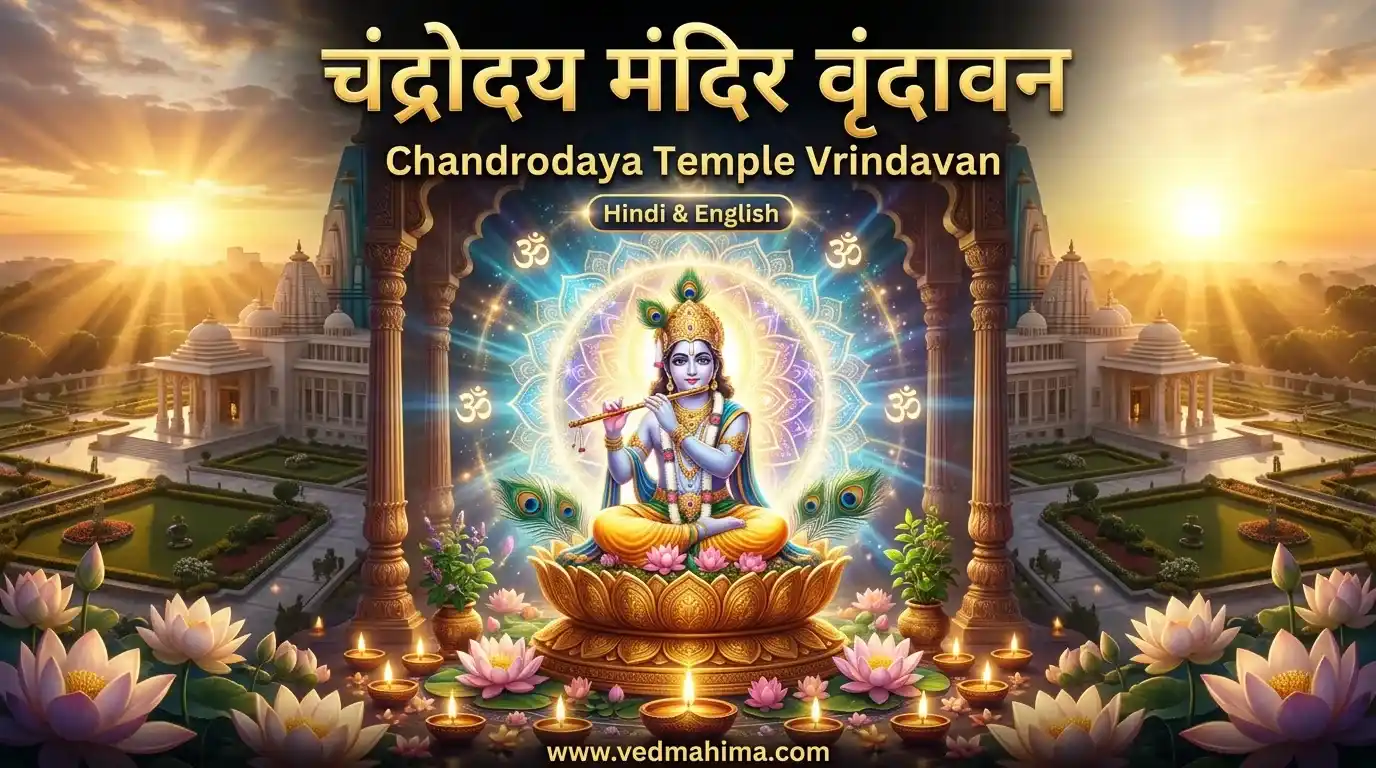
* The Vision of Srila Prabhupada: In the early 1970s, the founder-acharya of ISKCON, A.C. Bhaktivedanta Swami Prabhupada, stated that there should be a grand, skyscraper temple in Vrindavan that would attract affluent global citizens and intellectuals to witness the timeless philosophy of Sri Krishna. The layout of this structure directly executes that foundational instruction.
* The Re-creation of the Twelve Holy Forests: A highly unique dynamic feature of the temple landscape is the multi-acre ecological restoration project. The complex recreates the exact descriptions of the twelve legendary forests (Dvadasha Vana) of Braj as mentioned in the Vishnu Purana and Srimad Bhagavatam. These include Mahavana, Vrindavana, Madhuvana, and Bhandiravana, complete with artificial water bodies, mountain paths, and indigenous flora.
* The Grand Capsule Elevator Ride: Embedded inside the architectural core is a high-speed glass capsule elevator that travels up through a virtual planetary planetarium (Vedic Cosmos). This ride transports visitors to a high-altitude viewing gallery, giving them a bird's-eye view of the Yamuna River and the entire sacred landscape of Mathura-Vrindavan.
* The Grand Sri Krishna Janmashtami Festival: The absolute peak of religious fervor takes place during August/September to celebrate the appearance day of Lord Krishna. Over a million pilgrims converge on the temple platforms. The main deities are bathed in an elaborate, multi-hour Maha-Abhisheka containing rare herbs, fruit juices, and sacred elements, while the air continuously echoes with the high-pitched congregational chanting of the Hare Krishna Maha-Mantra.
* The Kartik Month Deepotsav & Damodara Lila: During the holy month of Kartik (October/November), the entire temple perimeter is decorated with tens of thousands of traditional clay oil lamps. Pilgrims gather every evening to offer lamps to Lord Damodara while singing the beautiful Damodarashtakam prayers, creating a spectacular display of communal devotion.
* Radhashtami and Jhulan Yatra: Celebrated with intense aesthetic care, these festivals feature gorgeous floral swings and custom-designed silken garments for the deities, accompanied by continuous community kitchens (Annakut) serving sanctified vegetarian food to all visitors.
* Mangala Aarti: At 04:30 AM, the altar gates open, drawing thousands into a high-energy morning dance and chanting session to awaken the divine forms.
* Sringar & Darshan Aarti: At 07:15 AM, the deities are unveiled in their daily custom-designed garments, accompanied by the singing of Srila Vishvanatha Chakravarti Thakura's Gurvastakam.
* Raja Bhog Aarti: At 12:30 PM, a grand multi-course traditional vegetarian feast is offered to the Lord, after which the gates close for afternoon rest.
* Sandhya Aarti: At 07:00 PM, the grand sunset ritual takes place. The entire main hall fills with the thunderous resonance of traditional mridangas, kartals, and brass horns, timed with the evening lighting panels.
* Shayan Aarti & Kapat Closing: At 08:30 PM, the final peaceful prayers are offered, and the silver altar gates are sealed for the night.
* By Road and Highway Network (Yamuna Expressway Axis): Vrindavan is highly accessible via the multi-lane Yamuna Expressway and the National Highway 19 (NH-19 / Delhi-Agra Highway). The road distance from New Delhi is roughly 140 km and takes about 2 to 2.5 hours via private luxury cabs or regular state transport buses (UPSRTC) that stop directly at the Chhatikara crossing entrance of Vrindavan town.
* By Rail Infrastructure (Mathura Junction - MTJ): The primary high-capacity railway terminal is the Mathura Junction Railway Station (MTJ), located just 12 km from the temple site. Mathura is a vital national rail hub connected directly to Delhi, Mumbai, Chennai, and Kolkata via premium high-speed trains like the Bhopal Shatabdi and various Rajdhani Expresses. From the station exit, local pre-paid auto-rickshaws, app-based cabs, and shared shuttles are available 24/7.
* By Air Transit (Jewar Noida International Airport & Agra Airport): The fastest international transit route is via the upcoming Noida International Airport at Jewar, located roughly 75 km away from Vrindavan. Alternatively, the Jinnah-adjacent domestic gateway of Indira Gandhi International Airport (DEL) in Delhi is 150 km away. From Jewar or Delhi airports, express tourist taxis can be booked to reach the temple base via the highway bypass in under 1.5 to 2 hours.
⏰ Best Time
The ideal and most comforting climate window to undertake the pilgrimage to Vrindavan Chandrodaya Mandir is during the winter months from October to March. During this period, the weather of the Braj region is highly pleasant for outdoor explorations. Planning the visit during Janmashtami or the Kartik month is highly recommended to experience the full spiritual splendor.
🛕 Temple Information
Chandrodaya Mandir, Bhakti Vedanta Swami Marg, Chhatikara Road, Vrindavan, Mathura District, Uttar Pradesh, India - 281121
• Main Complex Access Gates Open: 04:15 AM
• Morning Mangala Aarti & Kirtan: 04:30 AM to 05:15 AM
• Morning Darshan Reopens: 07:15 AM to 01:00 PM
• Afternoon Temple Closing for Bhog: 01:00 PM to 04:30 PM
• Evening Darshan Timings: 04:30 PM to 08:30 PM
• Evening Main Sandhya Aarti: 07:00 PM
• Night Final Kapat Closing: 08:30 PM
• Note: During Janmashtami Mahotsav, gates remain open for public darshan continuously for 24 hours.
77259-77260
helpdesk@vcm.org.in
https://www.vcm.org.in
🔗 Related Trending Mandir
About Chandrodaya Mandir Vrindavan
The long-term development lineage of Vrindavan Chandrodaya Mandir is managed under the strict supervision of the Vrindavan Chandrodaya Mandir Trust associated with ISKCON Bangalore. The operations incorporate high-tech crowd monitoring systems, underground parking facilities for thousands of vehicles, international standard guest houses, and massive centralized clean community kitchens capable of feeding over a hundred thousand pilgrims daily, ensuring that the ancient Vedic traditions of Braj are served through cutting-edge modern hospitality structures.