Shri Ekambareswarar Temple Kanchipuram
Sree Ekambareswarar Temple Kanchipuram Darshan Guide
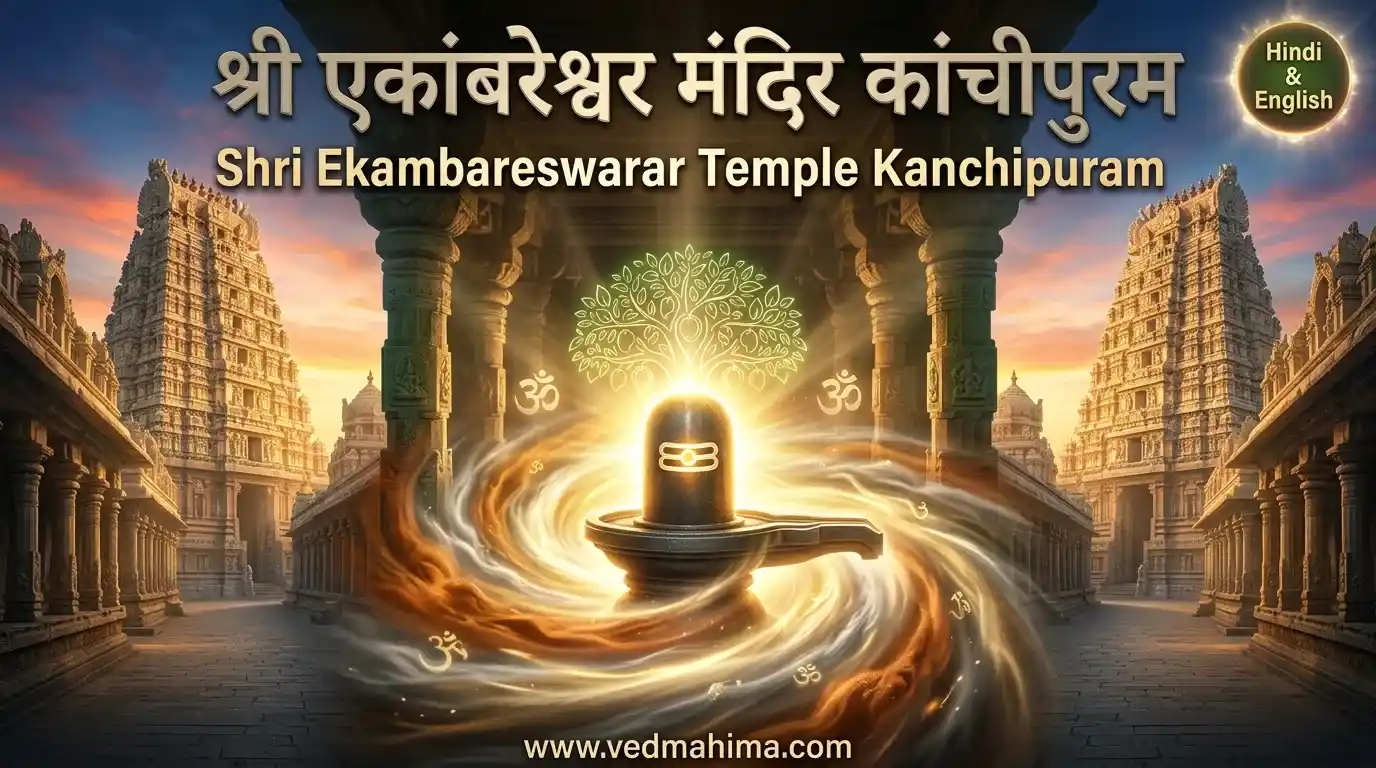
* The Immortal 3,500-Year-Old Mango Tree: The spiritual epicenter of the outer courtyard is the divine Sthala Vriksham—an ancient mango tree believed to be over 3,500 years old. Miraculously, this single tree possesses four distinct major branches, each representing one of the four holy Vedas (Rig, Yajur, Sama, and Atharva). The mangoes from these branches yield four entirely different tastes, symbolizing the diverse paths to reaching the one Supreme Truth.
* The Sand-Molded Prithvi Lingam: The principal deity in the sanctum sanctorum is a self-manifested (Swayambhu) sand Lingam. Because it is composed purely of earth/sand, no liquid abhishekams (water, milk, or oil) are ever performed directly on the idol. Instead, the sacred rituals and organic aromatic oils are offered only to the brass Avudaiyar (base) to fully protect the ancient structure.
* The Majestic Hall of a Thousand Pillars: Inside the inner complex lies the stunning Aayiram Kaal Mandapam (1,000-pillar hall), built during the Vijayanagara era. Walking through this vast granite maze reveals intricate carvings of divine guardians, yalis, and musical pillars that resonate when tapped gently.
* The Unique 108 Shiva Lingam Corridor: The inner covered corridor features a breathtaking spiritual alignment of 108 auspicious miniature stone Shiva Lingams carved precisely out of a single continuous granite rock face, creating an intense meditative walkway for pilgrims.
1. Ushathkala Puja (06:00 AM - 06:30 AM): The morning activation where the sanctum is opened amidst the chanting of Sri Rudram and the blowing of sacred pipes. The deity is adorned with fresh bilva leaves, initializing the day's earthly energies.
2. Kalasandhi Puja (07:30 AM - 08:30 AM): The secondary morning ritual where special cooked rice offerings and freshly prepared organic sweet dishes are presented to the deity. Public lines move exceptionally fast during this peaceful hour.
3. Uchikala Puja & Midday Closure (11:30 AM - 12:30 PM): The highly intense midday phase where elaborate multi-tiered camphor lamps are waved before the Prithvi Lingam. The temple then closes strictly for afternoon rest from 12:30 PM to 04:00 PM.
4. Sayarakshai Puja (06:00 PM - 07:00 PM): The grand evening twilight phase. The entire granite structure echoes with high-energy Tamil Shaivite hymns (Thevaram and Thiruvasagam) as traditional brass lamps illuminate the dark, ancient inner corridors.
5. Arthajama Puja & Night Closure (08:30 PM - 09:00 PM): The final concluding ritual of the day. A peaceful lullaby offering is made to the Lord, and the inner cosmic chambers are securely locked by the priests until the next dawn.
* Respecting the Sacred Mango Tree: The ancient Sthala Vriksham is protected by a dedicated stone and steel perimeter. Pilgrims are strictly prohibited from plucking leaves, pulling branches, or throwing coins onto the tree. Devotees wait under the designated zone to catch naturally falling leaves or fruits, which are considered highly miraculous blessings for fertility and marriage.
* Photography Restrictions: While photography is permitted in the open outer courtyards and near the grand Raja Gopuram, taking photos, recording videos, or using mobile phones inside the dark inner stone sanctum sanctorum (Moolasthanam) is completely banned and subject to confiscation of equipment.
* Maha Shivaratri: Celebrated during February-March, the temple remains open throughout the entire night. Thousands of devotees converge to participate in the four distinct Yaama Pujas performed with sacred hymns, turning the 25-acre complex into a sea of spiritual devotion.
* Navaratri & Deepavali: Special decorative illumination phases during October-November where the temple's 1,000-pillar hall is beautifully lit with clay lamps, and special floral decorations are offered to the processional deities (Utsava Murti).
* By Train (Detailed Railway Network): Kanchipuram features its own railway station (CJ), which is well-connected by regular passenger and express trains via the Chennai suburban rail network and Tirupati links. For major long-distance trains from North or Western India, Arakkonam Junction (AJJ) and Chengalpattu Junction (CGL), located about 35 kilometers away, serve as excellent railway transit points.
* By Road (Detailed Highway Navigation): Kanchipuram is perfectly connected via the Chennai-Bangalore National Highway (NH 48). The Tamil Nadu State Transport Corporation (TNSTC) operates a continuous fleet of ultra-frequent buses running every 10 minutes between Chennai (Koyambedu CMBT) and Kanchipuram. The drive takes around 1.5 to 2 hours through smoothly paved multi-lane expressways.
⏰ Best Time
The best time to visit the Sree Ekambareswarar Temple is from October to March during the pleasant winter window. Temperatures in Kanchipuram fluctuate smoothly between 20°C and 28°C during these months, making it perfect to comfortably explore the vast 25-acre complex and comfortably stand in the festival queues. It is highly recommended to avoid the intense summer months (April to June) when the regional heat index hits up to 40°C, causing extreme humidity and physical exhaustion during day treks.
🛕 Temple Information
Sree Ekambareswarar Temple Complex, Ekambaranathar Sannathi Street, Periya Kanchipuram, Tamil Nadu - 631502
Temple Main Gates Daily Operating Hours:
Morning Window (Open): 06:00 AM - 12:30 PM
Evening Window (Open): 04:00 PM - 09:00 PM
Authentic Daily Ritual & Puja Schedule:
Ushathkala Puja (Morning Initialization): 06:00 AM - 06:30 AM
Kalasandhi Puja (Morning Offering): 07:30 AM - 08:30 AM
Kakazha Puja Ritual: 10:30 AM
Maha Uchikala Puja (Midday Offering): 11:30 AM - 12:30 PM
Evening Reopening Doors: 04:00 PM
Sayarakshai Puja (Twilight Camphor Lamps): 06:00 PM - 07:00 PM
Arthajama Puja & Final Night Lullaby: 08:30 PM - 09:00 PM
*Note: Timings are extended up to midnight during the massive Maha Shivaratri night and the annual Panguni Uthiram festival days.
🔗 Related Trending Mandir
About Shri Ekambareswarar Temple Kanchipuram
The historical origin of the Sree Ekambareswarar Temple is embedded within deep Sangam antiquity, dating back over 1,500 years. It has been extensively praised in the 7th-century Tevaram hymns by the ancient Shaivite saints Appar and Sambandar. Originally founded and constructed by the Pallava Dynasty, who made Kanchipuram their imperial capital, the temple underwent magnificent structural Expansions under the medieval Chola Emperors, who added massive stone walls and inner corridors. The defining golden era of the temple culminated in the 16th century under the legendary Vijayanagara King Krishnadevaraya, who constructed the monumental 192-foot-tall southern Raja Gopuram and the iconic thousand-pillar hall. The temple acts as a living historical registry, featuring dozens of authentic stone inscriptions detailing generous land donations and royal gold gifts by various dynamic dynasties of Southern India.