Shri Govind Dev Ji Temple Jaipur
Shree Govind Dev Ji Temple Jaipur Darshan Guide
🙏 Devotional
🔥 Powerful
📿 Daily Prayer
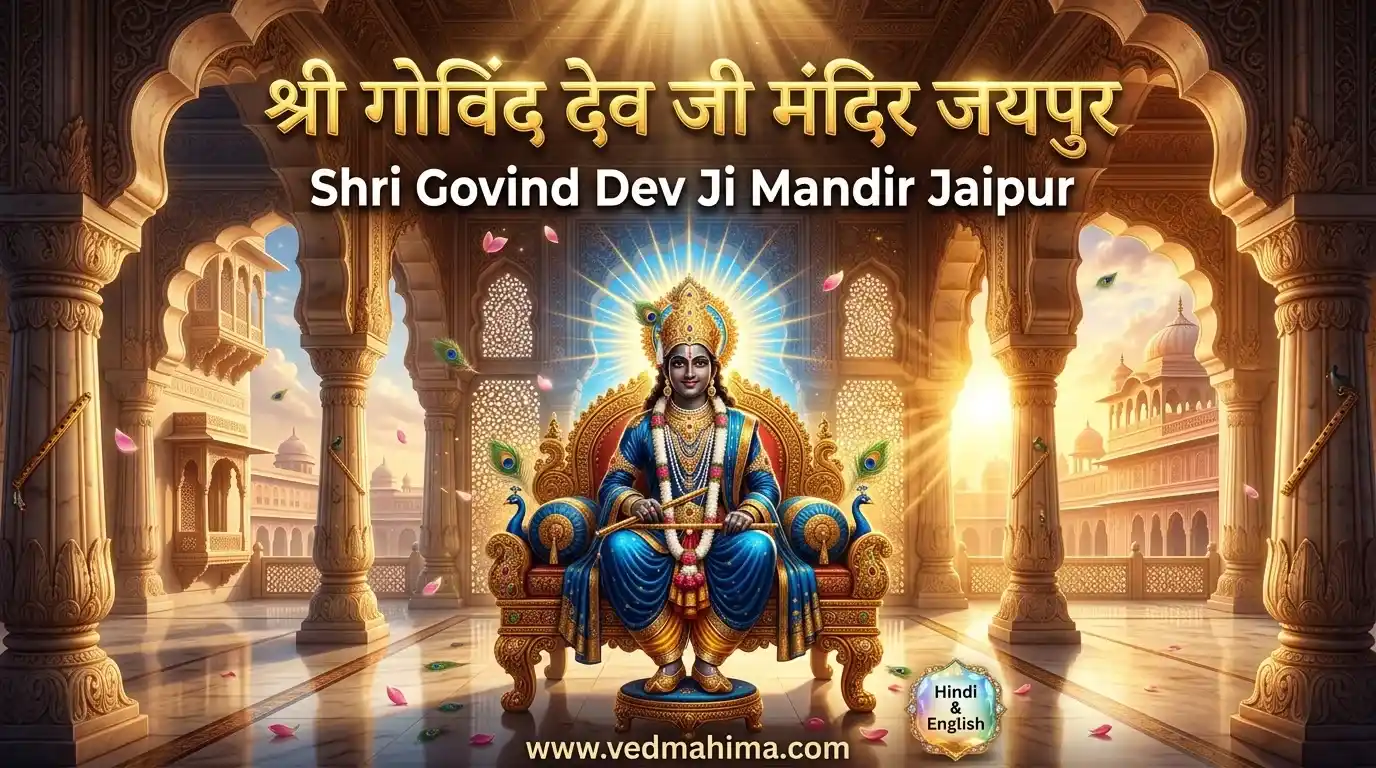
॥ Temple Overview & Divine Glory ॥
Shri Govind Dev Ji Temple, located within the prestigious City Palace complex in the pink city of Jaipur, Rajasthan, is one of the most sacred, historically monumental, and spiritually vibrant seats of Vaishnavism in the world. The temple is dedicated to Lord Krishna, who is worshipped here as Govind Dev Ji—the ultimate king and heart of Jaipur. According to deep scriptural legends, the central deity is extraordinarily unique: it is a Mundan-Chhavi (a face reflecting the exact, divine countenance of Lord Krishna), carved 4,900 years ago by Krishna's great-grandson, King Vajranabha. For the people of Jaipur and the royal family, Govind Dev Ji is not merely a deity, but the actual, living ruler of the city, while the kings historically served as His prime ministers (Diwans). Taking Darshan of this magnificent form is said to instantly cleanse the heart of material impurities, grant inner peace, and immerse the soul in pure, ecstatic Krishna-Prema.॥ Key Spiritual & Structural Aspects ॥
* The Live Counterpart of Vrindavan: The sacred deity originally resided in a magnificent seven-storeyed red sandstone temple in Vrindavan. To protect the Lord from iconoclastic Mughal invasions in the late 17th century, the deity was safely moved through Rajputana and finally enshrined in Jaipur by Maharaja Sawai Jai Singh II.* Guinness World Record Architecture: The temple is renowned for its architectural marvel—the Satsang Bhawan. Built in 1735, it features a monumental single-span flat roof constructed without any supporting pillars, which earned it a prestigious place in the Guinness Book of World Records.
* The Surya Mahal Alignment: The temple was intentionally constructed inside the Jai Niwas Garden such that Maharaja Sawai Jai Singh II could directly gaze upon the deity's inner sanctum from his royal seat at the Chandra Mahal palace.
* The Heart of Gaudiya Sampradaya: It stands as one of the most prominent, high-vibrational centers for the Gaudiya Vaishnava sect, drawing millions of global seekers who sit together to sing ecstatic congregation kirtans.
॥ The Ritualistic Cycle: Divine Daily Jhanki Aartis ॥
The daily schedule at the temple is organized into 7 distinct, highly cinematic Jhankis (glimpses). The timings are precisely calibrated according to seasonal sunrises and sunsets:1. Mangala Jhanki (04:45 AM - 05:15 AM Summer / 05:15 AM - 05:45 AM Winter): The first awakening window of the day, filled with high-energy conch blowing and devotional morning ragas.
2. Dhoop Jhanki (07:30 AM - 08:15 AM Summer / 08:00 AM - 08:45 AM Winter): Pure incense offerings are presented while the Lord is prepared for the morning ceremonies.
3. Shringar Jhanki (09:30 AM - 10:15 AM Summer / 09:45 AM - 10:30 AM Winter): The primary morning viewing where Govind Dev Ji is adorned with breathtaking royal crowns, heavy jewelry, and fresh garlands.
4. Gwal Jhanki (11:00 AM - 11:30 AM Summer / 11:15 AM - 11:45 AM Winter): Symbolizes the time when Lord Krishna takes His cows to the pastures; sweet milk offerings are presented.
5. Rajbhog Jhanki (11:45 AM - 12:30 PM Summer / 12:00 PM - 12:45 PM Winter): A lavish afternoon feast featuring premium traditional Rajasthani and Vedic delicacies is offered before afternoon closure.
6. Sandhya Jhanki (05:30 PM - 06:30 PM Summer / 05:00 PM - 06:00 PM Winter): Breathtaking twilight lamp offerings where thousands gather in the open hall, swaying to ecstatic drumming and kirtan.
7. Shayan Jhanki (08:30 PM - 09:15 PM Summer / 08:00 PM - 08:45 PM Winter): The final night prayers and sweet resting songs before the inner silver doors are locked for the night.
॥ Detailed Code of Conduct & Pilgrimage Guidelines ॥
* Strict Dress Code Architecture: To uphold the spiritual purity and majestic royal heritage of this ancient dham, all visiting pilgrims must dress in modest, socially acceptable attire. Men are highly encouraged to wear dhotis, kurtas, or simple trousers, while women should wear sarees or traditional salwar suits. Wearing highly casual modern Western outfits such as short skirts, distressed or ripped jeans, shorts, sleeveless tops, or revealing clothes is strictly forbidden within the holy courtyard.* Absolute Photography & Electronics Ban: Taking photographs, capturing digital videos, or operating mobile phone cameras inside the main pillarless hall and near the inner sanctum (Garbhagriha) is completely prohibited. Devotees must keep their mobile phones on silent or switched-off mode. Violating this rule or attempting to photograph the sacred deity is treated as a major offense against temple decorum.
* Footwear & Crowd Management: Footwear must be deposited safely at the official, well-managed free shoe counters located outside the primary palace-style gateways. Due to the massive influx of thousands of local devotees during peak morning and evening Jhankis, pilgrims are advised to move in disciplined lines, avoid rushing, and strictly follow the directions of the security personnel.
* Belongings & Valuables Caution: While there are no heavy luggage lockers inside the central courtyard, devotees are advised to carry minimal items. Keep your wallets, mobile devices, and personal gold ornaments highly secure, especially during crowded festival days and evening sandhya aartis.
॥ Major Festivals Celebrated In Full Splendor ॥
* Shri Krishna Janmashtami: This is the crowning annual festival of Govind Dev Ji Temple, attracting over a million devotees in a single day. The entire palace complex is illuminated with grand decorative lighting. A spectacular mid-night Maha-Abhishek (holy bathing ritual) with milk, curd, honey, and saffron is performed amidst a 21-gun salute by the state authorities, followed by ecstatic celebrations that last until dawn.* Holi & Phag Utsav: Celebrated for several days in the month of Phalgun, this festival transforms the temple into a divine playground. The deity is showered with natural gulal, real flower petals, and saffron-scented waters. Renowned classical artists from across India perform traditional Phag songs, Kathak dances, and Rasleela inside the massive Satsang Bhawan.
* Radhashtami: The appearance day of Srimati Radharani is celebrated with immense joy. Special Chhappan Bhog (56 holy delicacies) are offered, and the deities are dressed in premium golden or red silk costumes, surrounded by special devotional congregational chanting.
* Sharad Purnima: On this auspicious full moon night, the Lord is dressed in pristine, dazzling white silk attire adorned with real pearls. The entire courtyard is bathed in moonlight, and traditional Kheer (sweet rice pudding) that has been blessed under the moonbeams is distributed to thousands of pilgrims.
॥ Comprehensive Routing Guide: How to Reach Jaipur ॥
* By Air (Detailed Flight Route): The primary domestic and international gateway is Jaipur International Airport (JAI), situated in Sanganer, approximately 14 kilometers south of the temple complex. The airport is flawlessly connected with daily direct flights to major Indian metros like New Delhi, Mumbai, Bangalore, Hyderabad, and Kolkata, as well as international hubs in the Middle East. From the arrival terminal, travelers can seamlessly hire pre-paid airport luxury cabs, app-based taxis (Uber/Ola), or radio taxis, reaching the City Palace complex in roughly 35 to 45 minutes via the JLN Marg route.* By Train (Detailed Railway Network): The central rail head is Jaipur Junction (JP), located about 5 kilometers west of the temple. Jaipur Junction is a major category-A network hub receiving high-speed superfast trains, including the Vande Bharat Express, Shatabdi Express, and luxury tourist trains from New Delhi, Agra, Ahmedabad, and Mumbai. Outside the station, pilgrims have instant 24/7 access to computerized pre-paid auto-rickshaws, cycle-rickshaws for shorter heritage routes, direct private cabs, and localized low-floor city buses that drop you right at the Badi Chopad or City Palace gates within 15 to 20 minutes.
* By Road (Detailed Highway Navigation): Jaipur is highly accessible via an exceptional network of multi-lane national highways. If driving from New Delhi-NCR, one can take the ultra-modern Delhi-Mumbai Expressway or the National Highway 48 (NH-48), completing the comfortable 260-kilometer road journey in approximately 4 to 4.5 hours. Furthermore, the Rajasthan State Road Transport Corporation (RSRTC) operates a massive fleet of premium Volvo, air-conditioned sleeper, and standard deluxe buses from Delhi's ISBT Kashmiri Gate and Bikaner House, arriving at the central Sindhi Camp Bus Stand in Jaipur, which is just 4 kilometers away from the temple.
🙏 ॥ Thus completed ॥ 🙏
The Hindi text has been compiled based on original and authentic sources. If there is any difference,
error, or inconsistency between the Hindi and English versions, the Hindi text shall be considered the
authoritative version. If there are any errors or copyright-related concerns regarding this content,
please contact us.
📜 प्रामाणिक स्रोत:
📖 सार्वजनिक रूप से उपलब्ध स्रोत
📖 आधिकारिक मंदिर रिकॉर्ड
📖 सरकारी पोर्टल
📖 सत्यापित ऑनलाइन संदर्भ
About Shri Govind Dev Ji Temple Jaipur
The ancient history of the Govind Dev Ji deity is deeply intertwined with legendary eras and the golden history of the Rajput clans. Originally carved by King Vajranabha around 3,200 BC, the deity was lost in time until it was excavated by Srila Rupa Goswami, a chief disciple of Chaitanya Mahaprabhu, in the holy soils of Vrindavan in 1515. Impressed by the intense devotion, Akbar's general, Raja Man Singh of Amber, built a colossal, red sandstone temple in Vrindavan for the Lord in 1590. However, in 1669, during the fanatical rule of Aurangzeb, orders were issued to raze the temple. To protect the divine form, the priests secretly smuggled Govind Dev Ji out of Vrindavan, moving across various hiding spots in Rajputana, including Radhakund, Khawa, and Govindgarh. In 1715, the deity arrived in the valley of Amber. When Maharaja Sawai Jai Singh II founded the planned city of Jaipur in 1727, he officially consecrated Govind Dev Ji inside the central pavilion of his royal gardens, known as Surya Mahal. The Maharaja formally handed over the entire kingdom of Jaipur to Lord Govind Dev Ji, declaring Him the true King, while the royal lineage took the oath of running the administration as His humble representatives. Ever since, the deity has remained the supreme spiritual sovereign of Jaipur, standing as a living testimony to the deep covenant of protective faith, royal architecture, and pure devotion.