Shri Haridev Ji Temple Govardhan
Shree Haridev Ji Temple Govardhan Darshan Guide
🙏 Devotional
🔥 Powerful
📿 Daily Prayer
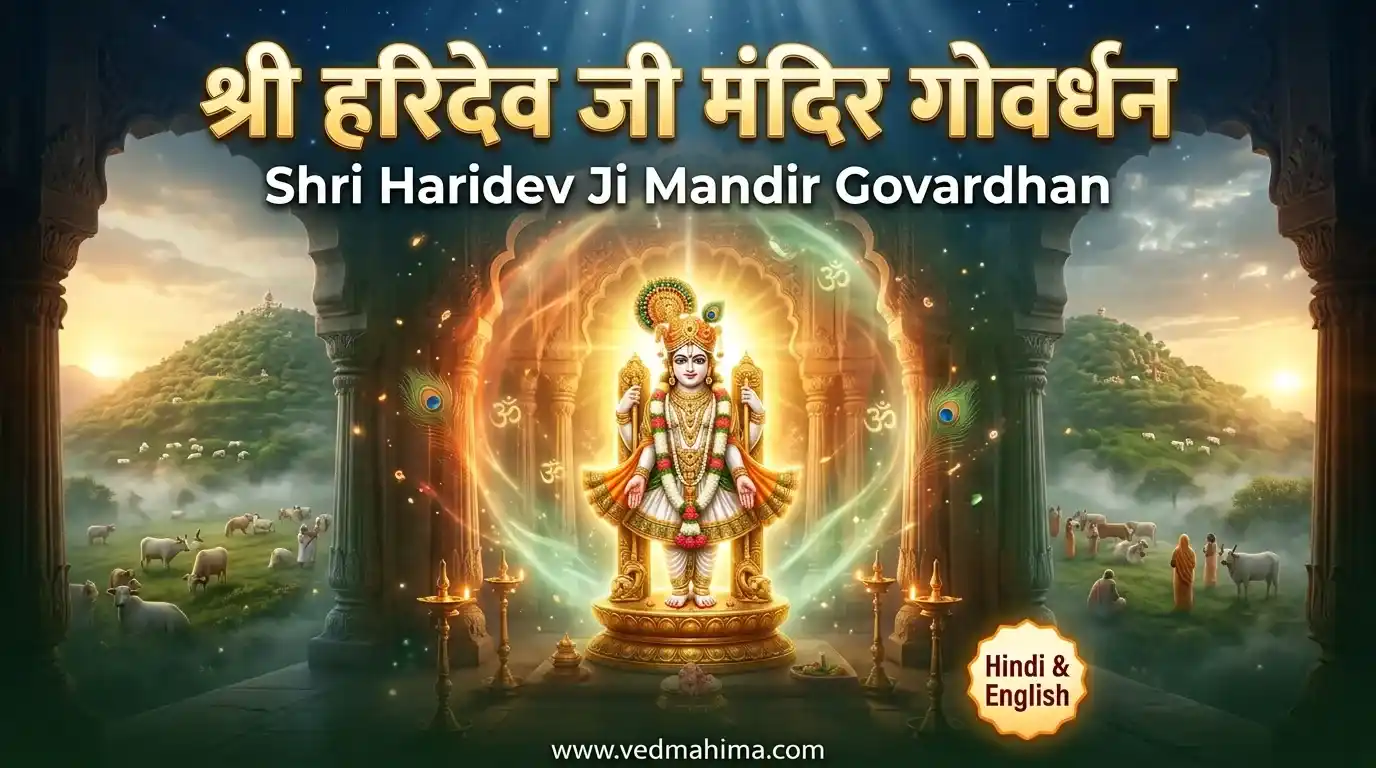
॥ Temple Overview & Divine Glory ॥
Shree Haridev Ji Temple, positioned near the holy banks of Manasi Ganga in Govardhan, Mathura district, Uttar Pradesh, is an exceptionally ancient, monumental seat of divine ecstasy within the Braj region. Lord Krishna is worshipped here as Haridev—the primeval Lord of the Govardhan Hill. This sacred temple holds an unparalleled scriptural position: historically, Haridev Ji is recognized as one of the four presiding directional deities (Devas) of Braj Mandal, appointed by King Vajranabha to eternally protect the holy land. According to deep Vaishnava traditions, no pilgrimage or circumambulation (Parikrama) of the sacred Govardhan Hill is considered complete or spiritually sealed without first taking the absolute blessings and devout Darshan of Shri Haridev Ji. Gazing upon this ancient form is said to instantly awaken pure devotional intent, eradicate deep material illusion, and realign the soul with eternal Krishna-Prema.॥ Key Spiritual & Structural Aspects ॥
* The Primal Presiding Deva: Shri Haridev Ji is traditionally revered as the southern pillar of Braj's divine defensive square, establishing an immense protective spiritual shield over all traveling pilgrims.* The Manasi Ganga Connection: The temple stands in immediate proximity to the mystical Manasi Ganga lake, the water body manifested directly from Krishna's mind, linking the temple to intense inner spiritual cleansing rituals.
* Imperial Sandstone Architecture: The current historic structure showcases the remains of brilliant 16th-century architectural masterwork, built using massive red sandstone blocks featuring grand pillared halls and classic carved structural beams.
* The Seat of Sanatana Goswami: This holy site was the chief intense meditation center for Srila Sanatana Goswami, who lived along the banks of Manasi Ganga and regularly performed structural services for the dynamic expansion of the temple.
॥ The Ritualistic Cycle: Divine Daily Aartis & Schedules ॥
The traditional timelines are maintained flawlessly by the local priests across seasons:1. Mangala Aarti (05:30 AM Summer / 06:00 AM Winter): The holy awakening ritual accompanied by sweet bells and dynamic Sanskrit chants.
2. Shringar Darshan (07:30 AM Summer / 08:00 AM Winter): The primary morning window where the Lord is adorned with premium silks and seasonal flowers.
3. Rajbhog Aarti (12:00 PM Summer / 12:30 PM Winter): Grand mid-day food offerings prepared on pure fires are presented to Haridev Ji before afternoon closure.
4. Sandhya Aarti (07:00 PM Summer / 06:30 PM Winter): Breathtaking evening twilight lamp offerings that fill the entire ancient hall with high vibrations.
5. Shayan Aarti & Closure (09:00 PM Summer / 08:30 PM Winter): Final night prayers and sweet offerings before the inner sanctum is securely locked.
॥ Detailed Code of Conduct & Pilgrimage Guidelines ॥
* Strict Dress Code Architecture: To preserve the pristine sanctity of this centuries-old Braj shrine, all visiting devotees must strictly adhere to traditional, modest attire. Men are highly encouraged to wear dhotis, kurtas, or simple trousers, while women should wear sarees or traditional salwar suits. Modern Western clothing such as short skirts, distressed denims, shorts, or revealing outfits are strictly prohibited inside the sacred courtyard.* Photography & Videography Prohibitions: Operating mobile cameras, professional DSLRs, or recording any digital video inside the inner sanctum (Garbhagriha) is entirely banned. Devotees are expected to maintain meditative silence and absolute decorum; capturing images of the dynamic pratibhu-vigraha is considered a severe disruption of traditional ritualistic laws.
* Footwear & Belongings Management: Footwear of any kind must be safely removed at the dedicated counters outside the main historical gateway before entering the pure stone premises. Pilgrims are advised to keep their personal belongings, heavy bags, and expensive leather articles safely inside their respective vehicles or hotel rooms, as there are no heavy locker facilities within the ancient architectural structure.
॥ Deep Architectural Marvel & Layout ॥
The temple design represents a beautiful classical fusion of indigenous styles. The high stone lintels and brackets inside the main hall exhibit majestic symmetrical carvings that have survived for centuries. Though parts of the higher spires were historically impacted, the core foundation and heavy stone pillars remain an engineering wonder, maintaining a highly serene, cool temperature within the sanctum.॥ Major Festivals Celebrated In Full Splendor ॥
* Guru Purnima (Mudiya Poono Mela): This is the most monumental annual festival of the temple, drawing millions of global devotees to Govardhan. It commemorates the disappearance day of Srila Sanatana Goswami. Pilgrims perform the 21 km parikrama and gather here for ecstatic congregational chanting, grand processions, and custom flag-hoisting rituals that fill the town with vibrant spiritual energy.* Annakut & Govardhan Puja: Celebrated with spectacular devotion on the day following Deepawali, this festival recreates the historical lifting of the Govardhan Hill by Lord Krishna. The local priests prepare an immense, multi-layered mountain of pure vegetarian delicacies, traditional sweets, and grains (Chhappan Bhog) that are offered directly to Haridev Ji amidst thousands of singing devotees.
* Jhulan Yatra (The Monsoon Swing Festival): During the sacred monsoon month of Shravan, the temple courtyard is transformed into a divine bower. A grand, intricately carved wooden swing is beautifully decorated with aromatic seasonal flowers, premium silks, and colorful beads, where the replacement deity is gently swayed amidst classical Braj kirtans and sweet devotional songs.
* Shri Krishna Janmashtami: The appearance day of Lord Krishna is celebrated with intense spiritual energy. The entire ancient sandstone campus is illuminated with thousands of lamps. A grand mid-night Maha-Abhishek (holy bathing ritual) using milk, honey, and sacred herbs is conducted, followed by special midnight aartis and distributions of holy prasadam.
॥ Comprehensive Routing Guide: How to Reach Govardhan ॥
* By Air (Detailed Flight Route): The closest fully operational international gateway is Indira Gandhi International Airport (DEL) in New Delhi, situated approximately 170 kilometers north of Govardhan. Upon landing, international and domestic travelers can comfortably hire pre-paid commercial air-conditioned SUVs or private luxury cabs. The journey takes roughly 3 to 3.5 hours via the well-maintained Yamuna Expressway corridor or the alternative National Highway 19 (NH-19), bringing you directly to the peripheral parking zones of Govardhan town.* By Train (Detailed Railway Network): The primary high-frequency railway hub connecting the region nationally is Mathura Junction (MTJ), positioned around 24 kilometers east of the temple. Mathura Junction receives major express and superfast trains from New Delhi, Mumbai, Kolkata, and Chennai daily. From outside the Mathura railway station complex, pilgrims have access to continuous 24/7 transportation modes, including localized unreserved passenger shuttle trains running to Govardhan station, private direct cabs, and budget-friendly shared auto-rickshaws that complete the scenic drive in about 45 minutes.
* By Road (Detailed Highway Navigation): Govardhan is seamlessly interlinked with major North Indian cities through an expansive network of state and national highways. If driving personally from Delhi-NCR, one can take the Yamuna Expressway and exit near Vrindavan/Mathura, or follow the traditional Delhi-Agra highway (NH-19) up to Chhata or Mathura, turning inward towards the Govardhan-Mathura road. Furthermore, the Uttar Pradesh State Road Transport Corporation (UPSRTC) operates a vast fleet of regular and deluxe buses departing frequently from Sarai Kale Khan and Anand Vihar ISBT in Delhi, as well as central bus terminals in Mathura and Vrindavan.
🙏 ॥ Thus completed ॥ 🙏
The Hindi text has been compiled based on original and authentic sources. If there is any difference,
error, or inconsistency between the Hindi and English versions, the Hindi text shall be considered the
authoritative version. If there are any errors or copyright-related concerns regarding this content,
please contact us.
📜 प्रामाणिक स्रोत:
📖 सार्वजनिक रूप से उपलब्ध स्रोत
📖 आधिकारिक मंदिर रिकॉर्ड
📖 सरकारी पोर्टल
📖 सत्यापित ऑनलाइन संदर्भ
About Shri Haridev Ji Temple Govardhan
The magnificent and ancient history of Shri Haridev Ji Temple spans across thousands of years, rooted deeply in the ancient scriptural age. The primary deity was originally installed roughly 4,900 years ago by King Vajranabha, the great-grandson of Lord Krishna, who established several major deities across Braj to preserve the holy memories of the Lord's pastimes. For centuries, the deity was served under the absolute devotion of local ascetics. In the 16th century, during the great Vaishnava renaissance, the profound saint Srila Sanatana Goswami rediscovered the deep scriptural importance of this specific spot and revived its regular traditional worship. Witnessing the immense devotion of the Goswamis, Raja Man Singh of Amber (Jaipur), the celebrated general of the Mughal Empire, constructed a grand, monumental stone temple at this site in the late 1500s. The structure was a towering architectural marvel of red sandstone, mirroring the style of the Govind Dev temple in Vrindavan. However, during the late 17th century, under the iconoclastic campaigns of Aurangzeb, the upper majestic storeys and shikhara of the temple were partially dismantled. To protect the ancient self-manifested form of Haridev Ji from destruction, the priests secretly moved the original deity to a safer location in Rajasthan, while a replacement pratibhu-vigraha (replica deity) was later installed to maintain the unbroken daily ritualistic cycles. Today, the ancient stone walls of Haridev Temple stand as an absolute monument of historical endurance, echoing centuries of deep, unyielding Vaishnava devotion.