Shri Harmandir Sahib Golden Temple Amritsar
Shri Harmandir Sahib Golden Temple Darshan Guide
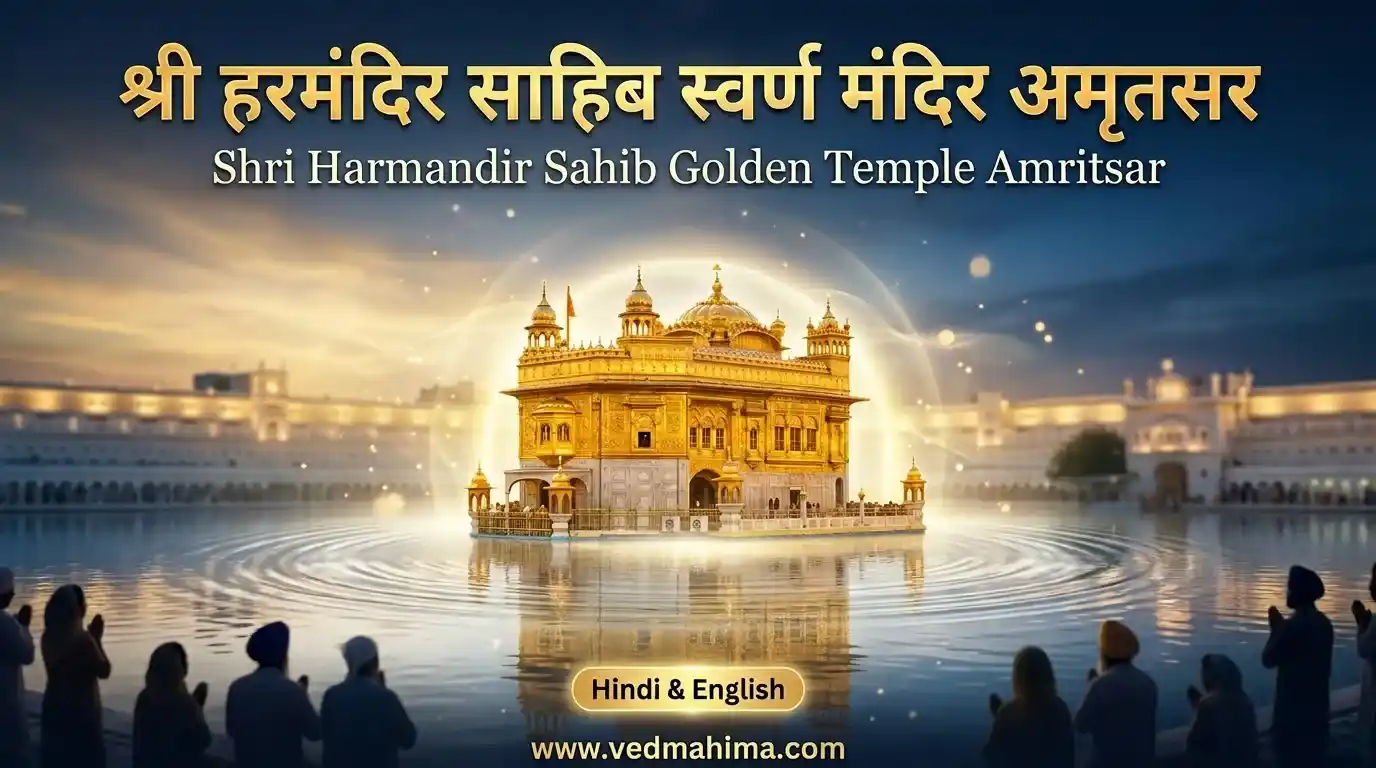
* The Golden Shikhars & Domes: The external structure of the inner sanctum is spectacularly dominated by shimmering, exquisite copper plates encased completely in pure, gleaming gold leaf. Historically, in the early 19th century, Maharaja Ranjit Singh, the legendary emperor of the Sikh Empire, sponsored the monumental gold gilding of the upper panels, using over hundreds of kilograms of pure gold, giving the shrine its iconic celestial glow that reflects magically over the surrounding waters.
* The Eternal Presence of Guru Granth Sahib: The central focal point of worship inside the inner sanctum is the Guru Granth Sahib Ji, the holy scripture and the eternal living Guru of the Sikhs. The holy volume is placed on a raised royal throne under a jewel-encrusted canopy, where continuous, soul-stirring Gurbani Kirtan (sacred hymns) is sung live by classical musicians from early dawn until late midnight, filling the atmosphere with high-frequency cosmic vibrations.
* The Guru Ka Langar (World’s Largest Mega Kitchen): A monumental living testament to human equality, the temple runs a massive community kitchen that feeds over 100,000 pilgrims completely free of charge every single day without fail. Everyone sits horizontally on the floor (Pangat) side-by-side as equals, completely obliterating social stratification.
1. Kiward Kholne Di Seva (02:30 AM - 03:00 AM): The monumental daily opening of the heavy silver doors of the inner sanctum. Devotees gather in deep silence, chanting silently as the primary kapaat open for the new day.
2. Prakash of Guru Granth Sahib (04:30 AM - 05:00 AM): The supreme morning ceremony. The holy scripture is reverently carried on a magnificent golden palanquin (Palki Sahib) from the Akal Takht to the inner sanctum, accompanied by the blowing of bugles and flower showers, followed by the reading of the daily royal decree (Hukamnama).
3. Continuous Gurbani Kirtan: Throughout the day, classical ragi musicians perform unbroken devotional singing of divine verses matched to precise astronomical ragas, broadcasting the sound current across the entire sarovar landscape.
4. Sukhassan Seva (10:00 PM - 10:30 PM): The deeply moving night ritual. The holy living Guru, Guru Granth Sahib Ji, is ceremonially closed, reverently placed back on the golden Palki Sahib, and carried in a royal procession back to its resting chambers at the Akal Takht for the night, after which the sanctum is thoroughly washed with milk and water.
* Gurpurabs (Guru Birth Anniversaries): Celebrating the birth or martyrdom days of the Sikh Gurus, specifically Guru Nanak Dev Ji and Guru Gobind Singh Ji. The entire Golden Temple is illuminated beautifully with millions of colorful LED lights, creating a breathtaking visual wonder matched with spectacular traditional fireworks over the holy pool.
* Bandi Chhor Divas (Diwali): Celebrating the historic return of Guru Hargobind Ji from captivity along with 52 Hindu kings. The entire complex is illuminated with hundreds of thousands of traditional earthen oil lamps (Diyas), presenting an unearthly, heavenly spectacle that draws global travelers.
* By Air (Flights): The Sri Guru Ram Das Jee International Airport (ATQ) is located just 11 to 13 kilometers away from the temple complex. It operates frequent direct domestic flights to major Indian hubs like New Delhi, Mumbai, Mumbai, and Bengaluru, alongside direct international flights to major cities like London, Birmingham, Dubai, Doha, and Singapore. Safe pre-paid airport cabs, free institutional shuttle buses managed by the temple board, and private taxis run continuously from the terminal gates.
* By Train (Railways): The Amritsar Junction Railway Station (ASR) is a massive, highly efficient rail hub located barely 3 kilometers from the shrine. It is directly connected to New Delhi via high-speed Shatabdi Express, Vande Bharat Express, and various superfast luxury trains coming from Kolkata, Mumbai, and Jammu. Eco-friendly e-rickshaws, auto-rickshaws, and local cycle-rickshaws operate round-the-clock from the station platforms.
* By Road (Highways): Amritsar sits strategically on the historic Grand Trunk Road (NH-44). Regular state-run luxury air-conditioned coaches run non-stop from prominent nearby territories like New Delhi, Chandigarh, Jalandhar, and Ludhiana to the Amritsar Inter-State Bus Terminal. To preserve the heritage atmosphere, private vehicles are rerouted to mega parking complexes near the city entrance, from where free e-rickshaws drop pilgrims directly to the heritage walking plazas leading to the temple gates.
⏰ Best Time
The best time to visit the Golden Temple is between October and March when the weather in Punjab is cool and comfortable. To experience the ultimate divine peace, visiting between 3:00 AM and 5:00 AM during the Amrit Vela prayers and the holy Prakash ceremony of the Guru Granth Sahib is highly recommended. Festivals like Diwali (Bandi Chhor Divas) and Vaisakhi offer unforgettable cultural view.
🛕 Temple Information
Golden Temple Road, Atta Mandi, Katra Ahluwalia, Amritsar, Punjab - 143006
Complex Open: 24 Hours Daily
Kiward Kholne Di Seva (Opening): 02:30 AM
Prakash Sri Guru Granth Sahib: 04:30 AM
Continuous Gurbani Kirtan: 05:00 AM - 10:00 PM
Sukhassan Seva (Closing Procession): 10:00 PM - 10:30 PM
01832553957
info@sgpc.net
https://www.sgpc.net
🔗 Related Trending Mandir


About Shri Harmandir Sahib Golden Temple Amritsar
The history of Shri Harmandir Sahib is a monumental saga of spiritual vision, supreme sacrifice, and sacred resilience. The site was chosen and the holy Amrit Sarovar excavation was initiated in 1577 by Guru Ram Das Ji, the fourth Sikh Guru, on land purchased from local landowners. The foundation stone of the inner shrine was uniquely laid in December 1588 by a famous Muslim Sufi Saint, Hazrat Mian Mir of Lahore, at the request of Guru Arjan Dev Ji, beautifully cementing the temple's core philosophy of interfaith harmony. Guru Arjan Dev Ji completed the structure and installed the first volume of the Adi Granth here in 1604. During the 18th century, the temple faced extreme devastation and blew up multiple times during Afghan invasions led by Ahmad Shah Abdali. However, the brave Sikh warriors continually rebuilt it from its ruins. In 1830, Maharaja Ranjit Singh reconstructed the complex in marble and donated hundreds of kilograms of pure gold to encase its domes, etching its identity forever as the Golden Temple.