Jagatpita Brahma Temple Pushkar
Jagatpita Brahma Temple Pushkar Darshan Guide
🙏 Devotional
🔥 Powerful
📿 Daily Prayer
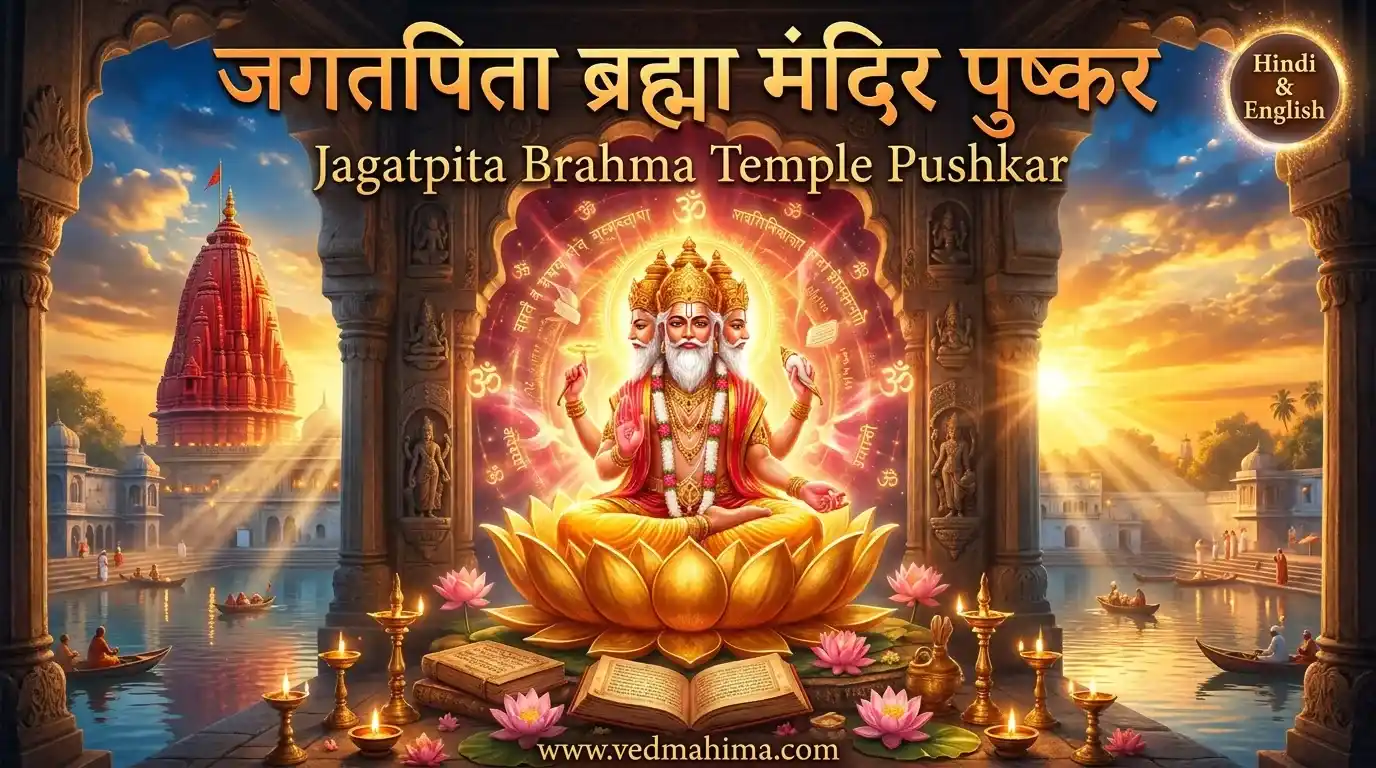
॥ Temple Overview & Divine Glory ॥
Jagatpita Brahma Mandir, nestled in the sacred lakeside town of Pushkar near Ajmer, Rajasthan, holds an extraordinary and unparalleled position in Sanatan Dharma as the most prominent and virtually the only active historical shrine globally dedicated to Lord Brahma—the Creator of the Universe. While traditional deities of Vishnu and Shiva are worshiped across millions of grand shrines, Lord Brahma is rarely worshiped in dedicated temples due to a divine cosmic curse, making Pushkar the ultimate epicentre for the creator's worship. Situated adjacent to the mystical Pushkar Lake, which contains 52 holy bathing ghats, this structure stands as a supreme seat of ancient spiritual energy. The primary sanctum sanctorum (Garbhagriha) houses a magnificent, life-sized four-faced (Chaumukhi) idol of Lord Brahma made of pure translucent marble, seated in a formal cross-legged meditative posture (Padmasana) alongside his consort, Goddess Gayatri. Holding his traditional cosmic symbols—the Vedas, the Kamandalu (water pot), the Sruva (sacrificial ladle), and the Akshamala (rosary)—the deity radiates profound creative wisdom and serene cosmic energy, pulling millions of global seekers and devout pilgrims every year.॥ Puranic Legends & The Divine Cosmic Curse ॥
* The Great Cosmic Yagna: According to the Padma Purana, the demon Vajranabha was terrorizing the earth and disrupting cosmic harmony. Lord Brahma threw his ultimate divine weapon, a celestial blue lotus flower, to annihilate the demon. Petals from this celestial lotus struck three distinct locations in the valley, and mystical water instantly gushed forth from the underworld, forming the holy lakes of Pushkar (Jyeshtha, Madhya, and Kanishtha). To cleanse the earth and establish cosmic peace, Lord Brahma decided to perform a grand fire sacrifice (Yagna) at this precise site.* The Wrath of Goddess Savitri: For the successful completion of a Vedic Yagna, the physical presence of the husband's legal consort is absolutely mandatory. However, Goddess Savitri was delayed as she was waiting for her divine companions to arrive. As the highly auspicious astrological alignment (Muhurat) was rapidly passing away, Sage Agastya and King Indra advised Brahma to marry a local milkmaid named Gayatri, purifying her through a sacred cow ritual so she could sit in the sacrificial pavilion. When Goddess Savitri finally arrived and found another woman occupying her absolute rightful position, she was consumed by immense divine wrath.
* The Cosmic Curse & Softening: Out of intense indignation, Goddess Savitri pronounced a monumental curse upon Lord Brahma, decreeing that despite being the creator of the entire universe, he would never be worshiped by mankind anywhere else on earth except in the isolated, sacred valley of Pushkar. Later, when the assembly of gods pleaded for mercy, she softened the curse, declaring that anyone who takes a purifying holy dip in Pushkar Lake and offers true prayers to Brahma will instantly receive absolute spiritual liberation (Moksha) from the cycle of rebirth.
* Goddess Savitri Hill Shrine: Following this intense cosmic confrontation, Goddess Savitri retreated to the highest mountain peak overlooking the lake, known as Ratnagiri Hill. A beautiful hill shrine stands there today, keeping a permanent, watchful protective eye over the entire Pushkar valley below.
॥ The Divine Daily Rituals & Traditional Aarti Cycle ॥
The daily liturgical worship inside the Brahma temple is strictly managed by dedicated ascetics following precise Vedic rules. The daily cycle features a spectacular array of deep structural changes throughout the seasons:* Mangala Aarti (Pre-Dawn): Celebrated two hours before sunrise, the silver doors are opened with sacred bells. The deity is awakened with specific Vedic hymns, and a simple breakfast of fresh fruits, milk, and mishri is offered to the creator.
* Sandhya Aarti (Twilight Assembly): Conducted exactly at dusk, the vast inner courtyard fills with hundreds of pilgrims. Massive brass lamps are lit, and a spectacular musical ceremony takes place with traditional drums, cymbals, and conch shells, creating an intense spiritual vibration.
* Shayan Aarti (Night Rest): Before the temple gates close for the night, a final soothing aarti is performed, and Lord Brahma is offered pure sweet milk and light delicacies before retiring for cosmic rest.
* The Holy Pushkar Lake Rituals: It is an ancient spiritual law that a devotee must first take a holy dip in the sacred waters of Pushkar Lake, offering a Pinda Daan (ancestral prayers) at the Brahma Ghat or Varaha Ghat, before entering the main temple complex to secure the full rewards of the pilgrimage.
॥ Architectural Grandeur & Structural Elements ॥
Built on an elevated stone platform, the present structure of the Brahma Temple dates back to the 14th century AD, though the original spiritual site is millennia old. The architecture features a brilliant combination of classic Rajasthani and traditional Indo-Aryan styles. A striking visual feature of the temple is its bright red spire (Shikhara) and a distinct blue-domed roof, visible from miles away. The main entrance features a grand gateway (Gopuram) adorned with a Hans (Goose) motif, which is the divine vehicle of Lord Brahma. The floors and pillared halls of the inner courtyard are beautifully paved with pure white marble, embedded with thousands of silver coins donated by historic devotees as tokens of gratitude. The structure has survived multiple foreign invasions, including the iconoclastic campaigns of Mughal Emperor Aurangzeb, thanks to the fierce protection of the local rulers and brave Giri ascetics who managed the shrine.॥ Kartik Purnima & The Famous Pushkar Camel Fair ॥
Pushkar turns into a massive cultural and religious hub during the autumn months, hosting iconic celebrations:* The Maha Pushkar Fair (Kartik Mela): This internationally acclaimed cultural fair coincides with the holy period of Kartik Purnima (October/November). It combines one of the world's largest camel and livestock trading events with intense spiritual celebrations, pulling global photographers and travelers.
* The Holy Kartik Purnima Dip: The five days from Prabodhini Ekadashi to Kartik Purnima are considered the most sacred. It is believed that during these days, all 330 million Hindu deities descend to Pushkar Lake to wash away the sins of humanity. Millions of devotees queue up for miles to take a dip and visit the Brahma Temple.
* Deepdan Ceremony: On the final night of Kartik Purnima, thousands of earthen oil lamps (diyas) are lit and floated onto the calm waters of the lake, creating a breathtaking golden reflection across all 52 ghats.
॥ Comprehensive Travel Guide: How to Reach Pushkar ॥
Pushkar is an exceptionally well-connected spiritual destination nestled within the rugged terrain of the Aravalli hills in Rajasthan, easily accessible through a highly developed network of airways, railways, and national highways:* By Road (Extensive Highway Network): Pushkar is exceptionally well-integrated into the national highway system. The town is situated just 15 km away from the major city of Ajmer, connected via a smooth, well-engineered mountain pass road that offers sweeping panoramic views of the valley. For long-distance travelers, Pushkar is easily accessible via National Highway 48 (NH-48), a premium multi-lane expressway that seamlessly links it to Delhi (approximately 400 km away) and Jaipur (145 km away). Another major state route connects Pushkar directly to Udaipur (280 km) and Jodhpur (185 km). The Rajasthan State Road Transport Corporation (RSRTC) operates an unbroken, round-the-clock fleet of deluxe, air-conditioned, and luxury Volvo buses from all key urban hubs directly into the main Pushkar Central Bus Stand.
* By Train (Premium Railway Infrastructure): The absolute primary railhead for reaching the shrine is the Ajmer Junction Railway Station (AII), located roughly 15 km away from the temple steps. Ajmer Junction is a massive, world-class railway hub directly linked to major Indian metropolises like Delhi, Mumbai, Ahmedabad, Kolkata, and Jammu through ultra-premium, high-speed trains. Devotees can comfortably book seats on the modern Delhi-Ajmer Vande Bharat Express, the Ajmer Shatabdi Express, or the long-distance multi-tier Superfast Express trains. From the Ajmer station exit, regular local buses, metered auto-rickshaws, and private app-based cabs are available 24/7 to transport pilgrims across the mountain pass into Pushkar. Additionally, Pushkar features its own beautiful local railway station (PUK) which is connected by automated daily passenger shuttle trains running from Ajmer.
* By Air (Airport Proximity & Taxi Routes): For international and long-distance domestic air travelers, the absolute nearest functional domestic terminal is the Kishangarh Airport (KQH), located near Ajmer at a distance of roughly 45 km from Pushkar. Kishangarh Airport operates regular, direct scheduled flights connecting to major transit hubs like Delhi and Mumbai. For a much wider network of national and international flights, the Jaipur International Airport (JAI) is the primary gateway, situated approximately 150 km away. Jaipur Airport receives direct international flights from various parts of the globe and all major Indian states. From either airport terminal, pilgrims can easily rent pre-paid luxury private sedans, multi-utility vehicles (SUVs), or highway cabs that glide smoothly over the expressways directly to the doorstep of the Jagatpita Brahma Temple.
🙏 ॥ Thus completed ॥ 🙏
The Hindi text has been compiled based on original and authentic sources. If there is any difference,
error, or inconsistency between the Hindi and English versions, the Hindi text shall be considered the
authoritative version. If there are any errors or copyright-related concerns regarding this content,
please contact us.
📜 प्रामाणिक स्रोत:
📖 सार्वजनिक रूप से उपलब्ध स्रोत
📖 आधिकारिक मंदिर रिकॉर्ड
📖 सरकारी पोर्टल
📖 सत्यापित ऑनलाइन संदर्भ
About Jagatpita Brahma Temple Pushkar
The historical timeline of the Jagatpita Brahma Temple in Pushkar represents a magnificent saga of structural resilience and spiritual continuity spanning thousands of years across Hindu cosmic epochs. Extensively referenced within the ancient text of the Padma Purana, as well as the monumental epics of the Ramayana and the Mahabharata, the site is recognized as the eternal seat of Lord Brahma's primeval Yagna fire. Historically, while the spiritual epicentre has been active since antiquity, the physical structure underwent severe challenges during the medieval era. It faced destruction and radical iconoclastic dismantling during the targeted temple-demolition campaigns of the Mughal Emperor Aurangzeb. However, the sacred site was fiercely defended by local Rajput clans and the militant Naga ascetics belonging to the Giri sub-sect of Hinduism. The architectural renaissance of the temple officially took place in the 14th century AD (circa 1352 AD), when the primary structural foundation was rebuilt by Jeva Bai, the pious wife of a prominent local ruler, and later expanded through investments by the rulers of Gwalior and Jaipur. The temple's inner lineage and worship structure were systematically reorganized under the direct spiritual direction of the great philosopher-saint Adi Shankaracharya, who reinstated the authentic Vedic Dashnami Sanyasi monastic order to serve as the permanent, hereditary custodians of the holy sanctum, ensuring that the ancient fire-worship methods remained pure and uninterrupted.