Mahabodhi Temple Bodhgaya
Mahabodhi Temple Bodh Gaya Complete Pilgrimage Guide
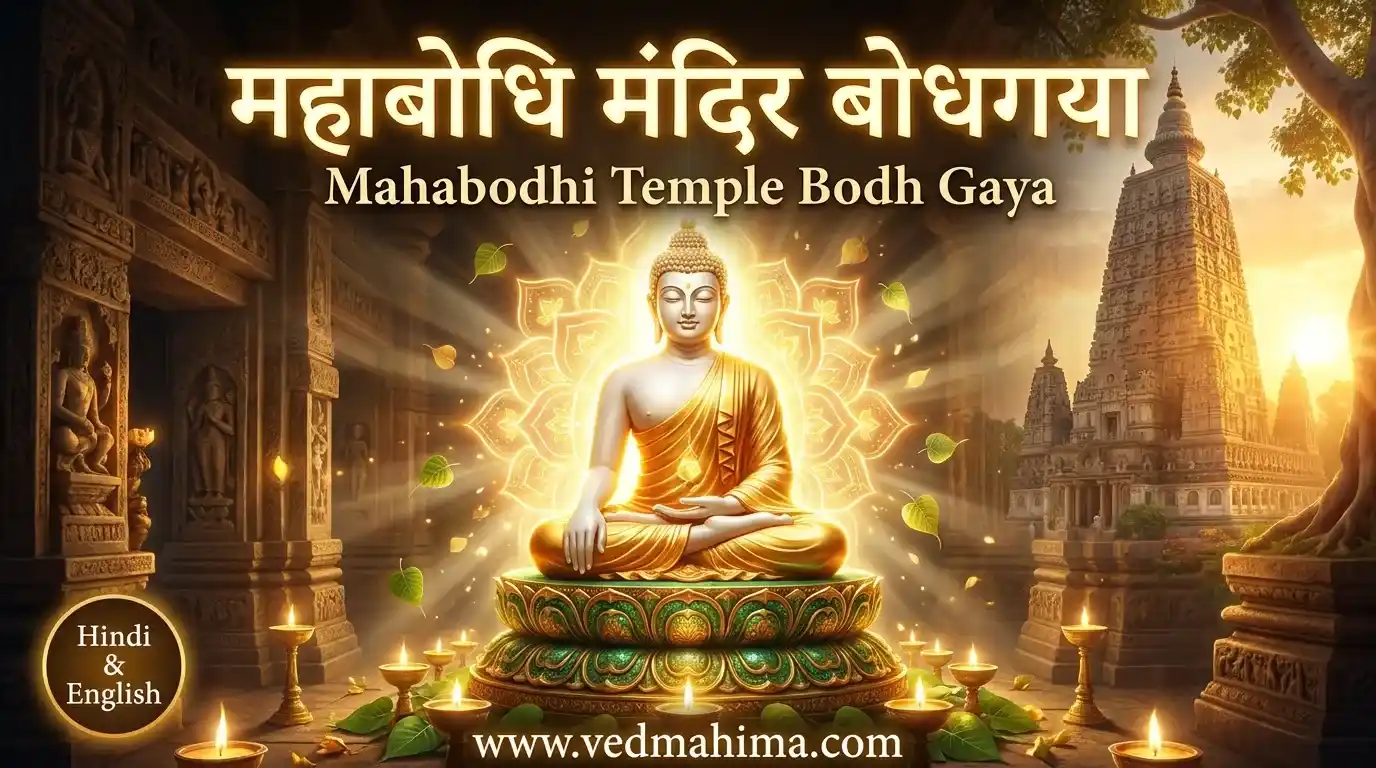
* The Golden Enshrined Buddha: Enshrined inside the main inner sanctum is a massive, highly revered 5-foot-tall black stone statue of the Buddha, fully gilded in heavy pure gold leaf. Carved over 1,500 years ago during the Gupta era, the Buddha sits in the supreme 'Bhumisparsha Mudra' (Earth-touching gesture), calling the Earth to witness His victory over the illusions of Mara.
* The Holy Bodhi Tree (Sri Maha Bodhi): Standing directly behind the western wall of the main temple is the magnificent, holy Bodhi Tree (Ficus religiosa). It is a direct continuous descendant of the original tree under which the Buddha meditated. It remains the most sacred botanical entity on Earth, surrounded by protective stone railings where pilgrims catch falling leaves as priceless spiritual relics.
* The Diamond Throne (Vajrasana): Placed precisely between the main temple structure and the Bodhi Tree lies the Vajrasana, a massive polished sandstone slab with geometric carvings. Established originally by Emperor Ashoka in the 3rd century BCE to mark the exact point of enlightenment, it is spiritually revered as the unshakeable 'Diamond Throne' or the structural center of the universe.
* The Seven Sacred Places (Satta Mahathana): The complex houses the seven precise locations where the Buddha spent seven consecutive weeks in deep meditative bliss after His awakening. These include the Animesh Lochan Chaitya (where He stood unblinking for a week in gratitude to the tree) and the Cankamana (the sacred raised stone path with carved lotus flowers marking His walking meditation path).
1. The Morning Opening & Sujata Kheer Offering (05:00 AM - 06:00 AM): The temple gates open to the public amidst the deep, echoing resonance of large brass bells and traditional Tibetan longhorns. Monks perform the grand ritualistic bathing of the main golden Buddha and offer symbolic rice-milk pudding (Kheer), commemorating the historic offering by Sujata.
2. International Chanting & Meditation Phase (06:00 AM - 12:00 PM): Throughout the morning, the stone courtyards fill with groups of international pilgrims. Monks sit under the Bodhi Tree performing full-body prostrations, while the air vibrates with Theravada Pali chants and Tibetan mantra recitations.
3. Midday Solitude Closure (12:00 PM - 02:00 PM): The inner sanctum doors are briefly closed to the public for the deity's ritual rest and internal maintenance, though the outer gardens and the Bodhi Tree area remain fully accessible for continuous meditation.
4. The Evening Dhamma Lamp Lighting & Evening Aarti (05:30 PM - 07:00 PM): As dusk falls, thousands of traditional butter lamps and candles are lit around the stone railings. Monks gather inside the main sanctum for the evening prayers, waving incense and reciting the Mangala Sutta, creating a deeply mystical atmosphere.
5. Night Closure & Complex Lockdown (07:00 PM - 09:00 PM): The final entry to the main complex closes at 08:30 PM. The final circumambulation loops are completed, and the entire high-security complex is securely locked down by the security forces at 09:00 PM.
* Camera Permissions and Fee Structure: While mobile phones are fully banned, standard digital cameras and professional video cameras are fully permitted inside the complex, but only after purchasing an official camera ticket at the main entry counter (nominally priced around INR 100 for still cameras).
* Strictly Enforced Modest Dress Code: To maintain the monastic sanctity of the site, all visitors must dress in respectful, modest attire. Men and Women must wear clothing that completely covers the shoulders and knees. Sleeveless shirts, crop tops, short skirts, and skimpy shorts are strictly barred. If required, shawls are available outside the gates.
* Footwear Decorum: Footwear is fully allowed in the outer concrete perimeter pathways. However, before entering the main lower courtyard containing the central temple and the Bodhi Tree, all shoes must be taken off and safely deposited at the free shoe-house counters located near the stone steps.
* The International Kagyu Monlam & Nyingma Festivals: Held during the peak winter months of December and January, these massive prayer festivals draw tens of thousands of Tibetan Buddhist monks. The entire temple area turns into a sea of maroon robes, with continuous chanting and spectacular arrangements of traditional torma (butter sculpture) offerings.
* Kathina Chivar Dana: Occurring in October-November, this marks the end of the rainy season retreat (Vassa), where devotees from across Southeast Asia arrive to offer new hand-woven robes and monastic essentials to the resident monks.
* By Train (Detailed Railway Network): The primary long-distance railway hub is the Gaya Junction Railway Station (GAY), situated comfortably about 16 kilometers north of the temple complex. Gaya Junction is a massive, highly connected station on the Grand Chord route, receiving premium trains like Rajdhani, Vande Bharat, and express trains from New Delhi, Kolkata, Mumbai, and Chennai. Regular pre-paid app cabs, local auto-rickshaws, and e-rickshaws ply non-stop from the station exit to Bodh Gaya.
* By Road (Detailed Highway Navigation): Bodh Gaya is well-connected to the major highway grid of India via a well-maintained 4-lane branch road connecting directly to the Grand Trunk Road (NH 19 / Old NH 2) at Dobhi, located 22 kilometers away. Frequent Bihar State Tourism Development Corporation (BSTDC) luxury AC buses and regular private coaches run daily between Patna, Nalanda, Rajgir, Varanasi, and the Bodh Gaya main bus stand.
⏰ Best Time
The best time to visit the Mahabodhi Temple is from October to March during Bodh Gaya's highly comfortable winter window. Temperatures during these peak months drop to a pleasant 12°C to 25°C, creating a perfectly serene environment for sitting in long outdoor meditation sessions, circumambulating the sacred stone plazas, and attending international peace festivals. It is highly advised to avoid the punishing summer stretch from April to June when the regional heat wave spikes up to 44°C, making daytime walking across the open stone plazas physically exhausting.
🛕 Temple Information
Mahabodhi Temple Complex, Buddha Marg, Bodh Gaya, Gaya District, Bihar - 824231
Mahabodhi Temple Standard Daily Operating Hours (All Days Open):
Campus Complex Entry & Darshan: 05:00 AM - 09:00 PM
Authentic Daily Rituals & Chants Windows:
Temple Gates Open & Morning Bath Ritual: 05:00 AM
Sujata Kheer Offering (First Morning Bhog): 05:30 AM - 06:00 AM
Public General Viewing & Meditations: 06:00 AM - 12:00 PM
Midday Sanctum Closure Window: 12:00 PM - 02:00 PM
Afternoon Reopening & Public Meditation: 02:00 PM - 05:30 PM
Grand Evening Dhamma Lamp Lighting: 05:30 PM onwards
Evening Chants & Mangala Sutta Recitation: 06:00 PM - 07:00 PM
Main Sanctum Entry Line Closes: 08:30 PM
Final Night Complex Lockdown: 09:00 PM
*Note: Operating hours remain open for 24 hours straight during the grand night of Buddha Purnima.
🔗 Related Trending Mandir
About Mahabodhi Temple Bodhgaya
The historic foundations of the Mahabodhi Temple are intensely intertwined with the golden era of Emperor Ashoka the Great, who visited the sacred spot in 260 BCE and constructed the first monumental shrine, along with the Diamond Throne (Vajrasana) and a stone protective railing. The core structure seen today, however, was fundamentally rebuilt, expanded, and raised in height using high-grade architectural bricks during the late Gupta Empire in the 5th and 6th centuries CE. Following the decline of Buddhism in medieval India and subsequent regional invasions, the massive temple was slowly abandoned and eventually buried under thick river silt from the Falgu River. In the late 19th century, a monumental and meticulous archaeological restoration project was spearheaded by British archaeologist Sir Alexander Cunningham and scholar Rajendralal Mitra, who excavated the pyramid from the earth, restored the holy Bodhi Tree descendant, and resurrected this crown jewel of global enlightenment.