Shri Nand Bhawan Temple Nandgaon
Shri Nand Bhawan Temple Nandgaon Darshan Guide
* The Holy Panihari & Yashoda Kund: Located at the immediate foothills of the temple are historical water bodies. Yashoda Kund is where Mai Yashoda used to bathe infant Krishna, while Panihari Kund is where the Gopis of Barsana traditionally gathered water and interacted with Krishna. Taking a symbolic splash here clears the heart of maternal anxieties.
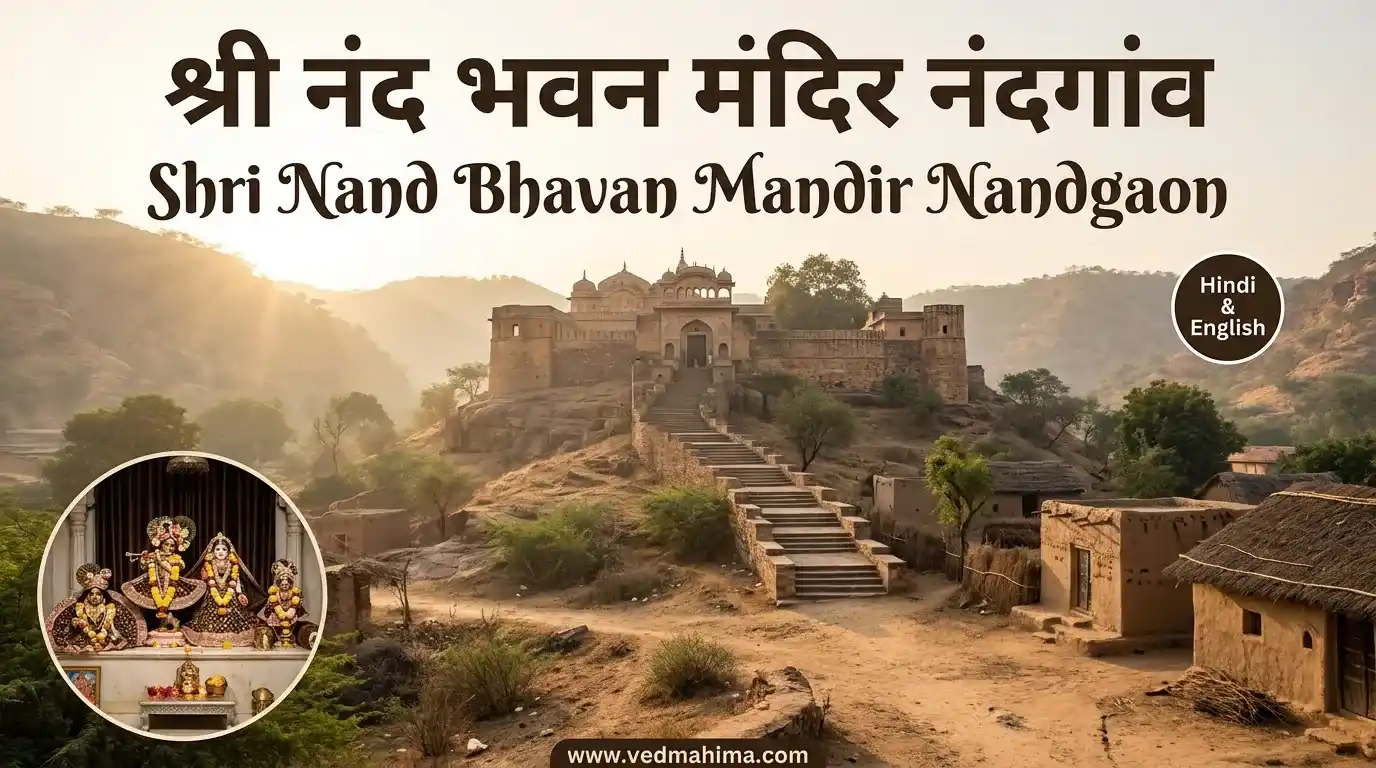
* The Architecture of Nandisvara Hill: The entire temple complex is constructed using heavy local red and yellow stone blocks, featuring rugged medieval battlements and winding staircases (over 150 steps) that climb the steep hill slope. The open terraces offer an panoramic 360-degree view of the vast green fields of the Braj region.
* The Dynamic Lathmar Holi Legacy: Nandgaon temple is the historical epicenter of the world-famous Lathmar Holi. Every spring, the menfolk (Gops) of Nandgaon march gracefully from this temple toward the nearby village of Barsana, carrying the divine shield of Krishna to participate in a symbolic spiritual battle of colors with the women of Barsana.
1. Awakening & Shringar Aarti (05:00 AM - 06:00 AM in Summer / 06:00 AM - 07:00 AM in Winter): The gentle morning awakening. The family priests open the silver doors to the soft, rhythmic acoustic vibrations of traditional string instruments, carefully dressing the young Krishna in vibrant turbans and peacock feathers.
2. Rajbhog & Midday Aarti (11:30 AM - 12:00 PM in Summer / 12:00 PM - 12:30 PM in Winter): The grand midday meal. Following the rustic pastoral background of Nanda Baba's kingdom, the Lord is offered heavy, traditional rural delicacies like pure fresh butter (Makhan), thick milk cakes, hot paranthas, and multi-tier sweets before taking an afternoon nap.
3. Utthapan & Evening Assembly (04:00 PM - 07:30 PM in Summer / 03:30 PM - 07:00 PM in Winter): The evening assembly. The temple gates re-open as twilight settles over the hills. Devotees gather on the open terrace courtyards to engage in loud, enthusiastic choral singing of ancient Braj verses while the priests wave multiple tiers of ghee lamps.
4. Shayan Aarti (09:00 PM in Summer / 08:30 PM in Winter): The final night closure. A special silver bowl filled with fresh forest water and fragrant betel leaves is placed near the bedside of the deity, and soft, soothing lullabies are sung by the hereditary priests to bring the child Lord to sleep.
* Lathmar Holi (The Festival of Eternal Love): The spectacular spring carnival. Thousands of international photographers and travelers fill the temple terraces to witness the dynamic exchange of colors between the villages of Nandgaon and Barsana, accompanied by classical folk poetry singing (Samaj Gayan).
* Radhashtami & Gopashtami: Special days where the adolescent Lord is beautifully decorated alongside cattle tableaus, honoring his role as the supreme cowherd protector (Gopala) of the universe.
* By Air (Flights): The closest international airport anchor is the Indira Gandhi International Airport (DEL) in New Delhi, situated roughly 145 kilometers away. It connects directly to the region via National Highway 19 (Delhi-Agra Highway) or the multi-lane Yamuna Expressway in under 3 hours. The upcoming Noida International Airport at Jewar will dramatically reduce this distance to about 85 kilometers. High-grade prepaid rental taxis run round-the-clock from the arrival terminals.
* By Train (Railways): The nearest immediate railway station is Kosi Kalan (KSV), located barely 11 kilometers away, which handles multiple express lines from Delhi and Agra. The primary major railway junction is Mathura Junction (MTJ), located 52 kilometers away, operating high-speed Vande Bharat and Shatabdi express lines. From both stations, private rental cabs, auto-rickshaws, and state buses are continuously available to drop pilgrims at the Nandgaon foothill vehicle terminals.
* By Road (Highways): Nandgaon sits beautifully just off the main National Highway 19 (Delhi-Agra Route), connected by a smooth 4-lane link road passing through Kosi Kalan. Regular state transport buses and air-conditioned luxury tourist coaches run frequently from New Delhi (Anand Vihar), Mathura, and Vrindavan directly to the Nandgaon bus terminal. To preserve the eco-sensitivity of the hill, private vehicles are seamlessly redirected to the expansive smart parking ground at the base, from where eco-friendly auto-rickshaws drop pilgrims near the staircase gates.
⏰ Best Time
The best time to visit the Shri Nand Bhawan Temple is between October and March when the weather in the Braj region is beautifully cool and comfortable for climbing the scenic hillside steps. To witness the peak cultural vibrancy, visiting during the spectacular Nandotsav festival (August/September) or the world-famous Lathmar Holi celebrations (March) is highly recommended.
🛕 Temple Information
Shri Nand Bhawan Mandir, Atop Nandisvara Hill, Nandgaon Township, Chhata Tehsil, Mathura District, Braj Region, Uttar Pradesh - 281403
Summer Timings (April to September):
Morning Phase: 05:00 AM - 12:00 PM (Shringar Aarti: 05:00 AM, Rajbhog Aarti: 11:30 AM)
Evening Phase: 04:00 PM - 09:00 PM (Evening Aarti: 06:30 PM, Shayan Aarti: 09:00 PM)
Winter Timings (October to March):
Morning Phase: 06:00 AM - 12:30 PM (Shringar Aarti: 06:00 AM, Rajbhog Aarti: 12:00 PM)
Evening Phase: 03:30 PM - 08:30 PM (Evening Aarti: 06:00 PM, Shayan Aarti: 08:30 PM)
🔗 Related Trending Mandir





About Shri Nand Bhawan Temple Nandgaon
The history of Shri Nand Bhawan Mandir is an ancient saga deeply rooted in the Puranic eras of the Dwapara Yuga. While the original palace of Nanda Baba fell into structural ruin over thousands of years following Lord Krishna's departure to Dwarka, the sacred geographical site was rediscovered in the 16th century AD by the legendary saints of the Chaitanya Mahaprabhu lineage, specifically Sanatana Goswami and Rupa Goswami, who identified the holy signs on Nandisvara Hill as detailed in the Bhagavata Purana. For several decades, the deities were worshipped in a simple sylvan canopy setup. The present robust, fortress-style temple structure was constructed in the mid-19th century by wealthy devotees and Maratha rulers, who used premium local red sandstone to build a monumental palace-temple, ensuring that the historical childhood seat of the Lord remains safely preserved for generations of Sanatani pilgrims.