Shri Tripura Sundari Temple Udaipur Tripura
Shri Tripura Sundari Shakti Peeth Matabari Udaipur Complete Yatra Guide
🙏 Devotional
🔥 Powerful
📿 Daily Prayer
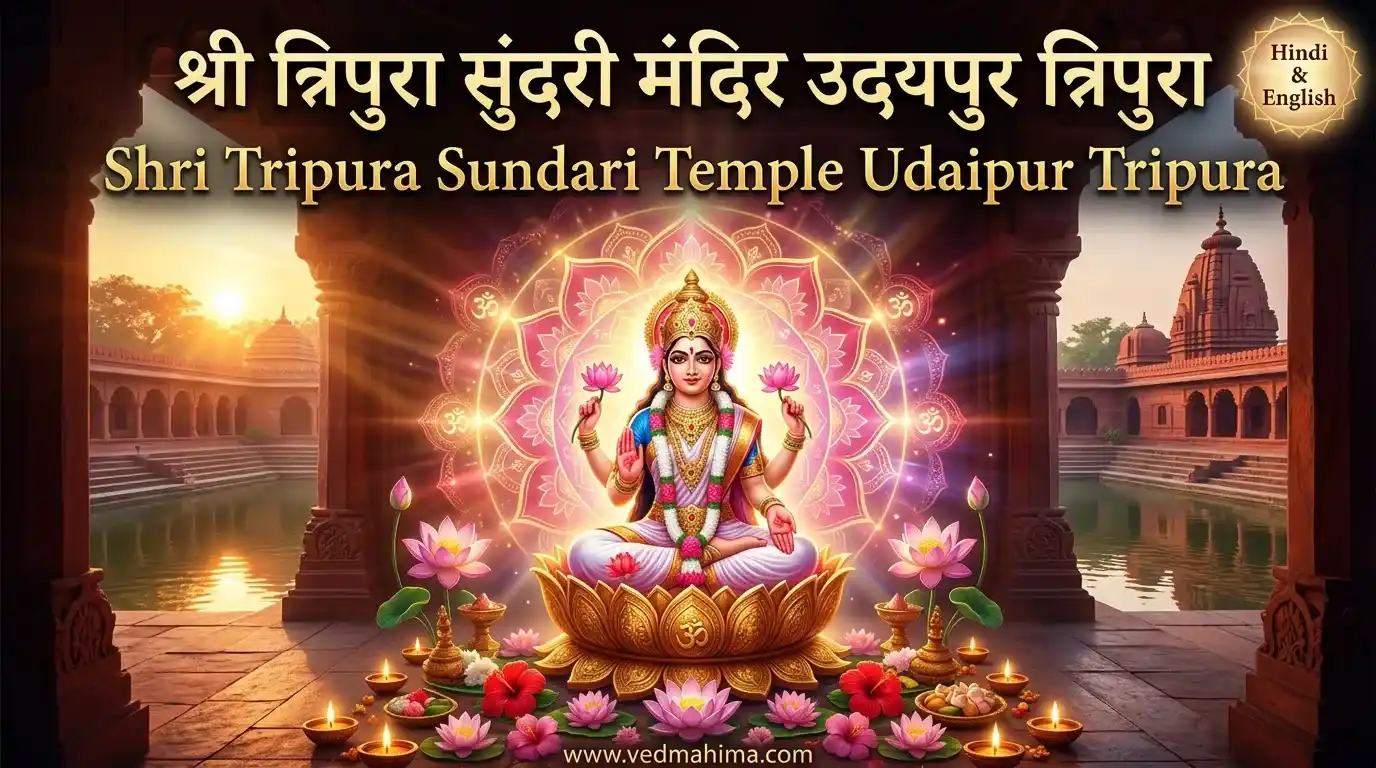
॥ Geo-Spiritual Majesty & Tortoise Mound Presence of Tripura Sundari ॥
Perched majestically atop a tortoise-shaped sacred hillock called Kurma-Pristha in the ancient royal city of Udaipur (formerly known as Rangamati, located 55 km from Agartala, Tripura), lies the highly potent and legendary shrine of Shri Tripura Sundari Shakti Peeth, affectionately addressed by lakhs of devotees as Matabari. Acknowledged across classical Tantric manuals and regional texts as one of the 51 pristine Shakti Peethas of Sanatan Dharma, this holy site is traditionally identified as the exact geo-spiritual coordinates where the Right Foot (Dakshina Pada) of Mata Sati fell during the divine dismemberment by Lord Vishnu's Sudarshana Chakra. The main sanctum houses a stunning, ancient black-stone idol of the four-armed Goddess standing upon a supine Lord Shiva, manifesting her cosmic protective persona as Tripura Sundari (The Supreme Beauty of Three Realms) or Maa Kali (Tripura Kali). Guarded closely by her cosmic protector Lord Shiva who manifests here as Tripureshwar Bhairav, the temple complex functions as the ultimate spiritual heart of the North-Eastern frontier, emitting intense waves of mystical power and evolutionary cosmic energy across centuries.॥ Puranic Legends: Maharaja Dhanya Manikya, The Royal Dream, and the Twin Idols ॥
The glorious dynamic history of Matabari is documented across the Rajmala (the royal chronicle of Tripura kings), the Pithamala, and regional Tantric epics:* The Divine Vision of Maharaja Dhanya Manikya: In the early 16th century (circa 1501 AD), Maharaja Dhanya Manikya was constructing a grand temple dedicated to Lord Vishnu on this tortoise mound. However, just before the installation, the Goddess appeared in the King's dream and revealed that her sacred idol was buried deep inside Chittagong (now Bangladesh) and must be brought and placed on this exact hillock. The King immediately executed the divine command, establishing the Shakta lineage in Tripura.
* The Mystery of the Twin Deities (Chhoti Maa): The inner sanctum houses two distinct stone idols. The primary, larger 5-foot idol is Goddess Tripura Sundari. Beside her stands a smaller 2-foot historic idol known as Chhoti Maa. Royal records show that the ancient kings of Tripura would invariably carry this smaller idol along to their military battlefields as their supreme protective talisman, returning it back to the main altar after securing victory.
* The Auspicious Kurma Peetha Structure: In advanced Tantra Shastra, a temple built on an earth formation that mimics the shell of a tortoise is called a Kurma-Peetha. This unique structural configuration naturally amplifies the grounding of negative cosmic rays, making it an extraordinarily rare and accelerated site for meditation and spiritual awakening.
॥ Architectural Framework & Medieval Tripura-Stupa Masonry ॥
Architecturally, the Tripura Sundari Temple stands as a stellar, unique specimen of medieval Tripura-stupa architecture combined with traditional Bengal Char-Chala (four-roofed) structural design elements. Built with exceptionally thick brick masonry and fortified walls to withstand regional seismic shocks, the temple features a square base that tapers upwards into a magnificent conical dome resembling a Buddhist stupa. The inner sanctum (Garbhagriha) is a stone-vaulted chamber where the dark stone deity is brilliantly illuminated by flickering oil lamps. Right behind the main temple structure lies the vast, legendary lake Kalyan Sagar, a deep-water habitat hosting massive, ancient black softshell tortoises (*Trionyx nigricans*) that are deeply revered as divine extensions of the temple ecosystem.॥ Comprehensive & Extra-Long Yatra Chronicle (Mahotsav) ॥
The annual Tripura Sundari Mahotsav is a spectacular, epoch-making spiritual and socio-cultural convergence that acts as the absolute baseline of religious life in Northeast India. It displays unparalleled communal unity, ancient royal grandeur, and extensive structural celebrations:* The World-Renowned Diwali Mela & Deepotsav: The absolute crown jewel of celebrations at Matabari occurs during the Diwali Festival (October/November). During this auspicious time, the entire hillock and the vast banks of Kalyan Sagar are illuminated with over one hundred thousand traditional earthen oil lamps. A monumental state-sponsored Diwali Mela is organized around the temple, drawing over half a million pilgrims from all over India and neighboring nations. Devotees wait in lines stretching for several kilometers along the decorated pathways to catch a glimpse of the Goddess, who is adorned in breathtaking royal gold attire and ancient diamond ornaments from the Manikya treasury.
* The Auspicious Navratri Festivities and Animal Welfare: During both the Sharad and Chaitra Navratri, the temple atmosphere is supercharged with the continuous, rhythmic chanting of the Chandi Path by a conclave of high priests. Special midnight prayers and complex homas (fire rituals) are performed to stabilize the spiritual grid of the region. Concurrently, thousands of pilgrims perform the sacred ritual of offering food to the holy tortoises of Kalyan Sagar, a tradition protected by strict environmental laws and religious decrees.
* The High-Energy Mangla and Shringar Maha-Aarti: The daily rhythm of the temple reaches its absolute peak during the evening Shringar Aarti. The sounding of massive traditional brass gongs, dhols, and conch shells creates a roaring, resonant frequency across the Udaipur valley, pulling thousands into a state of deep, spontaneous devotion.
* The Integration of Tribal and Non-Tribal Traditions: A unique, beautiful characteristic of the Matabari Mahotsav is the absolute harmony between the indigenous tribal communities of Tripura and non-tribal pilgrims. Tribal chieftains traditionally present their first harvest and unique hand-woven textiles to Maa Tripura Sundari, keeping a multi-century royal community covenant fully alive.
॥ Comprehensive Travel Guide: How to Reach Matabari Tripura Sundari ॥
Reaching the historic town of Udaipur is highly comfortable due to Tripura's advanced railway networks and well-developed national highway grids linking Agartala with sub-divisional towns:* By Road Transit (Agartala-Sabroom National Highway NH-8): Udaipur is located roughly 55 km south of the capital city, Agartala. It is connected via the beautifully smooth, four-lane National Highway NH-8. Regular, air-conditioned luxury buses, state transport (TRTC) coaches, and private tourist taxis operate continuously from Agartala (Nagerjala bus terminal) to Udaipur, completing the scenic, forest-lined road journey in just about 1 to 1.5 hours.
* By Rail Network (Udaipur Tripura Railway Station - UDPU): Udaipur houses its own modern railway station (UDPU), which is directly connected via regular passenger and express trains to Agartala Railway Station (AGTL) and the international rail network. Direct broad-gauge trains (like the Humsafar Express) connect Agartala to cities like Guwahati, Kolkata, and New Delhi. From Udaipur station, the temple is just 3 km away and easily reached via local auto-rickshaws.
* By Air Transit (Maharaja Bir Bikram Airport - IXA): The closest operational airport is the Maharaja Bir Bikram Airport (IXA) in Agartala, located about 65 km away from the temple site. It handles frequent direct flights from Kolkata, Guwahati, Delhi, and Bangalore. From the airport terminal, pre-paid luxury tourist cabs can be directly hired to reach the temple steps smoothly via the national highway axis.
🙏 ॥ Thus completed ॥ 🙏
The Hindi text has been compiled based on original and authentic sources. If there is any difference,
error, or inconsistency between the Hindi and English versions, the Hindi text shall be considered the
authoritative version. If there are any errors or copyright-related concerns regarding this content,
please contact us.
📜 प्रामाणिक स्रोत:
📖 सार्वजनिक रूप से उपलब्ध स्रोत
📖 आधिकारिक मंदिर रिकॉर्ड
📖 सरकारी पोर्टल
📖 सत्यापित ऑनलाइन संदर्भ
About Shri Tripura Sundari Temple Udaipur Tripura
The long historical antiquity of Matabari is fundamentally intertwined with the sovereignty of the independent Kingdom of Tripura and the ruling Manikya Dynasty. For over five centuries, the kings treated Maa Tripura Sundari as the supreme protectress of their state, minting coins carrying her divine name. Following the merger agreement with the Indian Union in 1949, the formal operational maintenance passed under state-aided regulatory structures. Today, the administrative security, historical assets, and grand welfare projects are meticulously managed by the Tripura Sundari Temple Trust, chaired by the district administration, ensuring that the ancient royal traditions remain perfectly preserved for millennia.