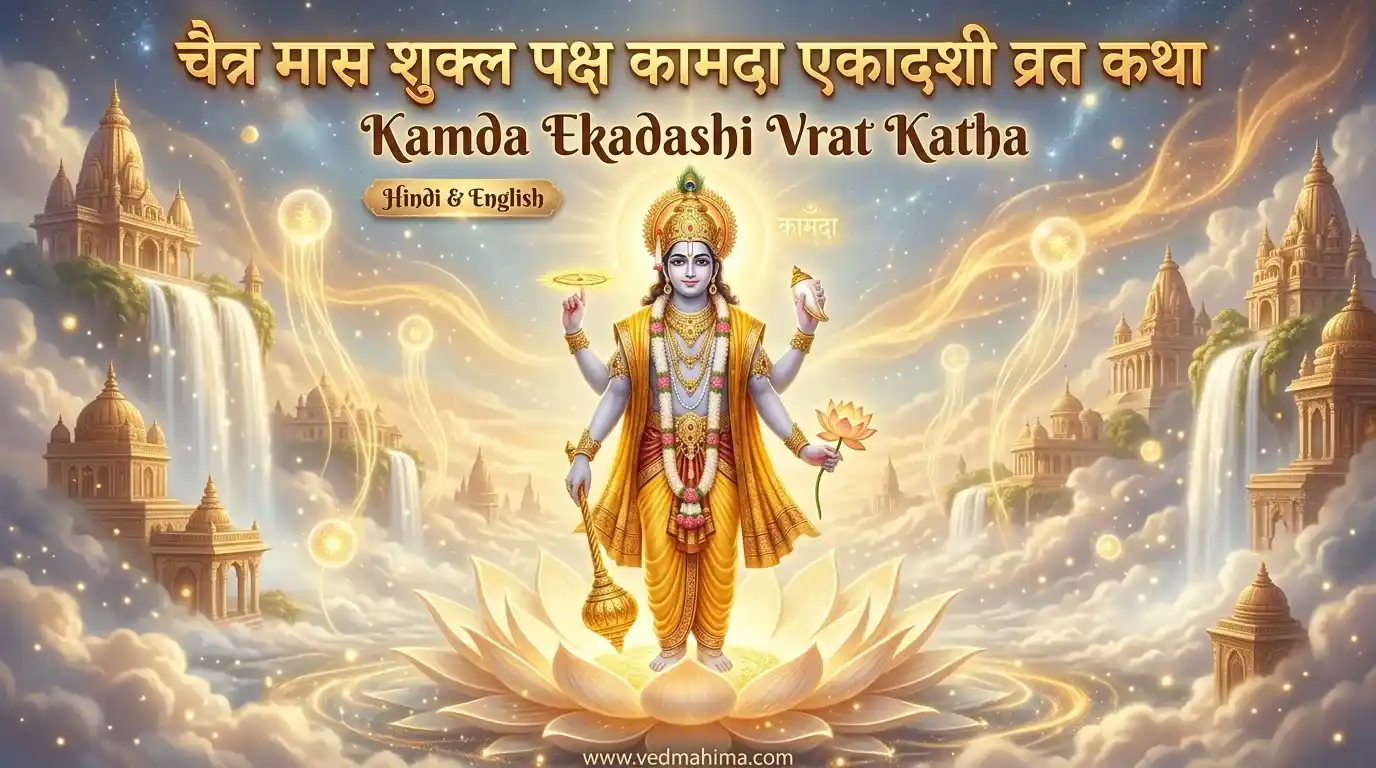
Chaitra Maas Shukla Paksha Kamada Ekadashi Vrat Katha
Wish fulfilment, Lalit and Lallita, curse removal, punya dana, Chaitra Shukla
॥ Introduction ॥
The Ekadashi that falls during the bright fortnight (Shukla Paksha) of the Hindu calendar month of Chaitra is universally celebrated as Kamada Ekadashi. True to its Sanskrit name ''Kamada'' (meaning the fulfiller of all desires), this sacred day holds an exceptionally supreme status in Sanatan Dharma. Dedicated entirely to Lord Vasudeva, this fast possesses the ultimate divine power to dissolve structural curses, dark energies, and demonic influences, leading the soul toward pure spiritual form and prosperity.
॥ Importance ॥
The spiritual excellence of Kamada Ekadashi is highly praised by Lord Shri Krishna Himself. It is described as a blazing forest fire (Davanal) capable of incinerating the massive fuel of accumulated human sins. This fast completely neutralizes heavy psychological burdens, demonic states (Rakshasa Bhava), and severe historical sins like Brahmahatya. Reading, hearing, or deeply meditating upon the holy glory of this fast bestows a human being with the immense spiritual merit equivalent to performing the grand Vajapeya Yajna.
॥ Puranic Reference ॥
The holy narrative of this fast is rooted in an ancient celestial dialogue between King Yudhishthira and Lord Shri Krishna during the Dwapar Yuga. Upon Yudhishthira''s eager request, the Lord narrated a highly historical discourse originally delivered by Sage Vashistha to King Dilip. Through the extraordinary events involving the Gandharva named Lalit and his devoted wife, the Apsara Lallita, in the golden city of Nagpur ruled by the Naga King Pundarika, the scripture perfectly demonstrates how the precise execution of Kamada Ekadashi can restore a cursed, monstrous demon back to a beautiful divine form.
॥ Story ॥
King Yudhishthira asked—O Vasudeva! Salutations unto You. Please be merciful and tell me about the Ekadashi that occurs during the bright fortnight (Shukla Paksha) of the month of Chaitra. What is its sacred name?
Lord Shri Krishna replied—O Rajendra! Listen with an absolute single-pointed mind to this historical account, which the great Sage Vashistha narrated to King Dilip when asked a similar question.
King Dilip said—O Holy Sage! I wish to hear about the Ekadashi of Chaitra Shukla Paksha. What is its name?
Sage Vashistha replied—O King! The Ekadashi falling in the Chaitra Shukla Paksha is named ''Kamada''. It is exceptionally meritorious and acts as a blazing forest fire to incinerate the fuel of all sins. In ancient times, there was an exceptionally beautiful city named Nagpur, adorned with magnificent palaces made of pure gold. In that city lived highly terrifying serpents, and King Pundarika was the supreme ruler of that Naga kingdom. Celestial Gandharvas, Kinnaras, and Apsaras also inhabited and served that beautiful city.
Among them lived an excellent Apsara named Lallita, and alongside her was her husband, a magnificent Gandharva named Lalit. They lived together as husband and wife and were constantly consumed by intense mutual love. The image of her husband was eternally enshrined in Lallita''s heart, and the beautiful Lallita resided perpetually in Lalit''s thoughts. One day, King Pundarika was sitting in his royal court enjoying musical entertainment. Lalit was performing a solo song before the court, but his beloved Lallita was not present there. While singing, he suddenly remembered his beautiful wife. Consequently, the rhythm of his feet stopped and his tongue faltered during the musical performance.
Karkotaka, the best among the Nagas, immediately sensed Lalit''s internal distraction. He reported the error to King Pundarika, highlighting the breakdown in rhythm and the flaw in singing. Hearing Karkotaka''s words, King Pundarika''s eyes turned red with extreme rage. He immediately cursed the infatuated Gandharva, saying—''O foolish one! Even while singing before me, you became completely subservient to your wife''s thoughts; therefore, turn into a hideous monster (Rakshasa) immediately!''
The moment King Pundarika uttered those words, the Gandharva turned into a terrifying demon. He acquired a horrific face, gigantic eyes, and a form that induced absolute fear at mere sight. He began suffering intensely, reaping the fruits of his past actions. Lallita was deeply distressed upon seeing her husband''s monstrous form and began suffering immense agony. She thought, ''What should I do? Where should I go? My husband is suffering due to a grave sin.'' Crying bitterly, she began following him deep into the dense forests.
While wandering, she spotted a beautiful hermitage in the forest where a highly peaceful sage was seated, maintaining no enmity with any living being. Lallita quickly approached the hermitage, offered her respectful obeisances, and stood before the sage. The sage was deeply compassionate; seeing the distressed lady, he said—''O auspicious one! Who are you? From where have you arrived? Tell me the complete truth.''
Lallita replied—O Great Sage! There is a Mahatma Gandharva named Viradhanva; I am his daughter, and my name is Lallita. My husband has been turned into a demon due to a royal curse. Seeing his condition, I find no peace. O Brahmin! Please prescribe my absolute duty at this hour. O virtuous one! Instruct me on a spiritual merit by which my husband can be liberated from this demonic state.''
The Rishi replied—O gentle lady! In this month of Chaitra, during the bright fortnight, falls the highly auspicious ''Kamada'' Ekadashi, which destroys all sins. Observe this fast meticulously according to the scriptural rules and donate the entire spiritual merit of this fast to your husband. The moment you transfer the merit, the flaw of the curse will vanish within a second.
Sage Vashistha continued—O King! Hearing the sage''s words, Lallita was filled with immense joy. She observed a strict fast on Ekadashi, and on the next day (Dwadashi), standing right before the divine deity of Lord Vasudeva in the presence of the Brahmarishi, she made this sacred declaration for her husband''s salvation—''May the monstrous demonic form of my husband be completely destroyed by the spiritual merit generated from the Kamada Ekadashi fast observed by me!''
Vashistha ji said—The moment Lallita uttered those words, Lalit''s sins were completely dissolved. He immediately assumed a beautiful divine body, his demonic form vanished, and he regained his original glorious Gandharva status. O best among kings! By the cosmic influence of Kamada Ekadashi, both husband and wife assumed forms even more beautiful than before, boarded a celestial aircraft (Vimana), and ascended directly to heaven. Understanding this supreme reality, one must observe this fast with extreme effort. I have narrated this story for the ultimate welfare of humanity. Kamada Ekadashi completely destroys severe sins like Brahmahatya and psychological afflictions like demonic states. O King! Reading or hearing its sacred glory grants the structural merit of performing the grand Vajapeya Yajna.
॥ Moral of the Story ॥
- Focus is essential during duties; a momentary distraction caused by material infatuation can lead to severe structural fallbacks and punishments in life.
- The power of a devoted partner can reverse curses; Lallita''s unconditional love and determination became the sole anchor for her husband''s ultimate redemption.
- Holy association provides immediate solutions; when lost in the dense forest of problems, reaching the hermitage of a self-realized sage opens the door to scriptural remedies.
- No state of degradation is permanent; even a terrifying demonic form (Rakshasa Bhava) can be dissolved instantly by transferring the divine energy of Ekadashi.
॥ Vrat & Worship Method ॥
- On Chaitra Shukla Dashami, consume a single pure Satvik meal before sunset and maintain absolute cleanliness of mind and body.
- On the morning of Ekadashi, wake up during Brahma Muhurta, perform sacred bathing, wear fresh clothes, and take a firm vow (Sankalpa) to fast before Lord Vasudeva.
- Establish a clean altar, place an idol or picture of Lord Vishnu, and perform worship using standard flowers, sandalwood paste, incense, and a pure ghee lamp.
- Offer fresh Tulsi leaves mandatorily to the Lord, as no Vishnu worship is complete without Tulsi.
- Spend the day chanting the holy names of Lord Narayana and reading or listening to this sacred Kamada Ekadashi Vrat Katha with deep devotion.
- Maintain a night vigil (Jagaran), singing bhajans and avoiding sleep completely to absorb the full spiritual vibrations of the fast.
- On Dwadashi morning, perform regular morning prayers, offer food or charity to self-realized Brahmins, and break the fast during the specified Parana window.
॥ Special Rules for Kamada Ekadashi ॥
- Altruistic Donation of Merit (Punya Dana): As demonstrated by Lallita, the spiritual power of this fast can be dedicated to the welfare or liberation of loved ones facing severe suffering.
- Absolute Focus: To counter the flaw of Lalit''s distraction, the practitioner must maintain complete mental focus during the execution of the fast.
- Avoidance of Negative Talk: Throughout the fast, a devotee must completely refrain from untruth, anger, and harsh speech to prevent any leakage of accumulated merit.
॥ Parana (Breaking the Fast) Method ॥
- The fast must be broken on Dwadashi Tithi strictly after sunrise and after the completion of the Hari Vasara period.
- Break the fast calmly by consuming holy Charanamrit, Tulsi water, or simple Satvik prasadam.
॥ Benefits ॥
- Grants the ultimate fulfillment of all righteous material and spiritual desires (Kama) of a devotee.
- Liberates individuals from structural curses, negative ancestral influences, and lower demonic states of mind.
- Completely dissolves severe historical sins, including heavy karmic burdens like Brahmahatya.
- Reading or hearing this sacred narrative bestows the immense spiritual merit equivalent to performing the grand Vajapeya Yajna.
About Chaitra Maas Shukla Paksha Kamada Ekadashi Vrat Katha
Lallita, grieving, follows her husband through the forest and reaches the ashram of a peaceful sage. She tells him who she is and asks how her husband can be freed. The sage tells her to keep the Kamada Ekadashi of Chaitra Shukla Paksha according to the rules and give the merit to her husband. She fasts on Ekadashi and, on Dwadashi, before an image of Lord Vasudeva, offers the merit for her husband''s release. At once the curse ends, Lalit regains his Gandharva form, and the couple rise to heaven in a vimana.
The Katha says that this Ekadashi destroys sins and that reading or hearing it gives the fruit of a Vajapeya yajna. These are matters of faith. The story''s central ideas are focus in one''s duty, a spouse''s devoted love and the idea of offering the merit of a vow for another''s good. The page also gives the vrat and puja method, special rules, parana and benefits believed in tradition. Fasts are best kept according to health. Related: Vishnu Chalisa and Papmochani Ekadashi.
❓ Frequently Asked Questions
Question: When is this Ekadashi kept?
Answer: On the Shukla Paksha Ekadashi of Chaitra (usually March or April), just after Chaitra Navratri begins. Shukla Paksha months have the same name in the purnimanta and amanta calendars, so only the date needs checking in a local panchang.
Question: What is the story of Lalit and Lallita?
Answer: In the city of Nagpur, the Gandharva Lalit sings before the Naga king Pundarika but remembers his wife Lallita, and his rhythm falters. The angry king curses him to become a rakshasa. Lallita follows him to a sage''s ashram, who tells her to keep this Ekadashi and give its merit to her husband. When she does, the curse ends and the couple go to heaven. The Katha is a devotional narrative.
Question: Who tells the Katha?
Answer: Lord Krishna tells it to Yudhishthira, who heard it from Sage Vashistha, who told it to King Dilip.
Question: What does "punya dana" mean in the Katha?
Answer: It means offering the merit of one''s fast for another person''s good, as Lallita does for her husband. It is a devotional idea of caring prayer, and does not replace medical or practical help for anyone who is suffering.
Question: What is the vrat vidhi?
Answer: Eat one satvik meal before sunset on Dashami, take a sankalp on Ekadashi morning, worship Lord Vasudeva (Vishnu) with tulsi, yellow flowers and a ghee lamp, read the Katha, keep a night vigil and break the fast on Dwadashi after sunrise within the parana window (see the Vishnu Chalisa).
Question: Can I keep a lighter fast?
Answer: Yes. The vrat is best kept according to health, and fruit or milk is acceptable. Pregnant women, the elderly, diabetics and those on medicines should follow a doctor''s advice. See also the Papmochani Ekadashi Katha.