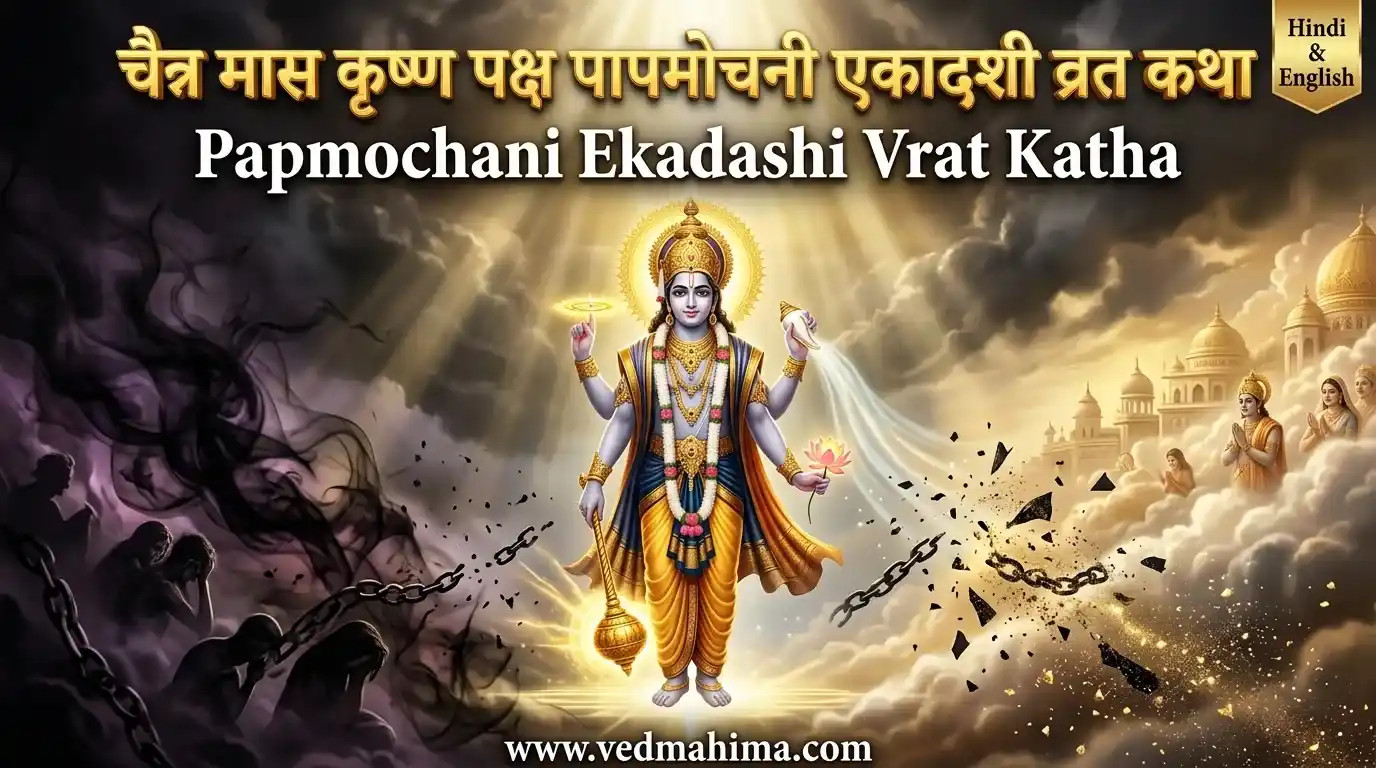
Chaitra Maas Krishna Paksha Papmochani Ekadashi Vrat Katha
Sin removal, Medhavi and Manughosha, night vigil, Dwadashi parana
॥ Introduction ॥
The Ekadashi that falls during the dark fortnight (Krishna Paksha) of the Hindu calendar month of Chaitra is universally celebrated as Papmochani Ekadashi. True to its Sanskrit name ''Papmochani'' (meaning the destroyer or liberator of sins), this sacred day holds an exceptionally supreme status in Sanatan Dharma. Dedicated entirely to Lord Narayana, this fast possesses the ultimate divine power to dissolve the heaviest accumulated sins, heavy karmic liabilities, and structural impurities of a devotee, leading the soul toward purity, peace, and ultimate liberation.
॥ Importance ॥
The spiritual excellence of Papmochani Ekadashi is highly praised by Lord Shri Krishna Himself. It is described as a highly potent purifier that can eradicate even the most severe historical sins such as Brahmahatya (killing of a Brahmin), theft of gold, consumption of intoxicants, and violating the wife of a guru. Reading, hearing, or deeply meditating upon the holy glory of this fast bestows a human being with the immense spiritual merit equivalent to donating one thousand sacred cows (Sahasra Godan) to righteous souls.
॥ Puranic Reference ॥
The holy narrative of this fast is rooted in an ancient celestial dialogue between King Yudhishthira and Lord Shri Krishna during the Dwapar Yuga. Upon Yudhishthira''s eager request, the Lord narrated a highly historical discourse originally delivered by Sage Lomasa to the ancient Emperor Mandhata. Through the extraordinary events involving Sage Medhavi, the son of Sage Chyavana, and the celestial nymph Manughosha in the beautiful Chaitraratha forest, the scripture perfectly demonstrates how the precise execution of Papmochani Ekadashi can lift a soul even from a terrible sub-human ghostly state (Pishacha Yoni).
॥ Story ॥
King Yudhishthira asked—O Lord! Please be merciful and tell me about the Ekadashi that occurs during the dark fortnight (Krishna Paksha) of the month of Chaitra. What is its sacred name, and what is its specific importance?
Lord Shri Krishna replied—O Rajendra! Listen carefully. I am going to narrate to you a highly sin-destroying historical account, which the great Sage Lomasa narrated to the sovereign Emperor Mandhata when asked a similar question.
Mandhata said—O Holy Sage! Out of absolute desire for the welfare of all living beings, I wish to hear about the Ekadashi of Chaitra Krishna Paksha. What is its name, its precise method, and what spiritual fruits are obtained by executing it?
Sage Lomasa replied—O best among kings! This is a dynamic history from ancient times. In the exceptionally beautiful Chaitraratha forest, which was heavily inhabited by celestial nymphs (Apsaras) and where Gandharva daughters engaged in musical pastimes, a beautiful Apsara named Manughosha arrived with the specific intent to allure the young and highly advanced Sage Medhavi. The great Sage was residing in that forest maintaining strict celibacy (Brahmacharya). Out of immense fear of the Sage''s spiritual power, Manughosha stayed a kos (about two miles) away from the hermitage and began playing her Veena while singing exceptionally sweet melodies.
While wandering through the forest, the great Sage Medhavi passed by that path. Seeing the stunning celestial nymph singing so beautifully, the Sage was immediately overcome by the intense weapons of Kamadeva (the deity of desire) and was forcibly brought under the control of illusion. Observing the Sage''s compromised state, Manughosha approached him, put down her Veena, and embraced him ritualistically. The Sage began enjoying her company, and completely consumed by desire, he lost all temporal awareness of day and night. In this manner, destroying the noble codes of ascetic lifestyle, many decades passed while he remained attached to her.
Eventually, Manughosha prepared to return to the heavenly worlds (Devaloka). At the time of departure, she requested—O Brahman! Kindly grant me permission to return to my country.
Sage Medhavi replied—O Divine Lady! Stay with me at least until I finish performing my early morning prayers (Sandhya Vandan).
The Apsara smiled and said—O best of Brahmins! Countless mornings and twilights have already passed away! Please show mercy upon me and calculate the absolute time that has flown past us.
Sage Lomasa continued—O King! Hearing her words, Medhavi''s eyes blinked in absolute shock. When he calculated the spent duration through his inner vision, he discovered to his horror that a massive fifty-seven (57) years had passed while living with her. Realizing that she had completely destroyed his hard-earned penance (Tapasya), intense anger arose within the Sage. Cursing her with burning eyes, he said—''O sinful woman! Turn into a hideous female ghost (Pishachi) immediately!''
Burnt by the terrifying curse of the Sage, she bowed her head with deep humility and pleaded—''O virtuous Brahmin! Please provide an escape or liberation from this curse. Wise souls state that friendship with noble beings is established by speaking just seven words or walking seven steps together. I have spent many glorious years in your service; therefore, O Master, show mercy upon me!''
The Sage then relented and said—O gentle lady! Listen carefully to the method of liberation from this curse. Although you have destroyed my massive structural penance, I shall tell you the remedy. The highly auspicious Ekadashi that falls during the Chaitra Krishna Paksha is named ''Papmochani''. It is the absolute destroyer of all heavy sins. O beautiful one! Meticulously executing its fast will completely liberate you from the ghostly Pishacha form.
After delivering the remedy, Sage Medhavi immediately returned to the holy hermitage of his highly advanced father, Sage Chyavana. Seeing his son return with an unstable aura, Sage Chyavana asked—''O son! What terrible deed have you performed? You have completely destroyed your accumulated spiritual power!''
Medhavi confessed with deep sorrow—O Father! I have committed the grave sin of indulging with a celestial nymph. Please prescribe a supreme atonement (Prayashchitta) that can completely burn away this massive sin.
Sage Chyavana replied—O Son! The Papmochani Ekadashi occurring in the dark fortnight of Chaitra month is the ultimate answer. Fasting on this day will completely dissolve your entire mountain of sins.
Acting strictly upon his father''s instructions, Sage Medhavi flawlessly executed the vow of Papmochani Ekadashi. By its divine influence, his sins were completely destroyed, and he was restored to his full spiritual glory and penance. Similarly, the Apsara Manughosha also observed this excellent fast with deep focus. By the grace of Papmochani Ekadashi, she was completely freed from the sub-human ghostly form, regained her radiant celestial body, and ascended directly back to the heavenly worlds. O King! Any human being who observes this fast is completely purified of all sins. Reading or hearing its sacred glory grants the structural fruit of donating one thousand cows. Even those who have committed heavy sins like Brahmahatya or structural theft are completely liberated by this fast.
॥ Moral of the Story ॥
- Vigilance is mandatory in spiritual life; even fifty-seven years of intense celibacy can be broken in a single moment if a practitioner lets down their guard against material desires.
- The company of holy souls always provides a remedy; despite her structural fault, Manughosha''s association with a sage ensured she received a scriptural path to redemption.
- Parental guidance is a divine shield; when Medhavi fell from his spiritual heights, his father, Sage Chyavana, did not condemn him but immediately provided the supreme scriptural solution.
- No sin is beyond the redeeming power of Ekadashi; whether it is a fallen sage or a cursed ghost, the cosmic vibrations of Papmochani Ekadashi can restore any soul to its original pure state.
॥ Vrat & Worship Method ॥
- On Chaitra Krishna Dashami, consume a single pure Satvik meal before sunset and maintain complete purity of mind and body.
- On the morning of Ekadashi, wake up during Brahma Muhurta, take a holy bath, wear clean clothes, and take a firm spiritual vow (Sankalpa) to fast.
- Set up a clean altar, place an image or idol of Lord Vishnu (Lord Chaturbhuj), and perform the grand Shodashopachara worship.
- Offer pure sandalwood paste, yellow flowers, seasonal fruits, incense, and a pure ghee lamp to the Lord. Offer fresh Tulsi leaves mandatorily.
- Spend the entire day chanting the holy names of Lord Narayana and reading or listening to this sacred Papmochani Ekadashi Vrat Katha with extreme devotion.
- Maintain a night vigil (Jagaran) alongside fellow devotees, singing Vishnu bhajans and avoiding sleep completely to maximize the fast''s efficiency.
- On Dwadashi morning, perform regular morning prayers, feed self-realized Brahmins or provide charity, and break the fast during the specified Parana window.
॥ Special Rules for Papmochani Ekadashi ॥
- Sincere Repentance: While performing the worship, a devotee must internally acknowledge past mistakes and sincerely pray to Lord Narayana for absolute forgiveness.
- Deep Charity (Dana): Donating food grains, clothes, or financial aid to the needy on Dwadashi day is highly highlighted to lock in the thousand cow donation merit.
- Complete Celibacy: Strict physical and mental celibacy must be maintained throughout the three days (Dashami to Dwadashi) to echo the underlying lesson of the story.
॥ Parana (Breaking the Fast) Method ॥
- The fast must be broken on Dwadashi Tithi strictly after sunrise and after the completion of the Hari Vasara period.
- Break the fast calmly by consuming holy Charanamrit, Tulsi water, or simple Satvik prasadam.
॥ Benefits ॥
- Eradicates the heaviest accumulated sins committed knowingly or unknowingly across multiple lifetimes.
- Liberates souls from negative planetary influences, psychological burdens, and lower astral realms (like Pishacha Yoni).
- Restores lost spiritual energy, peace of mind, and material prosperity, allowing a devotee to regain their structural focus in life.
- Grants the high spiritual merit equivalent to performing a thousand cow donations (Sahasra Godan) and ensures a heavenly abode after death.
About Chaitra Maas Krishna Paksha Papmochani Ekadashi Vrat Katha
Medhavi then goes to his father, Sage Chyavana, who gives him the same remedy for his own atonement. Both keep the fast, Medhavi regains his tapas, and Manughosha is freed from the pishachi form and returns to heaven. The Katha says that those who keep the fast are freed from sin and that reading or hearing it gives the fruit of a thousand cow donations. Its message is that sincere repentance, guidance from elders and a properly kept Ekadashi can restore a fallen soul.
The page also gives the vrat and puja method, special rules, parana and benefits believed in tradition. Ekadashi fasts are best kept according to one''s health, and fruit or milk is acceptable for those who cannot keep a full fast. The story is a devotional narrative, so please read it with care and respect. Related: Vishnu Chalisa and Kamada Ekadashi.
❓ Frequently Asked Questions
Question: When is this Ekadashi kept?
Answer: On the Krishna Paksha Ekadashi of Chaitra (usually March or April), soon after Holi. In the amanta calendar of Gujarat, Maharashtra and the south, the same Ekadashi falls in Phalguna, so please follow your local panchang.
Question: What is the story of Medhavi and Manughosha?
Answer: In the Chaitraratha forest, the Apsara Manughosha is sent to draw the young sage Medhavi away from his celibacy. They live together for fifty-seven years before he notices the time. He curses her to become a pishachi, then tells her the remedy, this Ekadashi. His father, Sage Chyavana, gives him the same remedy, and both are freed. The Katha is a devotional narrative.
Question: Who tells the Katha?
Answer: Lord Krishna tells it to Yudhishthira, who in turn heard it from Sage Lomasa, who told it to Emperor Mandhata.
Question: What is the vrat vidhi?
Answer: Eat one satvik meal before sunset on Dashami, take a sankalp on Ekadashi morning, worship Lord Vishnu with tulsi, yellow flowers and a ghee lamp, read the Katha, keep a night vigil, and break the fast on Dwadashi after sunrise within the parana window (see the Vishnu Chalisa and Tulsi Chalisa).
Question: Can I keep a lighter fast?
Answer: Yes. The vrat is best kept according to health, and fruit or milk is acceptable. Pregnant women, the elderly, diabetics and those on medicines should follow a doctor''s advice.
Question: What does the Katha say about its fruit?
Answer: It says the vrat removes sin and that reading or hearing it gives the fruit of a thousand cow donations. This is a matter of faith. The central message is sincere repentance and guidance from elders. See also the Kamada Ekadashi Katha.