Shri Ambabai Mahalakshmi Temple Kolhapur
Shri Karveer Nivasini Ambabai Mahalakshmi Shakti Peeth Kolhapur Complete Yatra Guide
🙏 Devotional
🔥 Powerful
📿 Daily Prayer
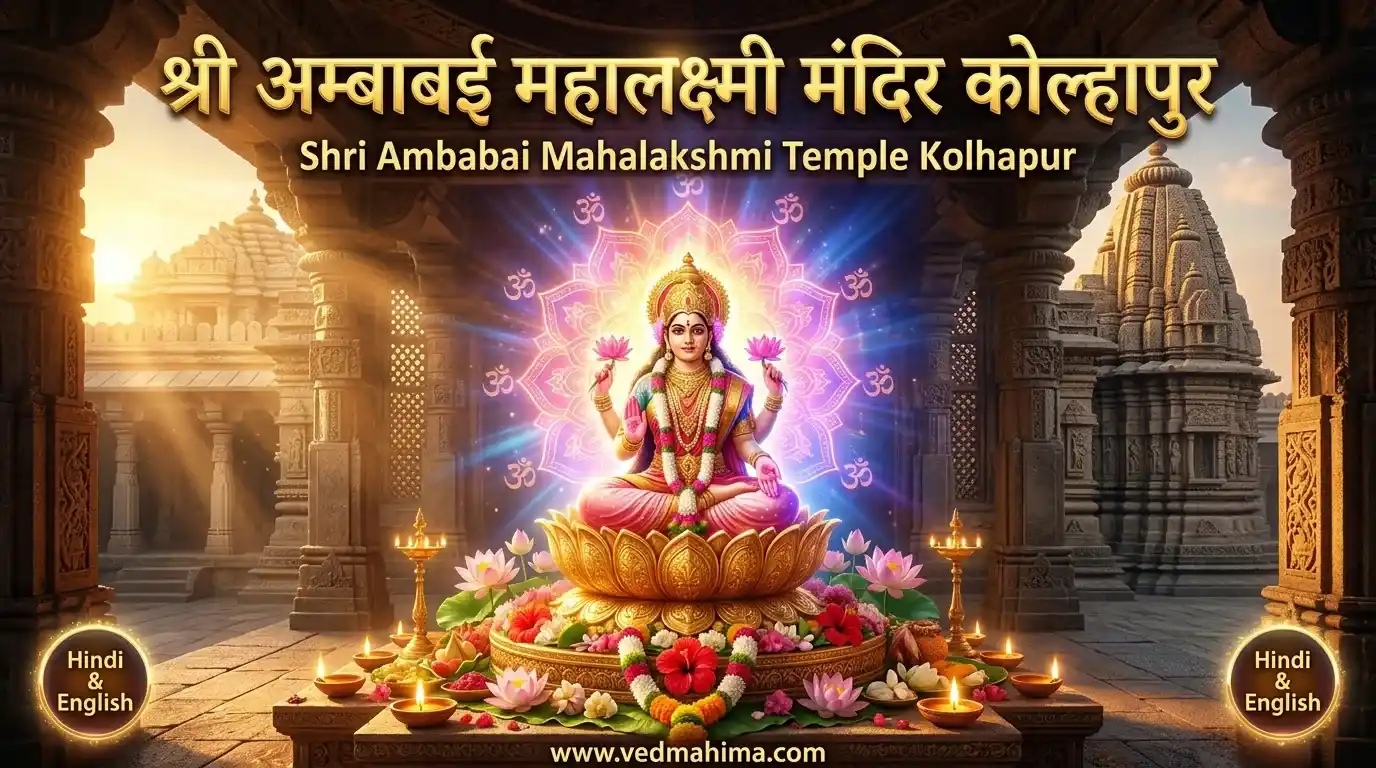
॥ Geo-Spiritual Majesty & The Matulinga Crown of Karveer Nivasini ॥
Situated at the heart of the ancient spiritual city of Kolhapur (historically documented as Karveer Kshetra on the banks of the Panchganga River in Maharashtra), lies the highly potent and architectural marvel of Shri Ambabai Mahalakshmi Temple. Recognized universally across the Karveer Mahatmya, Padma Purana, and classical Shakta scriptures as one of the highly unique and non-demolished Shakti Peethas, this holy site is deeply tied to spiritual liberation. Tantric lineages identify this site as a Siddha Peetha where divine cosmic energy flows without any structural decay. The main sanctum houses a magnificent 3-foot idol of the Goddess carved out of single, dense black gemstone (monolithic stone). Unlike conventional Hindu idols that face East or North, this self-manifested (Swayambhu) deity faces West (Pashchim). The Goddess is four-armed, carrying a shield (*Khetaka*), a mace (*Kaumodaki*), a citrus fruit (*Matulinga*), and a bowl (*Panpatra*). Uniquely, a sacred stone crown featuring a carved multi-hooded Sheshnag and a Shiva Linga rests on her head, representing the supreme convergence of Vaishnava, Shakta, and Shaiva energetic matrices. Guarded closely by Lord Shiva who manifests here as Krodh Bhairav, the temple serves as the absolute wish-fulfilling locus (Dakshin Kashi) of Western India.॥ Puranic Legends: Bhrigu's Footprint, Vishnu's Tapasya, and the Relief from Demon Kolhasur ॥
The glorious dynamic timeline of Kolhapur Mahalakshmi is woven into rich Puranic lore:* The Divine Wrath of Mata Lakshmi: According to legend, when Sage Bhrigu kicked Lord Vishnu on his chest to test his patience, Vishnu gently pressed the sage's feet instead of rebelling. Insulted by this submissive act, Goddess Lakshmi left Vaikuntha in deep anger and arrived at the Karveer forests to perform intense, silent penance (*Tapasya*), making this her eternal earthly abode.
* The Subjugation of Demon Kolhasur: The region was once terrorized by a powerful demon named Kolhasur. Responding to the prayers of the devas, the Goddess took a fierce form and annihilated him. Before his breath left, Kolhasur begged for a boon that the city be named after him (Kolhapur) and that pilgrims must offer initial respects to him, which the Goddess mercifully granted.
* The Status of Dakshin Kashi: Puranas declare that while Kashi (Varanasi) is the spiritual home of Shiva, Kolhapur is the absolute home of Lakshmi. It is believed that even during cosmic dissolution (*Pralaya*), the Goddess shields this entire holy pocket with her hand.
॥ Monumental Mahotsav: The Global Glory of Kiranotsav and Traditional Navratri ॥
The festivals at Kolhapur Mahalakshmi are calculated using centuries-old astronomical charts, bringing millions of global travelers to the state:* The Astronomical Kiranotsav (Sun Rays Festival): This is an architectural and mathematical wonder that takes place twice a year (January 31 to February 2, and November 9 to November 11). The temple walls and multi-layered stone windows are built in such a precise alignment that the setting sun rays pass directly through the main entrance gate, traveling over 250 feet straight into the dark inner sanctum. Over three consecutive days, the golden rays slowly rise from the bottom: on Day 1, they paint the feet of Maa Ambabai; on Day 2, they rise to illuminate her gold-clad chest; and on Day 3, the rays fully frame her serene face. It is a brilliant spectacle of ancient engineering.
* The Grand Sharad Navratri Utsav: For nine days, the entire temple complex is decorated with exotic flowers and heavy lighting. The unique attraction here is the Lalit Panchami palanquin procession (*Palkhi Mela*), where the processional idol of the Goddess is taken to Temblai Hill with state honors. Lakhs of devotees line the streets, singing traditional Marathi hymns and blowing conch shells.
* Chaitra Poornima Rath Yatra: Celebrated during March/April, a massive, highly decorated silver chariot (Rath) carrying the उत्सव मूर्ति (festival idol) is pulled by thousands of bareheaded devotees through the traditional old markets of Kolhapur town amid dynamic cultural firework displays.
॥ Comprehensive Travel Guide: Detailed Connectivity to Kolhapur Peeth ॥
Reaching the historical kingdom of Kolhapur is smooth and easy because of its prime location on the golden transport grid connecting Maharashtra and Karnataka:* By Road (National Highway 48 Axis): Kolhapur is situated directly on the premium multi-lane NH-48 (Mumbai-Bengaluru highway). It is roughly 230 km from Pune and 375 km from Mumbai. The Maharashtra State Road Transport Corporation (MSRTC) along with dozens of private operators run overnight sleeper luxury AC Volvo buses from Mumbai, Pune, Thane, Solapur, and Bengaluru straight to the Central Bus Stand (CBS) of Kolhapur, which is just 2.5 km from the temple gates.
* By Rail Network (Chhatrapati Shahu Maharaj Terminus - KOP): The city has its own prominent railway terminal, Kolhapur CSMT (Station Code: KOP). It is directly linked via superfast express trains to Mumbai (via Mahalaxmi Express, Koyna Express), Pune, Nagpur, Delhi, and Bengaluru. Auto-rickshaws and public cabs are available round-the-clock outside the station exits to drop you at the Mahadwar road entrance within 10 minutes.
* By Air Transit (Kolhapur Airport - KLH & Pune Airport - PNQ): The local Chhatrapati Rajaram Maharaj Airport (KLH) in Kolhapur operates regular domestic flights connecting to major transit centers like Mumbai, Hyderabad, and Bengaluru. For international travelers, Pune International Airport (PNQ), located 240 km away, serves as the primary practical gateway. Taxis can be effortlessly booked from Pune airport directly to the temple via the smooth expressway.
🙏 ॥ Thus completed ॥ 🙏
The Hindi text has been compiled based on original and authentic sources. If there is any difference,
error, or inconsistency between the Hindi and English versions, the Hindi text shall be considered the
authoritative version. If there are any errors or copyright-related concerns regarding this content,
please contact us.
📜 प्रामाणिक स्रोत:
📖 सार्वजनिक रूप से उपलब्ध स्रोत
📖 आधिकारिक मंदिर रिकॉर्ड
📖 सरकारी पोर्टल
📖 सत्यापित ऑनलाइन संदर्भ
About Shri Ambabai Mahalakshmi Temple Kolhapur
The architectural foundations of the current structural temple were laid down around the 7th century AD by King Karandev of the Chalukya Dynasty. It was later heavily expanded, reinforced, and beautified during the 11th to 13th centuries by the Shilahara and Yadava rulers. The temple faced destruction phases during external invasions but was fully restored to its peak glory by the Royal Maratha Empire under the legendary Chhatrapati Shivaji Maharaj and the subsequent Maratha rulers of Kolhapur (The Bhonsle Dynasty), who presented rare jewels, silver gates, and massive land endowments. Today, all assets, administrative security, and massive crowd tracking systems are flawlessly managed by the government-backed Western Maharashtra Devasthan Management Committee (WMDMC) under the direct supervision of the District Collector.