Shri Mata Vaishno Devi Temple Katra
Shri Mata Vaishno Devi Temple Darshan Guide
🙏 Devotional
🔥 Powerful
📿 Daily Prayer
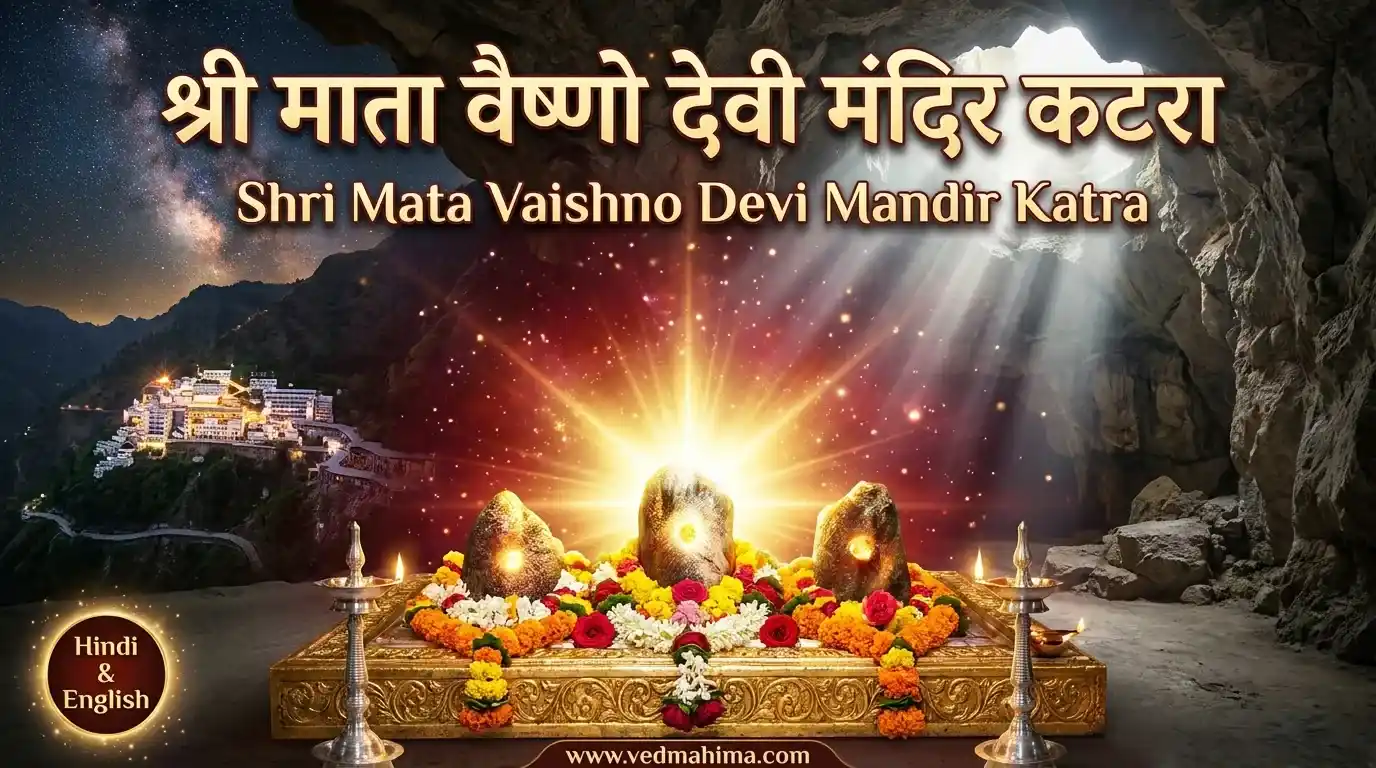
॥ Temple Overview & Divine Glory ॥
Shri Mata Vaishno Devi Sukrit Dham stands as one of the most revered, intensely vibrant, and globally celebrated ancient cave shrines of Sanatan Dharma. Nestled profoundly at an altitude of 5,200 feet within the folds of the holy Trikuta Mountains in the Katra jurisdiction of Reasi district within Jammu and Kashmir, India, this divine abode is considered a supreme epicentre of Shaktism. The temple does not house any traditional anthropomorphic stone statues; instead, the Divine Mother manifests herself inside a 98-foot-long natural geological cave in the form of three self-manifested rock formations known as the Holy Pindis. These three Pindis represent the supreme cosmic energies: Maha Kali (the energy of destruction and transformation, radiating a dark hue), Maha Lakshmi (the energy of sustenance and prosperity, radiating a yellowish-red glow), and Maha Saraswati (the energy of cosmic wisdom and intellect, radiating a pristine white hue). Scriptural traditions declare that Mata Vaishno Devi was created by the collective spiritual energies of these three primordial Goddesses to destroy evil forces and protect righteousness. Millions of walking pilgrims undertake a grueling yet spiritually ecstatic 12 to 13-kilometer mountain trek from Katra base camp annually, propelled by the ultimate spiritual belief that nobody visits this holy cave unless the Divine Mother herself issues the supreme cosmic invitation (Maa Aap Aap Bulati Hai).॥ Key Spiritual & Structural Aspects ॥
* The Self-Manifested Holy Pindis: The absolute focal point of ultimate devotion is the square marble platform holding the three ancient, natural stone Pindis. Water from the sacred mystic stream, Charan Ganga, continuously flows over the base of these Pindis, keeping the inner chamber dynamically chilled and radiating immense protective vibrations.* The Natural Cave Experience: The original ancient cave is a narrow, mystical rock tunnel through which devotees historically had to crawl to reach the inner sanctum. To accommodate the massive influx of contemporary global travelers safely, modern engineering added two artificial tunnels for exit and entry, while the ancient natural entry is selectively utilized during low-crowd winter phases.
* The Legend of Bhairon Nath: A foundational spiritual protocol dictating the Vaishno Devi pilgrimage states that the journey remains incomplete without visiting the Bhairon Ghati Temple, situated 3 kilometers higher on an adjacent peak. According to sacred lore, as Mata Vaishno Devi severed the head of the demoniac tantric Bhairon Nath, he repented at the last moment. The benevolent Mother forgave him and granted a cosmic boon that no devotee's darshan would be considered complete or fruitful without paying homage at his mountaintop shrine.
* The Holy Charan Paduka & Ardhkuwari: Along the historical trekking pathway, pilgrims pass through highly sacred intermediate stations. Charan Paduka marks the spot where the Goddess paused to look back at Bhairon Nath, leaving her footprints permanently etched on a rock. Ardhkuwari houses the historic Garbhjoon Cave, a narrow, womb-like natural rock canal where the Goddess hid and meditated in absolute secrecy for nine continuous months, mimicking a child in a maternal womb.
॥ The Continuous Divine Ritual Cycle ॥
The spiritual administration of the holy shrine follows a magnificent, unbroken daily ritualistic timeline governed by the Shri Mata Vaishno Devi Shrine Board (SMVDSB):1. Pratahkal Maha Aarti (05:00 AM - 07:00 AM): The grand morning twilight worship. The inner sanctum is thoroughly cleaned, and the holy Pindis are beautifully adorned in royal red garments (Chunri) and gold ornaments. Learned Vedic priests chant powerful hymns from the Vedas amidst the blowing of conch shells and deep rhythmic bells, while general darshan remains briefly suspended.
2. Sandhyakal Maha Aarti (05:00 PM - 07:00 PM): The spectacular evening twilight assembly. The entire outer cave area is illuminated beautifully with traditional oil lamps. A highly atmospheric camphor offering is waved, and sacred devotional stotras dedicated to Goddess Durga are sung live, broadcasting spiritual frequencies across the entire Trikuta mountain range.
3. Continuous Darshan: Except during the four hours dedicated to the two grand aartis, the doors of the holy cave remain open 24 hours a day, 365 days a year, facilitating the non-stop movement of pilgrims.
॥ Deep Architectural Marvel & Modern Complex ॥
The structural layout of the Vaishno Devi Bhawan has evolved from a simple stone platform outside a mountain cave into a massive, ultra-modern multi-level complex built securely against vertical rock faces. The architectural design ensures high-volume pedestrian circulation while preserving the absolute sanctity of the natural cave. The outer facades feature beautiful white marble structures topped with elegant golden spires (Shikhars). The Shrine Board has systematically integrated cutting-edge modern transit infrastructure into the rugged mountain topography, featuring a massive Passenger Ropeway System connecting the main Bhawan to Bhairon Ghati in under three minutes, eco-friendly battery-operated vehicle tracks, and a well-ventilated, multi-tier queue complex covered completely with weather-proof shelters to protect walking travelers from extreme mountain climates.॥ Major Festivals Celebrated ॥
* Ashwin and Chaitra Navratri: The ultimate spiritual celebrations of the year spanning nine nights. The entire 13-kilometer trekking pathway and the main Bhawan are intricately decorated with hundreds of tons of exotic fresh flowers and fruits imported globally. The Shrine Board conducts grand Shat Chandi Mahayagyas for universal peace, drawing global spiritual seekers.* New Year Celebrations: Witnessing an immense peak in footfall, hundreds of thousands of young pilgrims and families brave sub-zero winter temperatures to climb the Trikuta hills to secure the Divine Mother's blessings for the upcoming year.
॥ How to Reach Shri Vaishno Devi Katra ॥
Katra serves as the base camp for the pilgrimage and is exceptionally well-connected to major Indian hubs via an advanced multi-modal transit network:* By Air (Flights): The nearest domestic gateway is the Jammu Airport (IXJ), located approximately 50 to 52 kilometers away from Katra base camp. It operates frequent direct domestic flights to New Delhi, Mumbai, Bengaluru, and Srinagar. From the airport terminal, safe pre-paid airport cabs and state-run air-conditioned luxury buses run non-stop via the highway to Katra. Additionally, private helicopter services operate directly from Katra helipad (Sanji Chhat) to the main Bhawan for affluent travelers.
* By Train (Railways): The base town is directly served by the ultra-modern Shri Mata Vaishno Devi Katra Railway Station (SVDK). It connects seamlessly to New Delhi via high-speed Vande Bharat Express, Uttar Sampark Kranti, and various superfast luxury trains coming from Mumbai, Kolkata, and Ahmedabad. Local auto-rickshaws and shuttle coaches operate round-the-clock from the platform exits to the primary trekking registration gates at Katra.
* By Road (Highways): Katra is linked seamlessly via a well-maintained 4-lane national highway branching off from NH-44 (Jammu-Srinagar Highway). Regular luxury Volvo air-conditioned sleeper buses operate continuously from major neighboring territories like New Delhi, Amritsar, Chandigarh, and Ludhiana directly to the Katra Inter-State Bus Stand. Private vehicles can easily access Katra, where massive multi-tier parking lots are available, from where the journey must be completed on foot, mules, or battery cars.
🙏 ॥ Thus completed ॥ 🙏
The Hindi text has been compiled based on original and authentic sources. If there is any difference,
error, or inconsistency between the Hindi and English versions, the Hindi text shall be considered the
authoritative version. If there are any errors or copyright-related concerns regarding this content,
please contact us.
📜 प्रामाणिक स्रोत:
📖 सार्वजनिक रूप से उपलब्ध स्रोत
📖 आधिकारिक मंदिर रिकॉर्ड
📖 सरकारी पोर्टल
📖 सत्यापित ऑनलाइन संदर्भ
About Shri Mata Vaishno Devi Temple Katra
The history of Shri Mata Vaishno Devi Temple is an ancient chronicle preserved in the core Vedic lore and the historic epics of Mahabharata. The Trikuta Mountain finds mention in Rigveda, which describes it as a place of immense spiritual power. Historically, the Pandavas are believed to have visited and worshipped the Divine Mother here, constructing the earliest structural elements near the cave. For centuries, the hidden natural cave remained tucked away from human sight until it was rediscovered approximately 700 years ago by a devout Brahmin priest named Pandit Sridhar. Sridhar, a poor devotee living in Katra, was directed by the Goddess herself in a mystical dream to trace her hidden abode beneath the Trikuta folds. Upon traversing the rugged terrain, he uncovered the holy Pindis and initiated the formal lineage of daily ritual services. In modern history, the complete administration was taken over by the Government via the creation of the SMVDSB in 1986, transforming it into India's finest managed religious shrine.