Maa Vindhyavasini Temple Mirzapur Uttar Pradesh
Maa Vindhyavasini Temple Mirzapur Pilgrimage, History & Vindhyachal Trikon Yatra Guide
🙏 Devotional
🔥 Powerful
📿 Daily Prayer
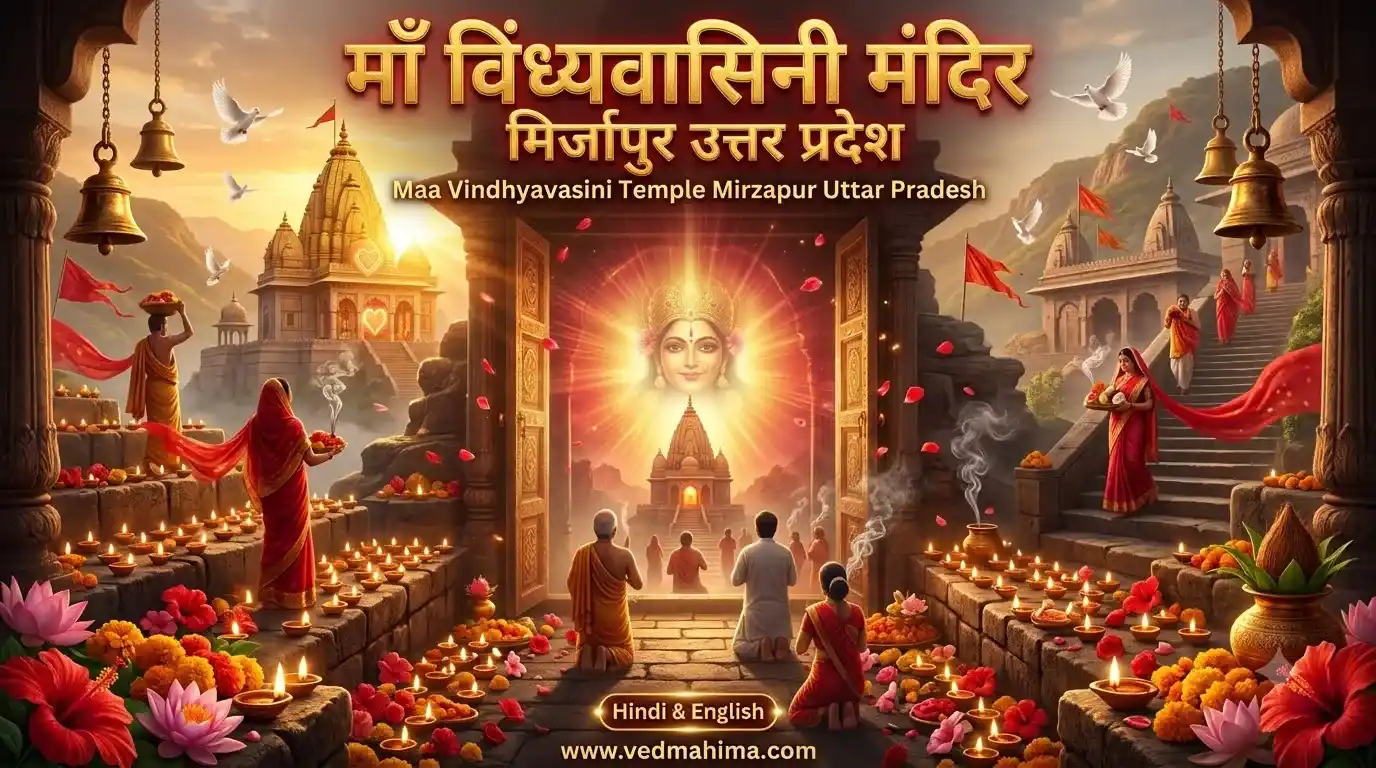
॥ Temple Overview & Divine Glory ॥
Maa Vindhyavasini Temple, located in the holy town of Vindhyachal in the Mirzapur district of Uttar Pradesh, is one of the most venerated, powerful, and ancient Shakti Peethas in Sanatana Dharma. Situated on the serene banks of the sacred River Ganga, this holy shrine is the primordial seat of Goddess Vindhyavasini (an incarnation of Supreme Shakti Goddess Durga). Unlike many other Shakti Peethas associated with the falling body parts of Sati, Vindhyachal is uniquely celebrated as a "Siddha Peetha" where Goddess Mahamaya chose to reside perpetually after her divine incarnation to fulfill cosmic promises. The temple forms the cosmic nucleus of the famous "Vindhyachal Trikon Yatra" (Triangular Pilgrimage), which connects three supreme manifestations of Shakti—Maa Vindhyavasini (Mahalakshmi), Maa Kali at Kali Khoh (Mahakali), and Maa Ashtabhuja atop the Vindhya hill (Mahasaraswati). The atmosphere inside the temple and its surrounding corridors hums with continuous chanting of Durga Saptashati, Vedic hymns, and the echoing resonance of brass bells, attracting millions of devotees and Tantric sadhakas throughout the year.॥ Key Spiritual & Structural Aspects ॥
* The Divine Idol & Siddha Peetha Manifestation: The main sanctum sanctorum houses the miraculous, self-manifested idol of Maa Vindhyavasini adorned with a striking silver crown, radiant eyes, and exquisite silk attire. She represents Goddess Mahalakshmi within the Shakti tradition.* The Sacred Vindhyachal Trikon Yatra: Completing the pilgrimage to Vindhyachal requires performing the 3-point triangular circuit: starting with Darshan at Maa Vindhyavasini Temple (center), proceeding to Kali Khoh Cave Temple (representing Mahakali), and concluding at Ashtabhuja Devi Temple (representing Mahasaraswati).
* Significance in Krishna Leela & Yogamaya: Maa Vindhyavasini is the divine Mahamaya/Yogamaya who took birth as the infant daughter of Yashoda in Gokul on the exact night Lord Krishna was born in Kansa's prison. When the tyrannical demon king Kansa tried to kill the infant by hurling her against a stone, she slipped from his hands, assumed her celestial eight-armed form in the sky, foretold Kansa's death, and permanently took residence on the Vindhya mountains.
* The Newly Developed Vindhya Corridor: Designed along the lines of the Kashi Vishwanath Dham, the grand Vindhya Corridor Project has dramatically transformed the temple landscape with wide pink-sandstone pathways, decorated arched gateways, and spacious courtyards ensuring smooth Darshan for lakhs of pilgrims daily.
॥ The Detailed Divine Ritual & Aarti Cycle ॥
The worship at Maa Vindhyavasini Temple follows ancient Shakta Tantric and Vedic traditions with four major grand Aartis performed every 24 hours:1. Mangala Aarti & Morning Shringar (03:00 AM to 04:00 AM): The day begins in the auspicious Brahma Muhurta. The divine deity is bathed with holy Ganga water and Panchamrit, dressed in bridal silk garments (Saree), and adorned with fresh garlands of red hibiscus and marigold before the dawn Mangala Aarti.
2. Midday Aarti & Bhog Seva (12:00 PM to 10:30 PM): The afternoon Aarti is accompanied by elaborate offerings of traditional Sattvic Bhog, fruits, and milk sweets.
3. Sandhya Maha Aarti (07:00 PM to 08:00 PM): The evening Aarti is an electrifying event. Dozens of heavy multi-tiered brass oil lamps, incense smoke, conch blowing, and the rhythmic beat of dhol-tasha reverberate across the Ganga ghats, creating an atmosphere of intense devotion.
4. Badi Aarti / Shayan Aarti (09:30 PM to 10:30 PM): The night concludes with the grand Badi Aarti where special floral decorations and chants take place before the sanctum closes briefly for rest.
॥ Deep Architectural Landscape & Layout ॥
The architectural structure of Maa Vindhyavasini Temple reflects classic North Indian Nagara style combined with newly carved Vindhya Corridor sandstone art. Built on a raised stone platform near the Ganga riverbank, the temple complex features a grand main entry gate decorated with lion motifs (Vahana of Goddess Durga). The sanctum sanctorum (Garbhagriha) is constructed of thick antique stone walls topped by a majestic stone spire (Shikhara) holding a brass Kalash and sacred red flag. The outer courtyard features dedicated shrines for Lord Shiva (Kajali Teej Shiva), Lord Hanuman, Goddess Annapurna, and Lord Bhairava (who acts as the eternal guardian of the Shakti Peetha). The surrounding corridors are built using fine Chunar pink sandstone, providing shaded colonnades for pilgrims to sit, meditate, and perform Japa.॥ Major Festivals Celebrated ॥
* Chaitra and Sharad Navratri Melas: Navratri is the biggest festival at Vindhyachal. During both Chaitra (March-April) and Sharad (September-October) Navratris, a massive 9-day grand fair (Mela) takes place. Over 15 to 20 lakh pilgrims visit the shrine to perform Mundan ceremonies, Kanya Pujan, and Tantric Sadhana.* Kajali Teej Festival: Celebrated during the month of Bhadrapada (August-September), Kajali Teej holds deep cultural roots in Mirzapur. The entire town celebrates with folk singing (Kajali), night-long processions, and special temple decorations.
* Deepotsav & Annakut: Celebrated after Diwali, the temple complex and the adjacent Ganga ghats are illuminated with thousands of earthen lamps (diyas), accompanied by grand food offerings to the Goddess.
॥ How to Reach Maa Vindhyavasini Temple Mirzapur ॥
Situated in the Vindhyachal town of Mirzapur district, Uttar Pradesh, the temple is seamlessly connected by direct rail and highway routes:* By Train (Railways): Vindhyachal Railway Station (BDL) is located just 1 km away from the temple (5 minutes by auto-rickshaw). For major long-distance superfast trains (Vande Bharat, Rajdhani, Express), Mirzapur Railway Station (MZP) is located 8 km away, and Prayagraj Junction (PRYJ) is approximately 80 km away. Taxis and auto-rickshaws operate round-the-clock from both stations.
* By Road & City Transport: Vindhyachal is located right along National Highway 19 (NH-19) connecting Prayagraj and Varanasi. Regular government (UPSRTC) and private buses operate frequently from Varanasi (65 km), Prayagraj (80 km), and Mirzapur Bus Stand directly to Vindhyachal.
* By Air (Flights): Lal Bahadur Shastri International Airport, Varanasi (VNS) is the nearest airport, located approximately 72 km away. Prayagraj Airport (IXD) is around 90 km away. Devotees arriving by air can easily hire direct prepaid taxis to reach Vindhyachal in under 2 hours via the national highway.
🙏 ॥ Thus completed ॥ 🙏
The Hindi text has been compiled based on original and authentic sources. If there is any difference,
error, or inconsistency between the Hindi and English versions, the Hindi text shall be considered the
authoritative version. If there are any errors or copyright-related concerns regarding this content,
please contact us.
📜 प्रामाणिक स्रोत:
📖 दुर्गा सप्तशती (मार्कंडेय पुराण)
📖 देवी भागवत पुराण
📖 सार्वजनिक रूप से उपलब्ध स्रोत
📖 आधिकारिक मंदिर रिकॉर्ड
📖 सरकारी पोर्टल
📖 सत्यापित ऑनलाइन संदर्भ
About Maa Vindhyavasini Temple Mirzapur Uttar Pradesh
The celestial genesis, legendary lore, and scriptural glory of Maa Vindhyavasini Temple are deeply documented across the Markandeya Purana (Durga Saptashati), Devi Bhagavata Purana, and Matsya Purana. Unlike many other prominent Shakti Peethas that emerged from the severed limbs of Goddess Sati carried by Lord Shiva, Vindhyachal holds a distinct and supreme status as a "Siddha Peetha"—a holy sanctuary created directly by the divine will of the Supreme Goddess Mahamaya for the eternal protection of the universe.
According to the sacred texts, during the Dwapara Yuga, when the demon king Kansa was committing atrocities in Mathura and threatened to kill every newborn child of Devaki, Lord Vishnu orchestrated a divine play (Leela). Lord Vishnu directed Yogamaya (the cosmic power of illusion) to take birth as the daughter of Yashoda and Nanda in Gokul on the exact night when Lord Krishna was born in Kansa's dungeon. Vasudeva secretly exchanged the infant Krishna with Yashoda's baby girl and brought her back to Mathura.
When Kansa rushed into the cell to slay the infant, he grabbed the baby girl by her feet and attempted to dash her against a stone slab. Miraculously, the divine child slipped from Kansa's grasp, rose high into the cosmic sky, and transformed into her majestic eight-armed goddess form (Ashtabhuja Durga) holding weapons in all her hands. Laughing at Kansa's foolishness, she proclaimed: "O foolish Kansa, your slayer has already been born in Gokul and is growing up safely!"
After declaring Kansa's imminent doom, the Goddess chose the holy Vindhya mountain range along the banks of the sacred River Ganga as her permanent earthly residence. She promised the gods and sages that as "Vindhyavasini" (She who resides in the Vindhyas), she would grant all spiritual boons, destroy evil forces, and protect her devotees in the era of Kali Yuga. Over the millennia, great sages including Maharishi Agastya, Vashishta, and Tantric masters performed rigorous penance here. Today, with the realization of the grand Vindhya Corridor, Maa Vindhyavasini Temple continues to shine as an eternal beacon of Sanatana faith, Shakti worship, and divine grace.