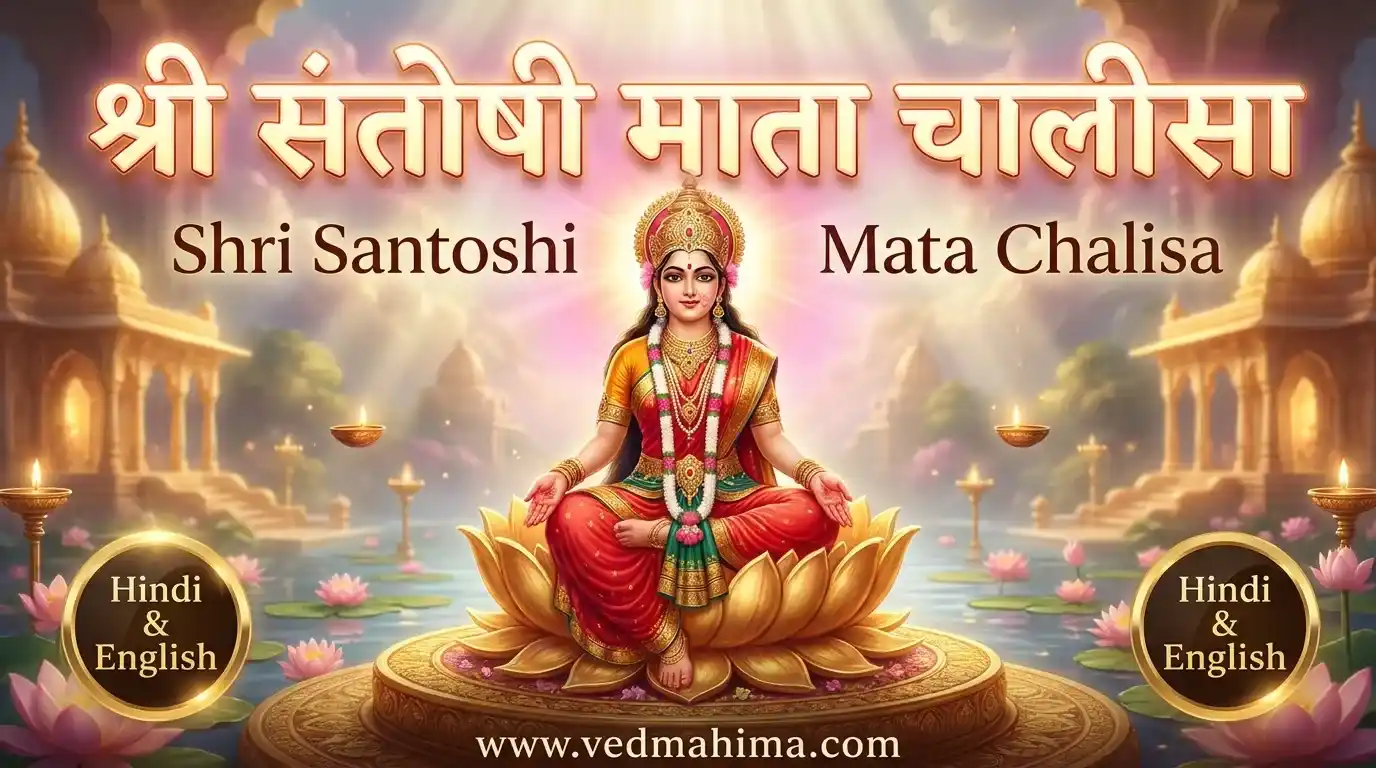
Shri Santoshi Mata Chalisa
Santoshi Mata Friday vrat, gud-chana bhog, saat Shukravar vrat and udyapan vidhi, Ganesh ji ki putri, santosh and wish fulfillment
Shri Ganpati pad naay sir,
Dhari hiy Sharda dhyan.
Santoshi Maa ki karun,
Keerati sakal bakhaan.
॥ Chaupai ॥
Jai Santoshi Maa Jag Janani,
Khal mati dusht daitya dal hanani.
Ganpati Dev tumhare tata,
Riddhi Siddhi kahlavahin mata.
Mata-pita ki rahau dulari,
Keerati kehi vidhi kahun tumhari.
Kreet mukut sir anupam bhaari,
Kanan kundal ko chhavi nyaari.
Sohat ang chhata chhavi pyari,
Sundar cheer sunahari dhaari.
Aap chaturbhuj sughad vishaala,
Dhaaran karahu gale van mala.
Nikat hai gau amit dulari,
Karahu mayur aap aswaari.
Jaanat sabhi aap prabhutai,
Sur nar muni sab karahin badaai.
Tumhare darsh karat kshan maai,
Dukh daridr sab jaay nasaai.
Ved Puraan rahe yash gaai,
Karahu bhakt ki aap sahai.
Brahma dhing Saraswati kahai,
Lakshmi roop Vishnu dhing aai.
Shiv dhing Girija roop biraaji,
Mahima teenon lok mein gaaji.
Shakti roop pragati jan jaani,
Rudra roop bhai maat Bhavani.
Dushtdalan hit pragati Kaali,
Jagmag jyoti prachand niraali.
Chand Mund Mahishasur maare,
Shumbh Nishumbh asur hani daare.
Mahima Ved Puraan barani,
Nij bhaktan ke sankat harani.
Roop Sharada hans mohini,
Nirankaar saakaar daahini.
Pragataai chahundish nij maya,
Kan kan mein hai tej samaaya.
Prithvi Surya Chandra aru taare,
Tav ingit kram baddh hain saare.
Paalan poshan tumhin kartin,
Kshan bhangur mein praan hartin.
Brahma Vishnu tumhein nit dhyaavain,
Shesh Mahesh sada man laavain.
Manokamna poorn karni,
Paap kaatni bhav bhay tarni.
Chitt lagaay tumhein jo dhyata,
So nar sukh sampatti hai paata.
Bandhya naari tumhin jo dhyaavai,
Putra pushplata sam vah paavai.
Pati viyogi ati vyaakul naari,
Tum viyog ati vyaakulyaari.
Kanya jo koi tumko dhyaavai,
Apna man vaanchhit var paavai.
Sheelvaan gunvaan ho Maiya,
Apne jan ki naav khivaiya.
Vidhi poorvak vrat jo koi karahin,
Taahi amit sukh sampatti bharahin.
Gud aur chana bhog tohi bhaavai,
Seva karai so aanand paavai.
Shraddha yukt dhyan jo dharahin,
So nar nishchay bhav son tarahin.
Udyapan jo karahi tumhara,
Taako sahaj karahu nistaara.
Naari suhagin vrat jo karti,
Sukh sampatti son godi bharti.
Jo sumirat jaisi man bhaava,
So nar vaiso hi phal paava.
Saat Shukra jo vrat man dhaare,
Taake poorn manorath saare.
Seva karahin bhakti yut joi,
Taako door daridr dukh hoi.
Jo jan sharan Mata teri aavai,
Taake kshan mein kaaj banaavai.
Jai Jai Jai Ambe Kalyani,
Kripa karau mori Maharani.
Jo koi padhai maat chalisa,
Taape karahin kripa Jagdisha.
Nit prati paath karai ik baara,
So nar rahai tumhara pyaara.
Naam let byaadha sab bhaage,
Rog dosh kabahun nahi laage.
॥ Doha ॥
Santoshi Maa ke sada,
Bandhau pag nish vaas.
Poorn manorath hon sakal,
Maat harau bhav traas.
About Shri Santoshi Mata Chalisa
The first verses introduce her. She is hailed as the mother of the world and the destroyer of the armies of the wicked. The Chalisa says Ganpati Dev is her father and Riddhi and Siddhi are called her mothers (see the Ganesh Chalisa), and that she is the beloved daughter of her parents. It describes her incomparable crown, earrings, golden garment and forest garland, her four arms and her peacock vehicle, with a cow close by. It says that even a moment of her darshan removes sorrow and poverty.
The next verses place her within the wider tradition of the Goddess. She stays beside Brahma as Saraswati, beside Vishnu as Lakshmi and beside Shiva as Girija (see the Saraswati Chalisa, Lakshmi Chalisa and Parvati Chalisa). She appeared as Kali for the destruction of the wicked and killed Chand, Mund, Mahishasura, Shumbh and Nishumbh (see the Kali Chalisa and Durga Chalisa). The verses add that the earth, sun, moon and stars follow her will, that she feeds and sustains, and that Brahma, Vishnu and Shesh meditate on her.
The second half is about the vrat. It says that the childless woman who meditates on her receives a son, that the woman suffering separation finds relief, and that an unmarried girl who worships her receives the groom of her choice. It says that one who keeps the vrat by the rules gains happiness and wealth, that gud (jaggery) and chana (gram) are the bhog she likes, that one who performs the udyapan is carried across easily, and that married women who keep the vrat see their laps filled. Its most specific line is that one who keeps the vrat for seven Fridays has every wish fulfilled. Many families keep 16 Fridays, so follow your tradition. It ends by saying that one who recites the Chalisa once a day stays dear to the Mother, and that taking her name removes disease and fault.
These are matters of faith. The vrat is best understood as a practice of simplicity, patience and contentment, taken alongside honest effort and, where needed, medical care. Please also note that vrat customs, such as avoiding sour food, come from tradition and are not written in the Chalisa.
❓ Frequently Asked Questions
Question: Who is Santoshi Mata, and how does the Chalisa introduce her?
Answer: The Chalisa calls her Jag Janani, the destroyer of the armies of wicked demons, and the beloved daughter of her parents. It says Ganpati Dev is her father and Riddhi and Siddhi are her mothers (see the Ganesh Chalisa). She is worshipped as the goddess of contentment (santosh).
Question: How does the Chalisa describe her form?
Answer: It describes an incomparable crown, earrings, a golden garment and a forest garland. She is four-armed, and her vehicle is a peacock, with a cow standing near her.
Question: How many Fridays is the Santoshi Mata vrat kept for?
Answer: The Chalisa says that one who keeps the vrat for seven Fridays (saat Shukra) with a steady mind has all wishes fulfilled. In many homes the vrat is kept for 16 Fridays, so follow your family tradition. The Chalisa also mentions performing the udyapan (concluding ceremony) of the vrat.
Question: What is the bhog of Santoshi Mata?
Answer: The Chalisa says that jaggery and gram (gud aur chana) are the offering she likes. By tradition, many devotees avoid sour food on the day of the vrat and the day of the udyapan. This is a custom of the vrat tradition and is not stated in the verses.
Question: Which other forms of the Goddess are named in the Chalisa?
Answer: It says she appears as Saraswati beside Brahma, as Lakshmi beside Vishnu and as Girija beside Shiva, and as Kali for the destruction of the wicked (see the Saraswati Chalisa, Lakshmi Chalisa, Parvati Chalisa and Kali Chalisa). It names Chand, Mund, Mahishasura, Shumbh and Nishumbh (see the Durga Chalisa).
Question: What does the Chalisa promise to those who recite it?
Answer: It says the childless, the separated, unmarried girls and those in poverty find relief, and that one who recites it once daily is dear to the Mother. These are promises of faith and are best taken as hope alongside honest effort.