Shri Annapurna Chalisa
Maa Annapurna of Kashi, Parvati tapasya and Shiva marriage story, Annapurna Jayanti, kitchen puja for anna-dhan abundance
Vishweshwar padpadam ki,
raj nij sheesh lagay.
Annapurne, tav suyash,
barnau kavi matilay.
॥ Chaupai ॥
Nitya anand karini mata,
Var aru abhay bhav prakhyata.
Jai! Saundarya sindhu jag janani,
Akhil paap har bhav-bhay-harni.
Shwet badan par shwet basan puni,
Santan tuv pad sevat rishimuni.
Kashi puradhishwari mata,
Maheshwari sakal jag trata.
Vrishabharudh naam Rudrani,
Vishw viharini jai! Kalyani.
Patidevta suteet shiromani,
Padvi prapt keenh Giri Nandini.
Pati vichhoh dukh sahi nahin pava,
Yog agni tab badan jarava.
Deh tajat Shiv charan sanehu,
Rakhehu jaat Himagiri gehu.
Prakati Girija naam dharayo,
Ati anand bhavan manh chhayo.
Narad ne tab tohin bharmaayu,
Byah karan hit paath padhayu.
Brahma Varun Kuber ganaye,
Devaraj aadik kahi gaye.
Sab devan ko sujas bakhani,
Mati palatan ki man manh thani.
Achal rahin tum pran par dhanya,
Keenhi siddh Himachal kanya.
Nij kau tab Narad ghabraye,
Tab pran poorn mantra padhaye.
Karan hetu tap tohin updeshu,
Sant bachan tum satya parekhehu.
Gagangira suni tari na tare,
Brahma tab tuv paas padhare.
Kaheu putri var maangu anupa,
Dehun aaj tuv mati anurupa.
Tum tap keenh alaukik bhaari,
Kasht uthayehu ati sukumari.
Ab sandeh chhaad kachu moson,
Hai saugandh nahin chhal toson.
Karat ved vid Brahma jaanahu,
Vachan mor yah sancha maanahu.
Taji sankoch kahahu nij ichha,
Dehun main manmaani bhiksha.
Suni Brahma ki madhuri bani,
Mukh son kachu musukay Bhavani.
Boli tum ka kahahu Vidhata,
Tum to jagke srashtadhaata.
Mam kaamna gupt nahin toson,
Kahvava chahahu ka moson.
Daksh yagya mahan marti baara,
Shambhunath puni hohin hamara.
So ab milahin mohin manbhaye,
Kahi tathastu vidhi dhaam sidhaye.
Tab Girija Shankar tav bhayau,
Phal kaamna sanshay gayau.
Chandrakoti Ravi koti prakasha,
Tab aanan mahan karat nivasa.
Mala pustak ankush sohai,
Kar manh apar paash man mohai.
Annapurne! Sadapoorne,
Aj anavady anant apoorne.
Kripa sagari kshemankari Maa,
Bhav vibhuti anand bhari Maa.
Kamal vilochan vilasit bale,
Devi Kalike! Chandi karale.
Tum Kailash maahin hvai Girija,
Vilasi anand saath Sindhuja.
Swarg Mahalakshmi kahlaayi,
Martya lok Lakshmi padpaayi.
Vilasi sab manh sarv swarupa,
Sevat tohin amar pur bhupa.
Jo padhihahin yah tuv Chaalisa,
Phal paihahin shubh sakhi Isa.
Praat samay jo jan man layo,
Padhihahin bhakti suruchi adhikayo.
Stri kalatra pati mitra putra yut,
Parameshwar labh lahi adbhut.
Raj vimukh ko raj divavai,
Jas tero jan sujas badhavai.
Paath maha mud mangal data,
Bhakt manovanchhit nidhi paata.
॥ Doha ॥
Jo yah Chaalisa subhag,
padhi navhinge math.
Tinke kaaraj siddh sab,
sakhi Kashi Nath.
About Shri Annapurna Chalisa
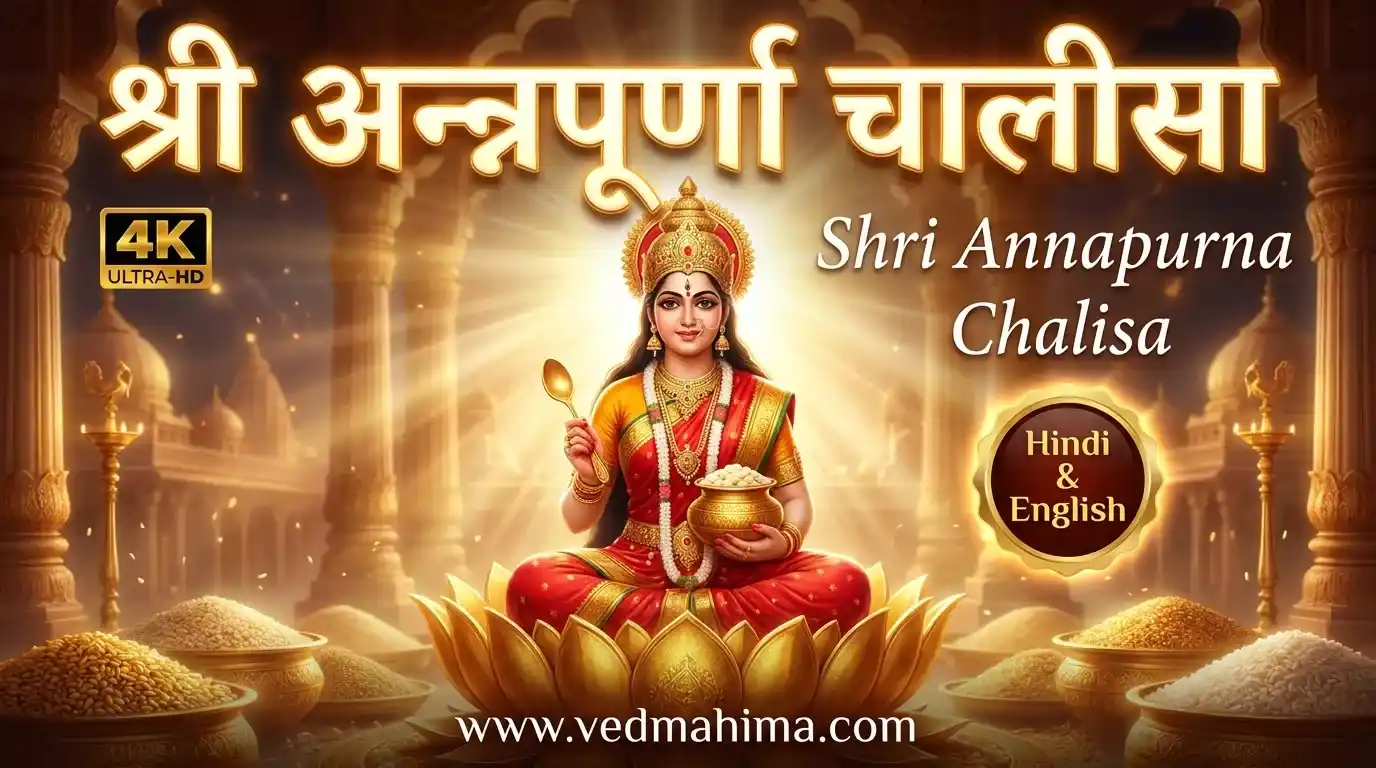
The opening doha bows to the dust of Vishweshwar''s feet and promises to sing Annapurna''s glory as far as the poet''s understanding allows. The first verses call her the giver of constant joy, boons and fearlessness, a sea of beauty, the mother of the world, the destroyer of all sin and fear of worldly life. She is dressed in white, saints and sages serve her feet, and she is Kashi Puradhishwari, Maheshwari, protector of the whole world, and Rudrani who rides a bull (see the Parvati Chalisa).
The central story starts with Sati. The Chalisa says the devoted wife could not bear separation from her husband and burned her body in the fire of yoga, with her love for Shiva''s feet intact. She was then born at Himalaya''s house and named Girija, bringing joy to the home (see the Shiv Chalisa). Then Narada tried to mislead her, teaching her to think about marriage differently and listing the merits of Brahma, Varun, Kuber and Indra instead, but she stayed firm in her vow. The Himalayan princess proved her devotion. When Narada grew worried, he taught her the mantra that fulfils a vow and advised tapasya.
When her tapasya was done, Brahma came and told her to ask for a boon, saying he would give whatever matched her heart. She answered with a smile that her wish was no secret to the creator: at Daksha''s yagya she had given up her body, and she wished that Shambhunath would again be her husband. Brahma said "Tathastu" and left, and Girija''s wish was fulfilled.
The Chalisa then describes her form. The light of a crore moons and a crore suns lives in her face, she carries a rosary, a book, an ankush and a noose, and she is called Annapurna, the ever-full, unborn and endless, a sea of grace and a bringer of welfare. It names her as Kalika and Chandi, as Girija on Kailash, and as Mahalakshmi in heaven and Lakshmi in the world of mortals, with kings of heaven in her service (see the Mahalakshmi Chalisa and the Kali Chalisa).
The closing verses say that one who reads it in the morning with love gains devotion, a family, friends and great fortune, that the one who is far from power may be given it, and that devotees receive their heart''s wish. The last doha says that those who bow their heads and read it see their work succeed, with Kashi Nath as witness. These are matters of faith. Annapurna worship is best taken as gratitude for food, sharing with those in need and steady effort at work, alongside the prayer.
❓ Frequently Asked Questions
Question: Who is Maa Annapurna, and how does the Chalisa introduce her?
Answer: The Chalisa calls her the ruler of the city of Kashi (Kashi Puradhishwari), Maheshwari, protector of all the world and Rudrani who rides the bull. She is dressed in white and served by saints and sages, a sea of beauty and the destroyer of all sin and fear. She is worshipped as the goddess of food and nourishment (see the Parvati Chalisa).
Question: What is the story of Sati and Girija in this Chalisa?
Answer: It says she could not bear separation from her husband and burned her body in the fire of yoga, and while leaving the body her love for Shiva''s feet remained. She was then born in Himalaya''s house as Girija, and great joy filled the home. This is the Sati and Parvati tradition (see the Shiv Chalisa).
Question: What did Narada do, and how did she respond?
Answer: The Chalisa says Narada tried to mislead her and taught lessons that would change her mind about marriage, praising Brahma, Varun, Kuber and Indra instead. She stayed firm on her vow. When Narada grew worried, he taught her a mantra and advised tapasya to fulfil her vow.
Question: What boon did she ask from Brahma?
Answer: When Brahma came and asked her to name a boon, she said she had no secret from him: she wished for Shambhunath again as her husband, as she had lost him at Daksha''s yagya. Brahma said "Tathastu," and her wish was fulfilled.
Question: How does the Chalisa describe her form and her other names?
Answer: It says her face holds the light of a crore moons and a crore suns, and she carries a rosary, a book, an ankush and a noose. It also calls her Kalika and Chandi, Girija on Kailash, Mahalakshmi in heaven and Lakshmi in the mortal world (see the Mahalakshmi Chalisa).
Question: When and how should the Annapurna Chalisa be recited?
Answer: Early morning after a bath, with a lamp lit near the kitchen or the grain store. Fridays, Annapurna Jayanti (Margashirsha Purnima), Akshaya Tritiya and Navratri are favoured. Offer food with gratitude and never waste it, as that is the heart of her worship.


